Overlapping ShapesLevel 5 · No. 2
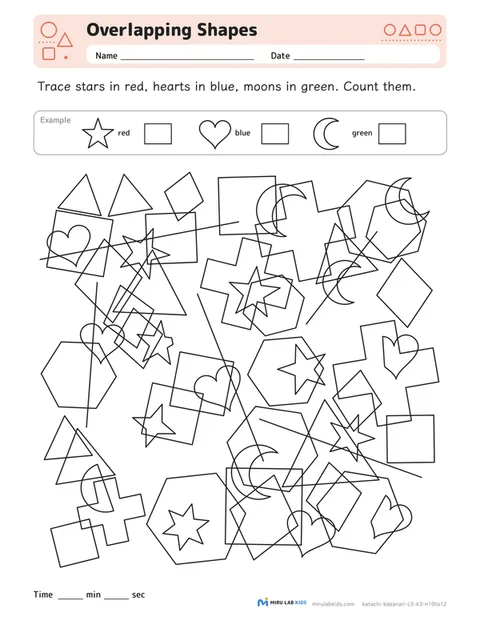
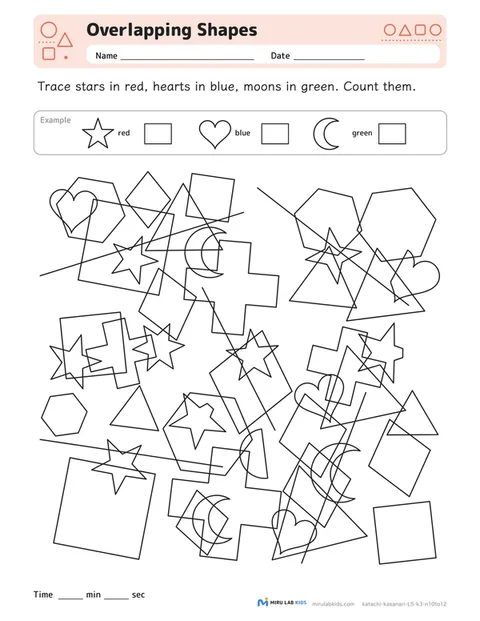
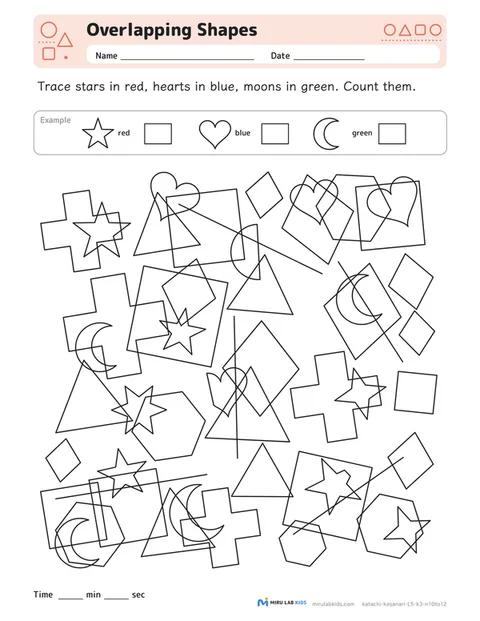
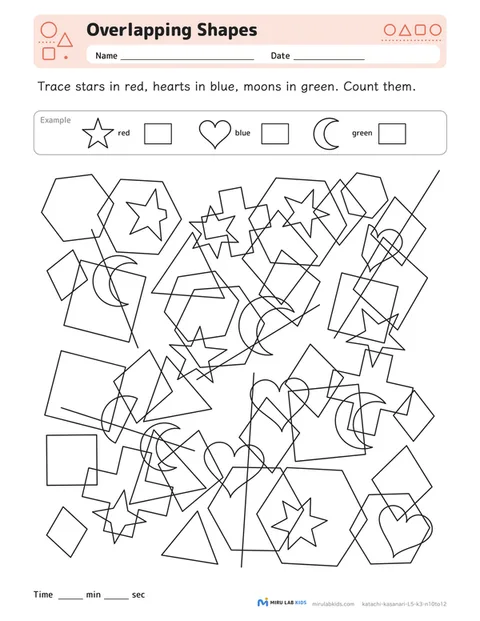
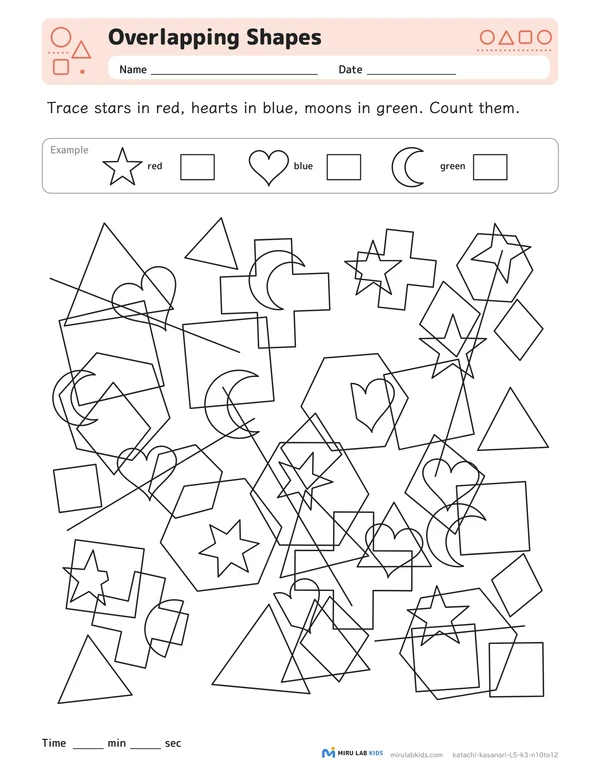
Three kinds of shapes, 10 to 12 in all. The most complex overlaps, with many look-alike shapes.
Aimsfigure-ground perception / visual closure and grouping / visual discrimination / eye-hand coordination / visual attention and scanning
PrintUS Letter
Worksheet + answers2 pagesA4 paper
Opens a PDF. Page 1 is the worksheet and page 2 is the answers. Please do not repost or sell the worksheets.
The worksheet prints fine in black and white. The answer page is color-coded, so color printing is recommended for it.
Terms of Use
Aims of this activity
- Picking out just the target shape from many overlapping lines (figure-ground perception)
- Seeing a shape as one whole even when its outline is crossed by other lines (visual closure and grouping)
- Telling apart look-alike shapes, such as stars with a different number of points or a heart with a piece missing (visual discrimination)
- Following a line all the way around with the eyes and the pencil (eye-hand coordination)
- Searching the whole page without missing any, and counting (visual attention and scanning)
The page is filled with outline shapes that overlap one another.Your child finds every shape that matches the example (stars, hearts, or moons), traces each one with the colored pencil shown, and writes how many there are.To find a shape among overlapping lines, your child needs to set the other lines aside as "background" and follow only the outline of the target shape.At higher levels there are more kinds and more shapes to find, the overlaps get more complex, and look-alike shapes appear, such as stars with six points or a heart with a piece cut off.The activity aims to build the ability to pick out what matters from a busy picture.
Code at the bottom right: katachi-kasanari-L5-k3-n10to12
Tips
- One page at a time is plenty.
- Before starting, have your child trace the example shapes with a finger so it is clear what to look for.
- Trace each shape all the way around before counting it. This helps avoid missing a shape or counting one twice.
- Stars with the wrong number of points and shapes with a piece missing do not count. If your child is unsure, compare with the example together.
- On the answer page, the shapes to find are colored and numbered. Check together how many your child found.
- Write the time it took at the bottom of the page so you can compare next time.
If it is too hard
- Go down one level.
- Give a hint about where a shape is, such as "near the top" or "on the right side."
- Trace the first shape together to show how it works.
- Have your child mark each shape as soon as it is found, then trace it.
If it is too easy
- Go up one level.
- Record the time and see whether your child can find them all a little faster than last time.