Incomplete ShapesLevel 5 · No. 9
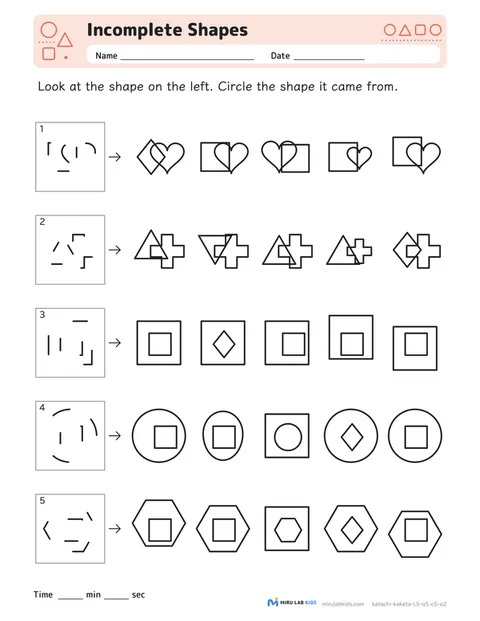
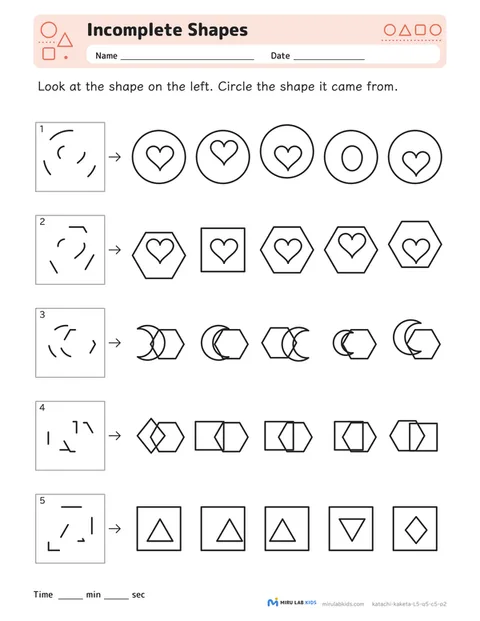
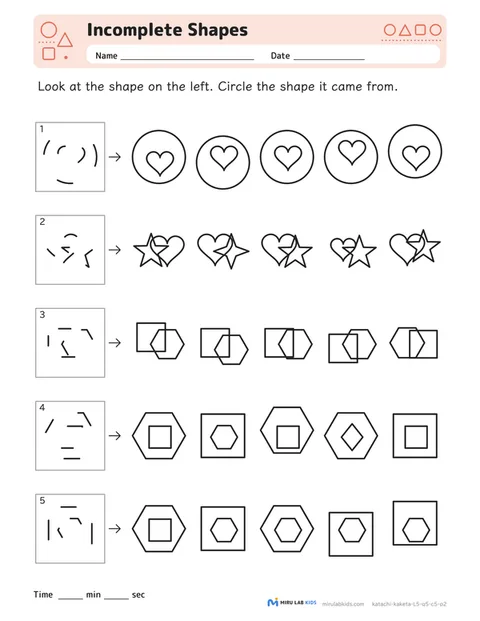
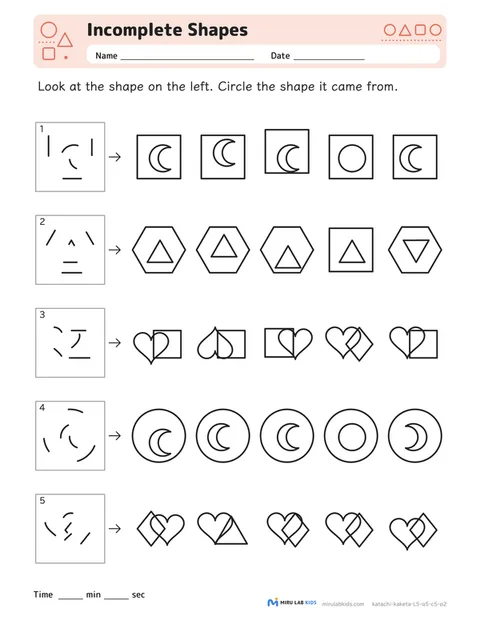
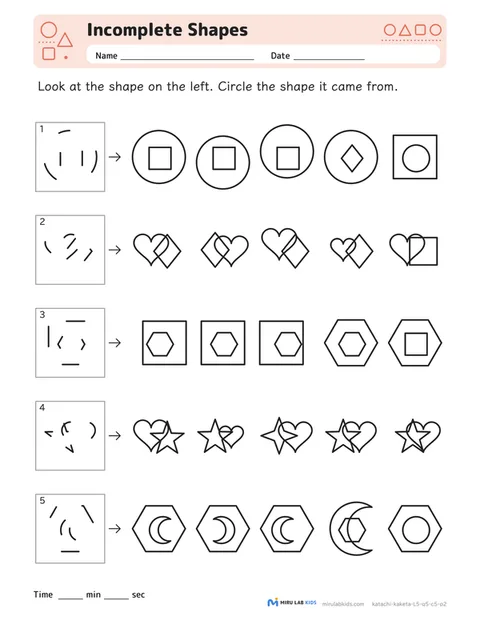
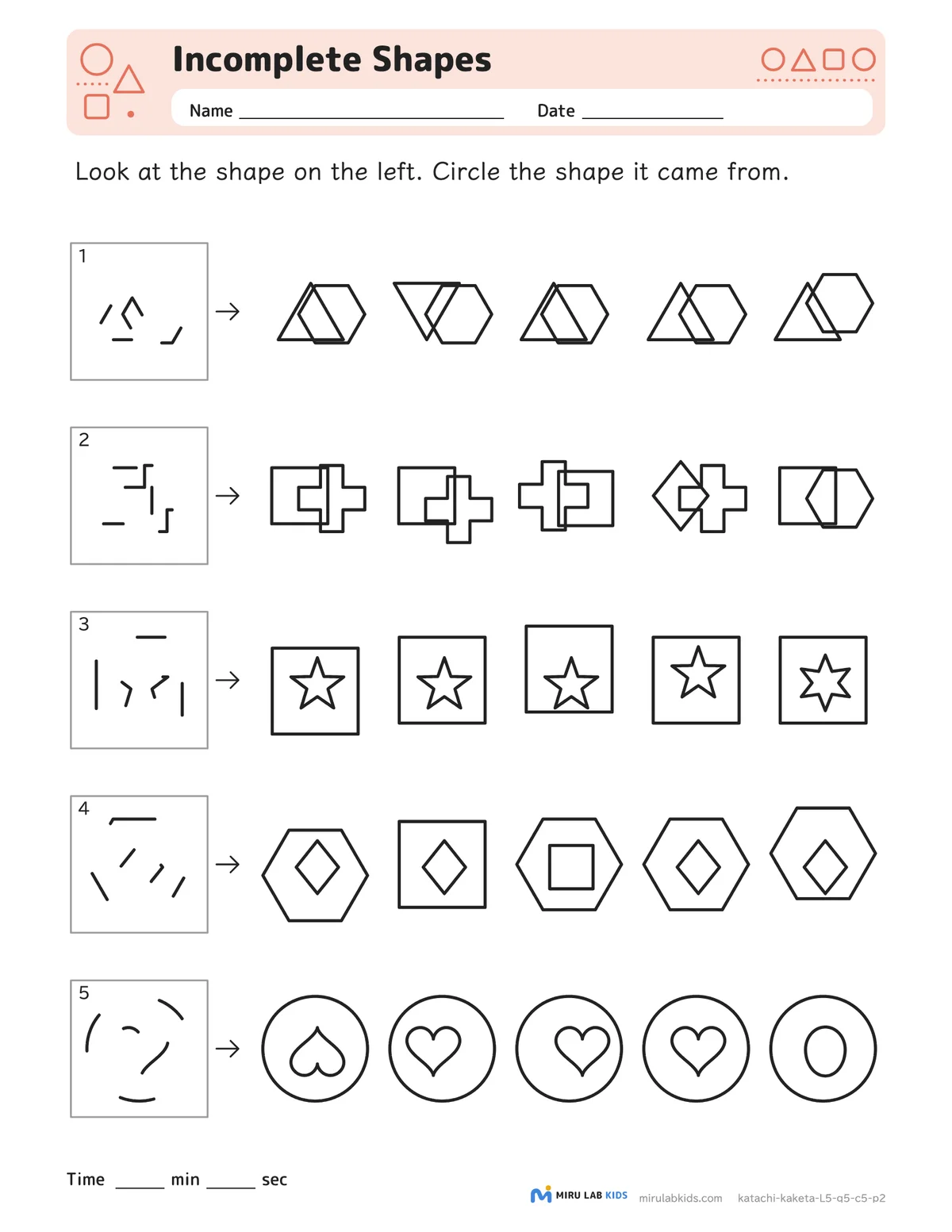
Two shapes. About a third of the outline remains and almost all corners are missing. 5 choices that need careful comparison.
Aimsvisual closure / shape completion / visual discrimination / spatial relations and careful comparison
PrintUS Letter
Worksheet + answers2 pagesA4 paper
Opens a PDF. Page 1 is the worksheet and page 2 is the answers. Please do not repost or sell the worksheets.
The worksheet prints fine in black and white. On the answer page the missing lines are added in red, so color printing is recommended for it.
Terms of Use
About this worksheet
| Questions | 5 (choose from 5) |
|---|---|
| Outline remaining | about 40% |
| Look-alike choices | look-alike shapes (6), upside-down shapes (2), shifted shapes (11), swapped shapes (1) |
- Some choices differ only in position or size. Watch whether your child compares each one with the remaining lines.
Aims of this activity
- Seeing a whole shape even when only part of it is visible (visual closure)
- Extending the remaining lines to picture missing corners and points (shape completion)
- Telling apart look-alike shapes, such as stars with a different number of points or upside-down shapes (visual discrimination)
- Comparing the position and size of two shapes carefully (spatial relations and careful comparison)
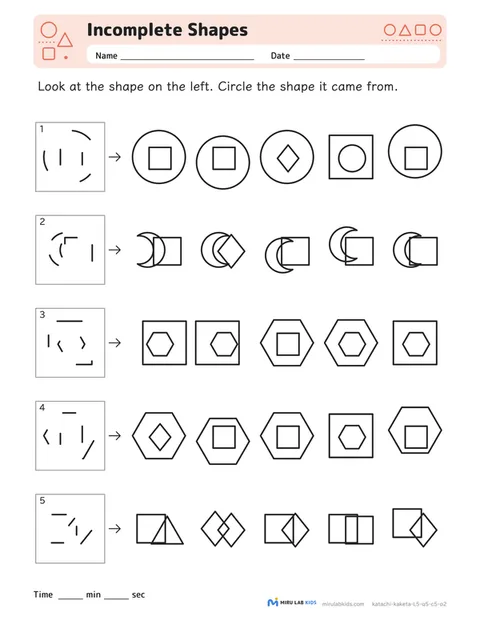
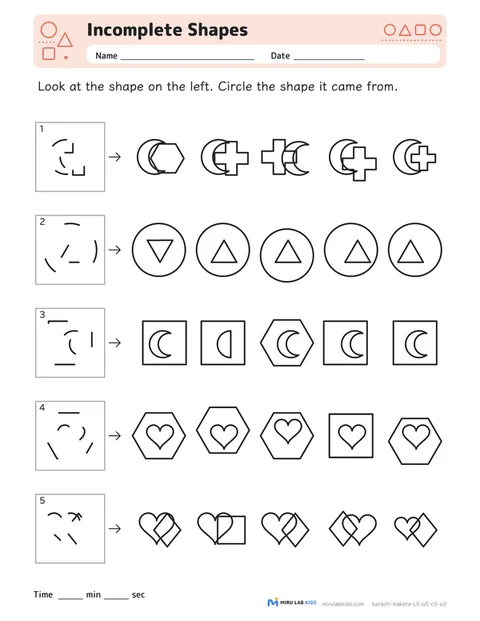
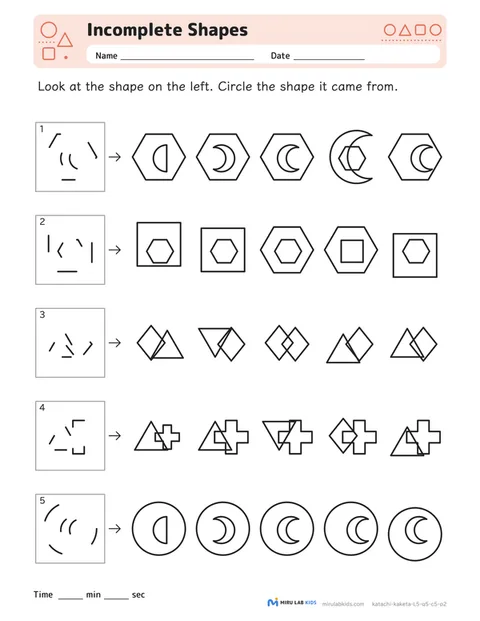
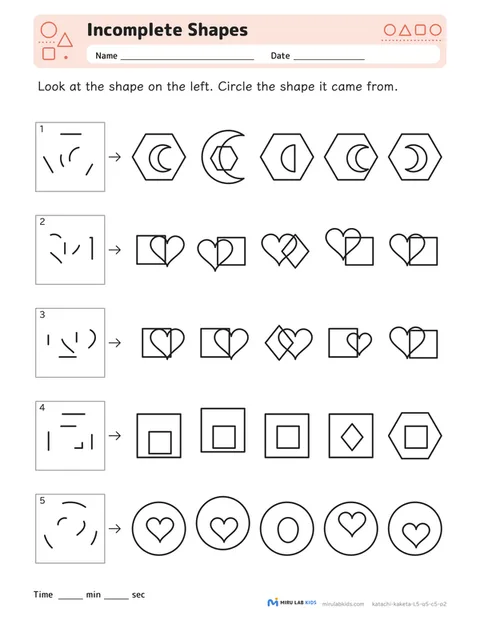
Your child looks at an "incomplete shape" with parts of its outline missing and circles the shape it came from on the right.Using the lines that remain as clues, your child connects the missing parts in their mind and pictures the whole shape.At higher levels fewer lines remain, the corners and points that give a shape its character disappear, and the choices include look-alike shapes.At Levels 4 and 5 two shapes are combined, so your child checks not only which shapes they are but also their position and size.The activity aims to build the ability to see a whole shape from a part of it.
Code at the bottom right: katachi-kaketa-L5-q5-c5-p2
Tips
- Look at the incomplete shape on the left and circle the choice it came from. When unsure, compare the remaining lines with each choice one at a time.
For what to say, choosing a level and what to do if it is too hard, see Incomplete Shapes: a guide for grown-ups.