 Spatial Relations
Dot Grid Copying: PicturesFree printable worksheets
Aims
- Seeing the exact position and direction of each line, using the dots as guides (visual-spatial relations)
- Looking back and forth between the example and the empty grid (saccades and shifting attention)
- Drawing lines that match what is seen (eye-hand coordination)
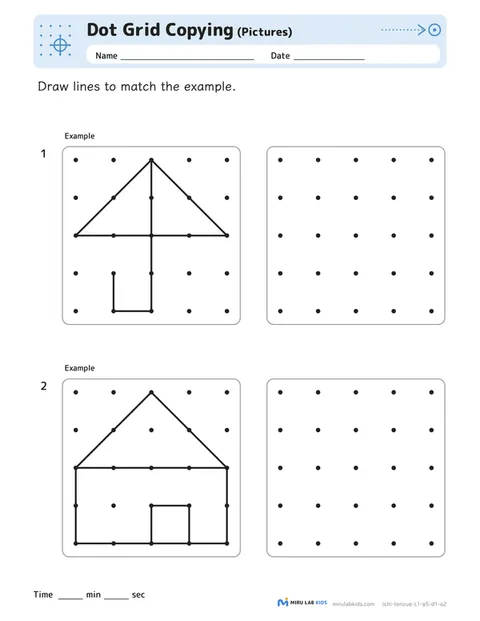
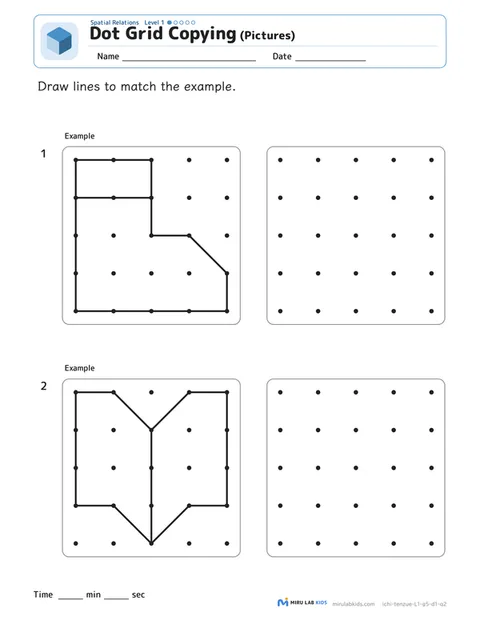
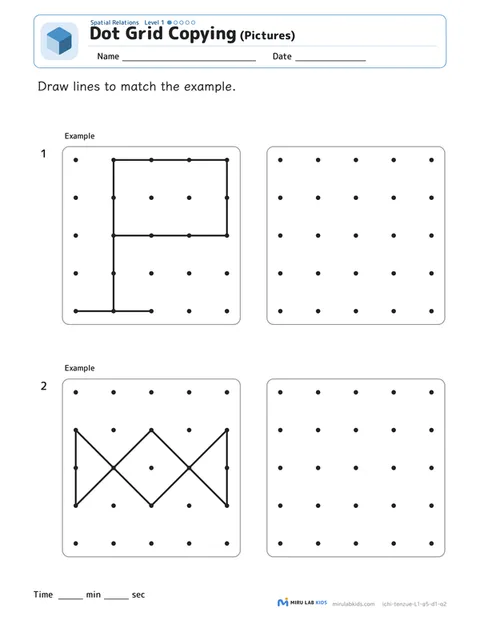
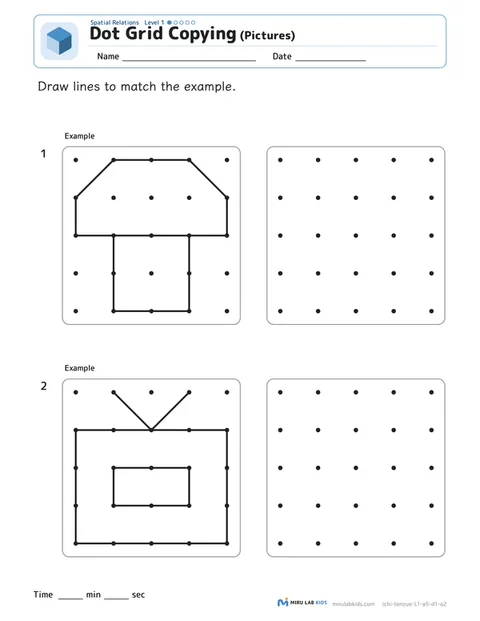
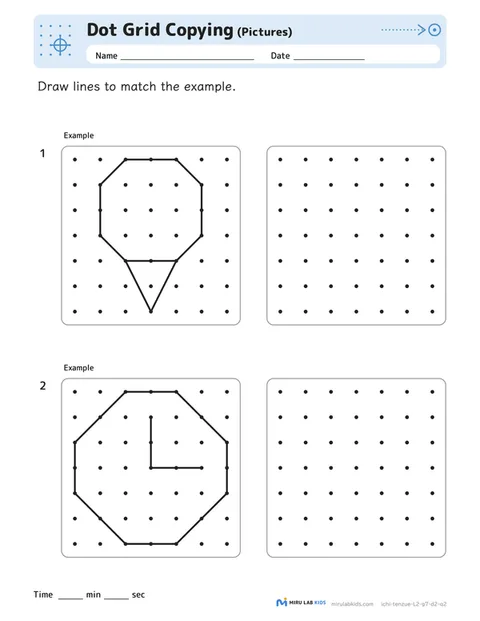
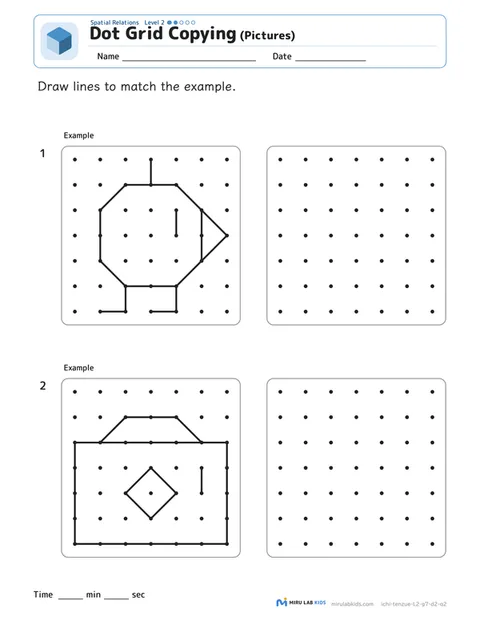
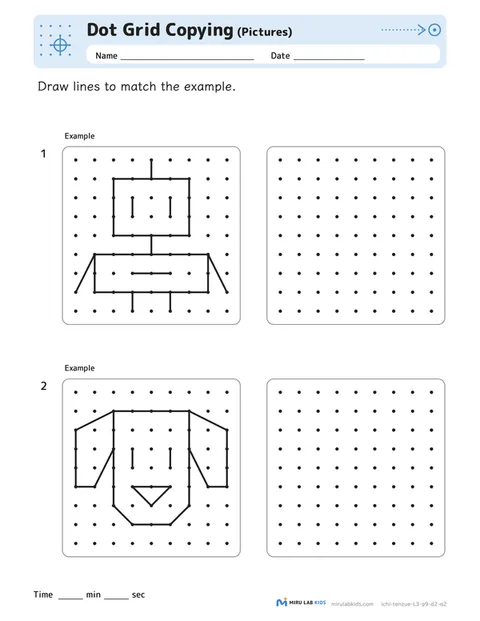
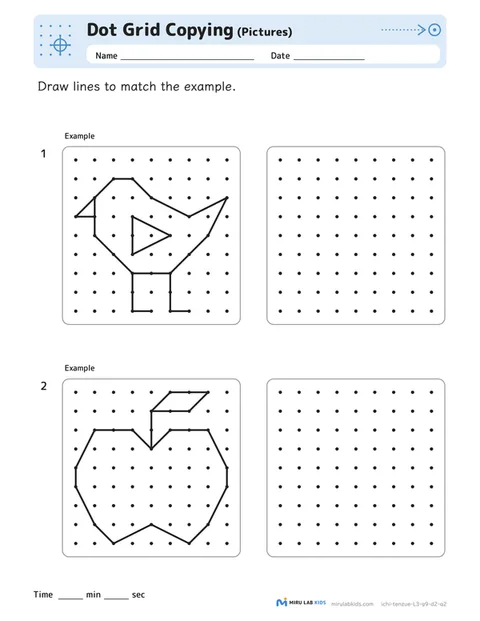
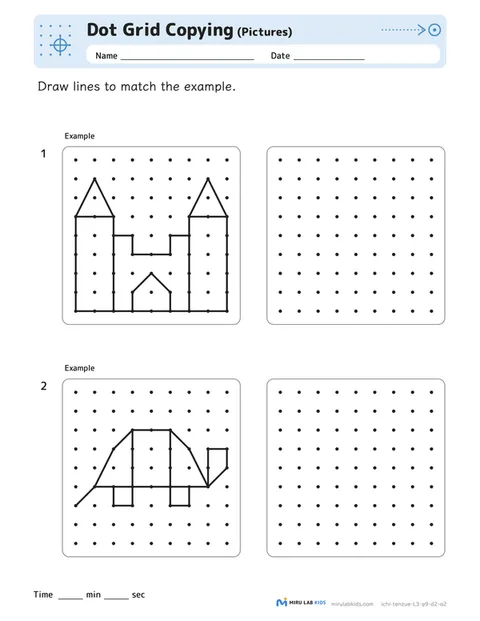
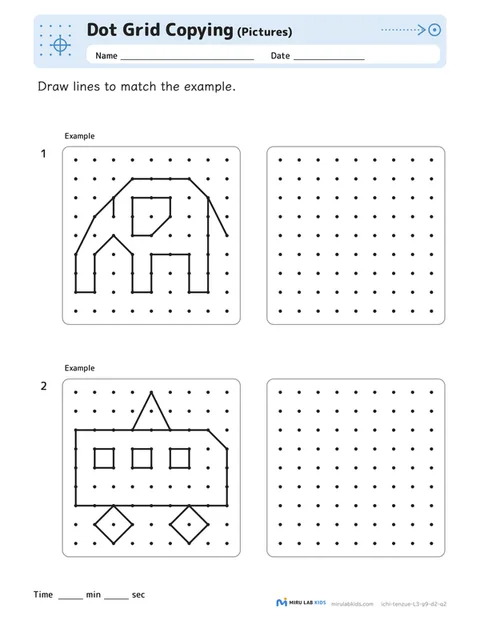
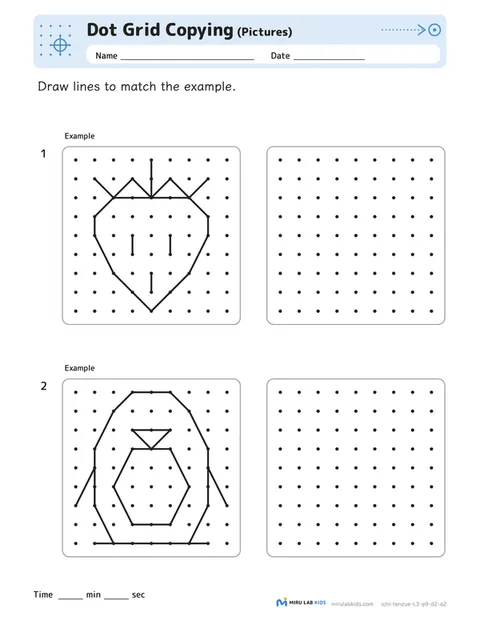
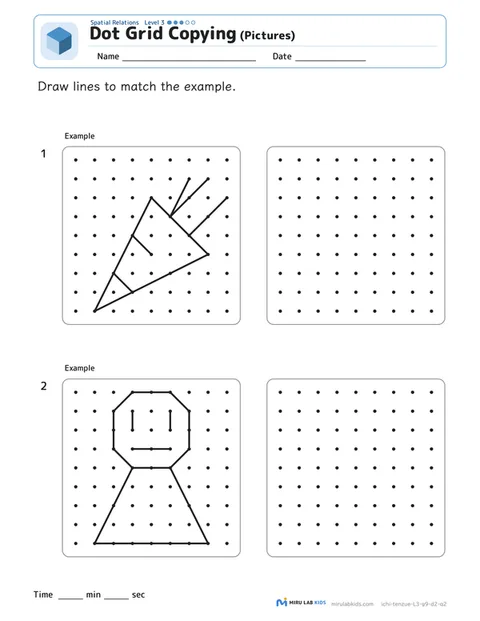
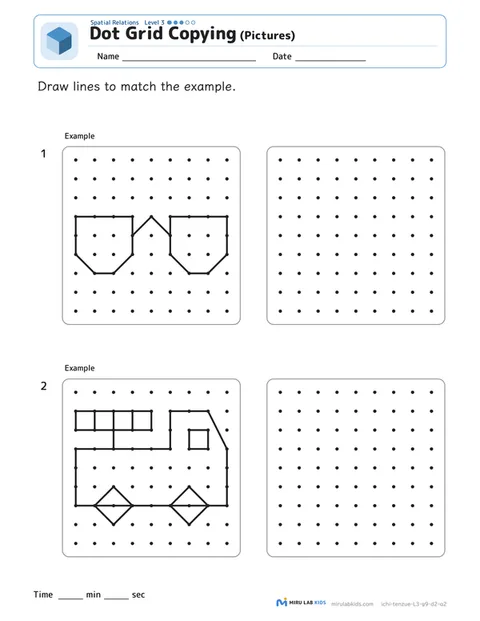
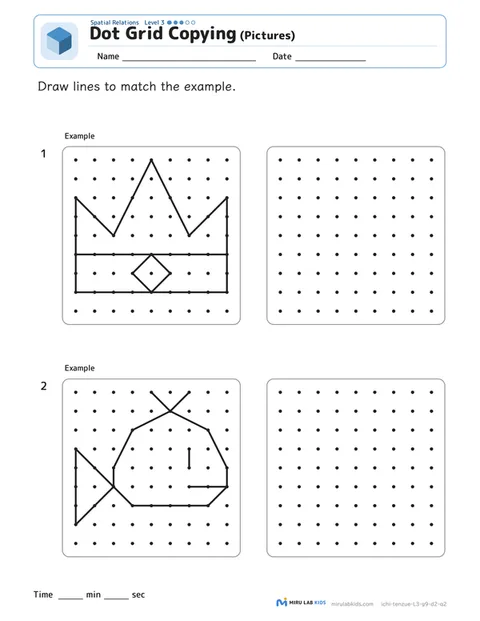
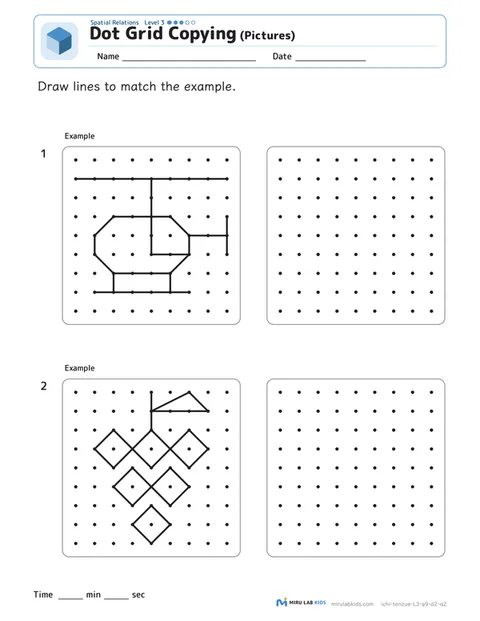
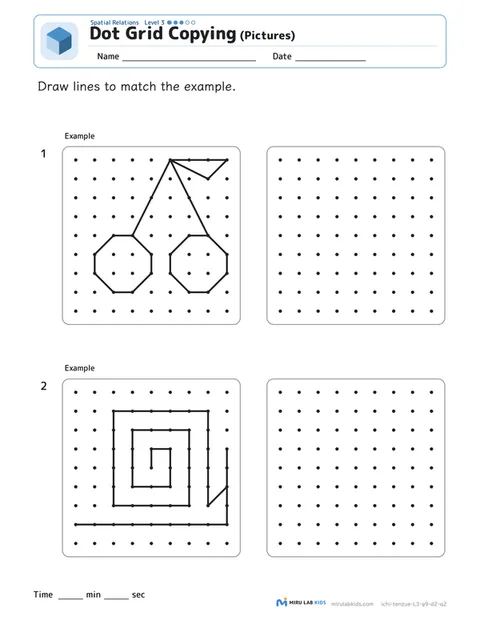
Your child copies the lines drawn on the example grid onto the empty dot grid beside it.When the copy is finished, it becomes a picture, such as a fish, a house, or a rocket.Recognizing the picture makes the activity more fun, and the finished shape gives your child a clue for spotting their own mistakes.The activity aims to build the ability to judge the position and direction of lines, and to move the hand to match what the eyes see.
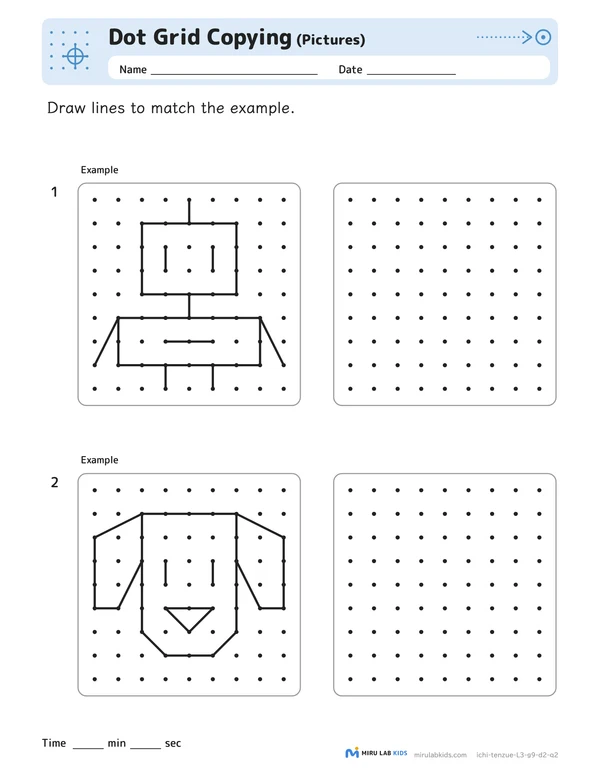 Level 3 example ›
Levels
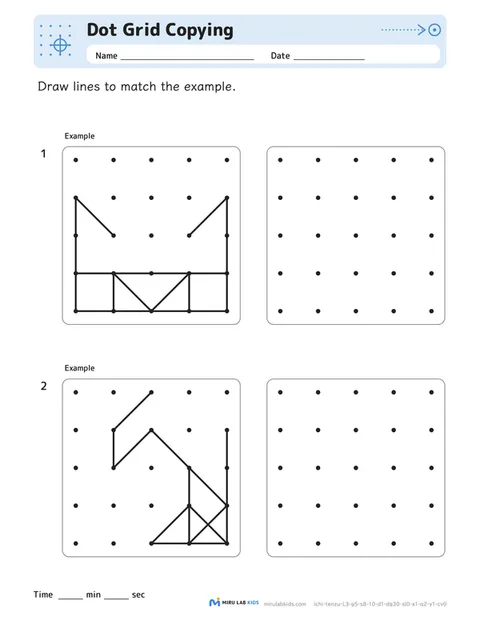
| Level 1 | Easy. 5 × 5 dots and simple pictures made of straight and diagonal lines. 2 puzzles per page. | 10 worksheets |
|---|---|---|
| Level 2 | Medium. 7 × 7 dots, including shallow diagonals (two dots across, one dot up). 2 puzzles per page. | 10 worksheets |
| Level 3 | Hard. 9 × 9 dots and detailed pictures with many lines. 2 puzzles per page. | 10 worksheets |
Tips
- Look at the lines on the example grid and copy them onto the empty dot grid beside it, in the same positions. When the copy is finished, it becomes a picture.
For what to say, choosing a level and what to do if it is too hard, see Dot Grid Copying: Pictures: a guide for grown-ups.
Worksheets
Choose a worksheet to open its printing page.
Print in bulk
Level 1Easy. 5 × 5 dots and simple pictures made of straight and diagonal lines. 2 puzzles per page.
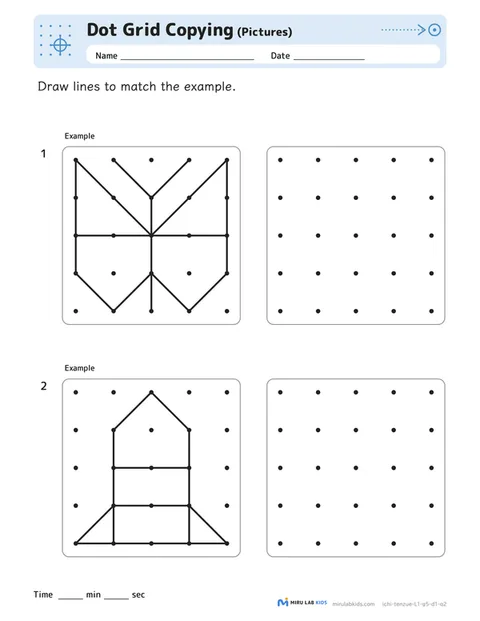
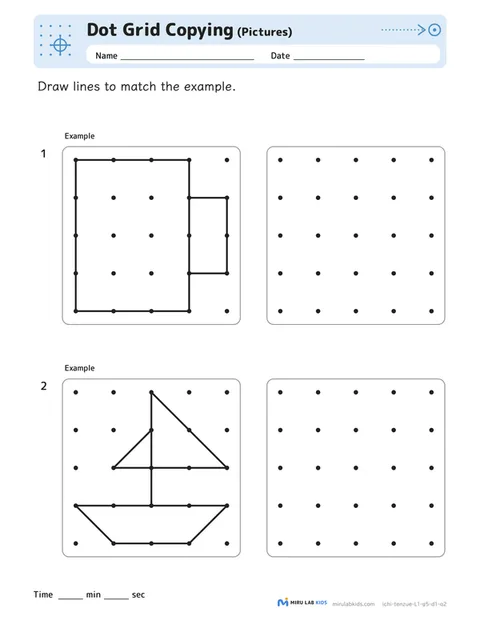
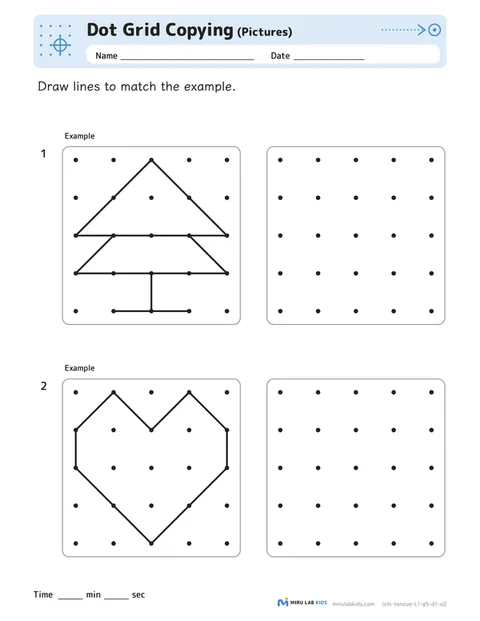
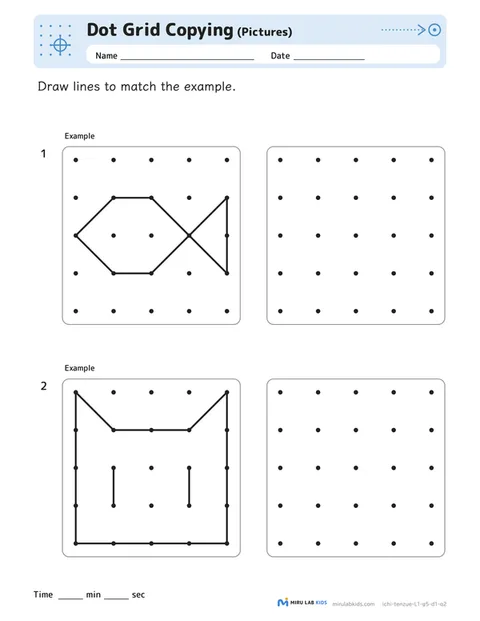
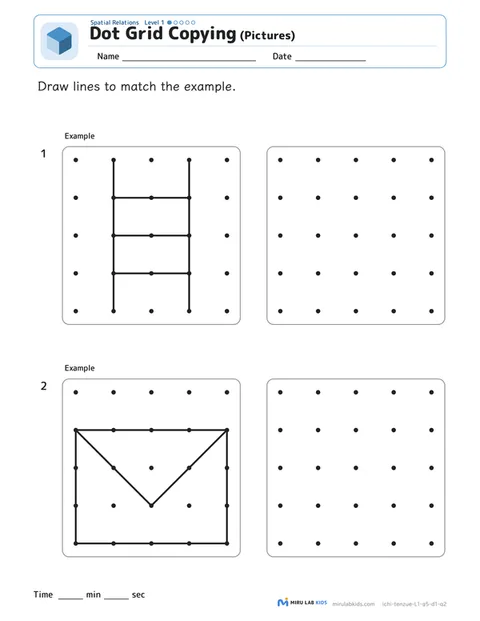
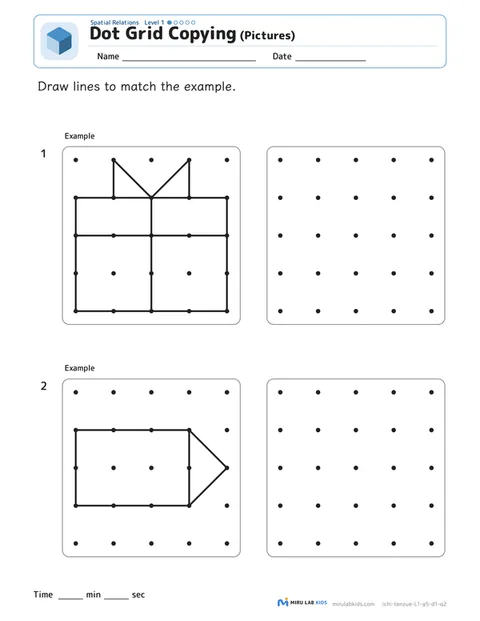
Level 2Medium. 7 × 7 dots, including shallow diagonals (two dots across, one dot up). 2 puzzles per page.
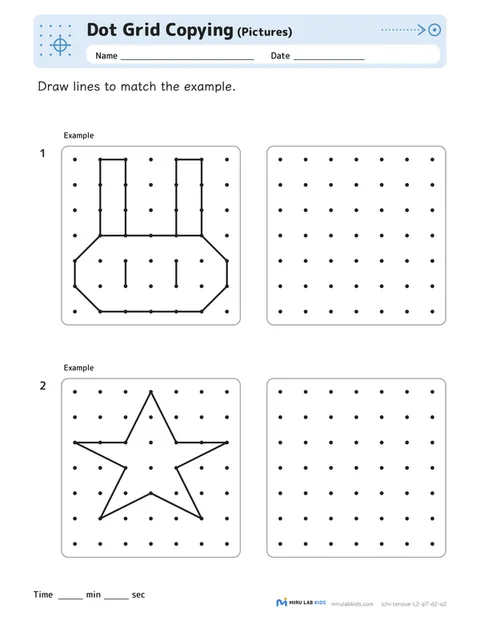
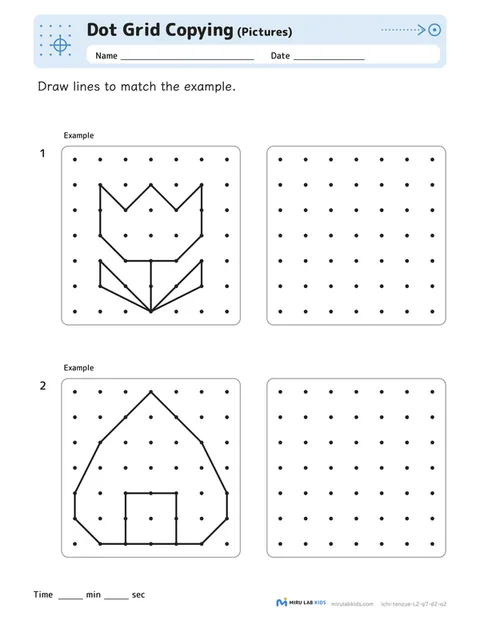
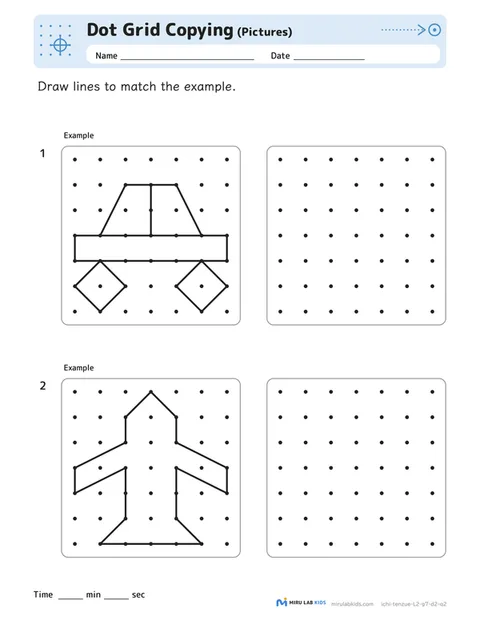
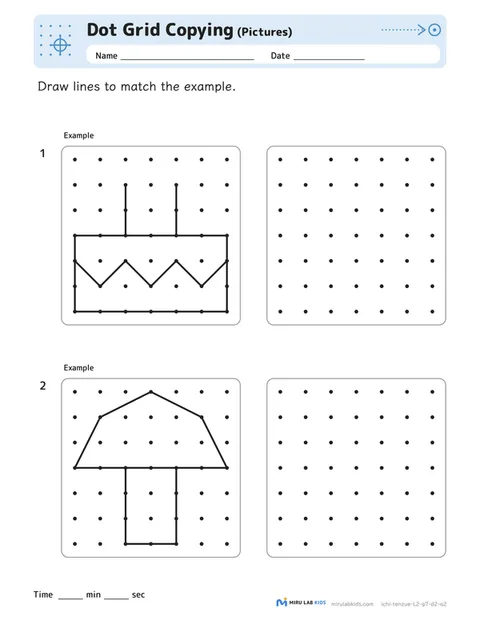
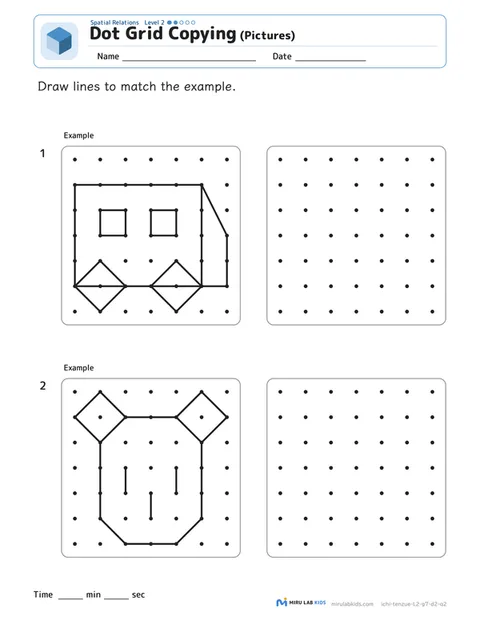
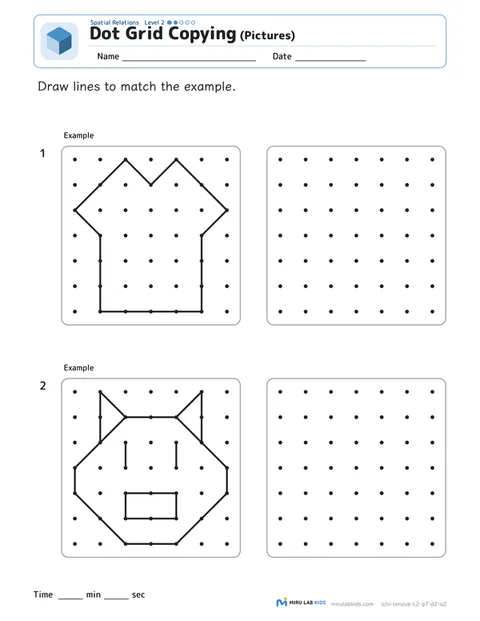
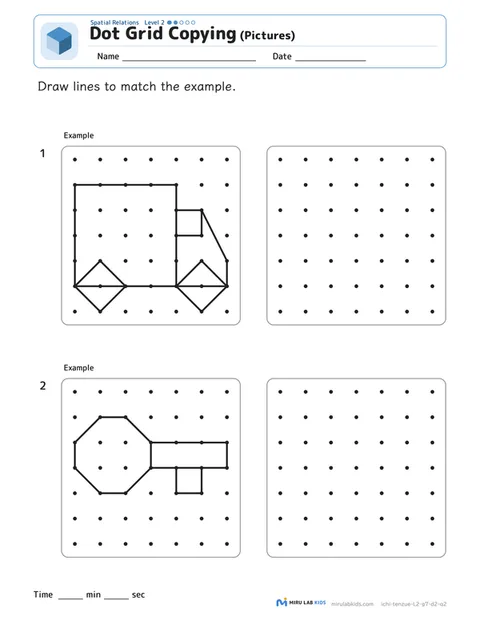
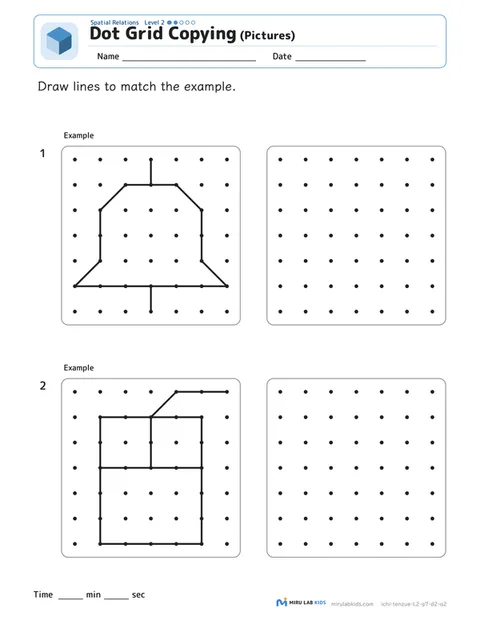
Level 3Hard. 9 × 9 dots and detailed pictures with many lines. 2 puzzles per page.
Dot Grid Copying: Pictures: a guide for grown-ups
Who it is for
- Making dot grids funGuessing the picture keeps children going until the copy is done.
- Messy handwritingPractice judging the position and direction of lines, a base for writing letters and drawing shapes.
- Slow at copying from the boardPractice moving the eyes back and forth between the example and your own paper.
- Spotting own mistakesThe finished picture gives a clue, such as "this part looks strange."
- Not writing letters yetIt is only connecting dots, so children who do not write letters yet can try it.
- Therapy and classroom sessionsAll you need is one sheet of paper and a pencil, and you can enjoy the picture together.
Choosing a level
Copied correctly and happily
- Go up one level.
- Record the time and see whether your child can finish a little faster than last time.
Lines are off or your child loses track
- Start with Levels 1 and 2 of Dot Grid Copying (fewer dots).
- After copying a line, trace it on the example with a finger to mark it as done.
What to watch for
| Comparing | Does your child look at the example for each line? Or copy by the look of the picture alone? |
|---|---|
| Position | Even if the shape looks right, does a line start one dot off? |
| Diagonals | Is a diagonal going the wrong way, or is a shallow diagonal drawn too steep? |
| Keeping track | Does your child lose track of which lines are done, copying one twice or skipping one? |
| Head and body | Does the whole head move a lot when looking at the example? Is the face very close to the page? |
| Time | Writing the time at the bottom of the page each time makes small changes easier to notice. Copying it onto the Time Log lets you line up results at the same level. |
If something keeps worrying you, it can help to talk with an eye doctor or another specialist rather than deciding on your own.
Things you can say
- Before startingWhat do you think it will be?Try not to say what the picture is until it is finished, so your child can enjoy guessing.
- When unsureSecond from the top, third from the left.Naming a dot's position helps your child check where a line goes.
- When offLet's count to the starting dot.Do not say what is wrong. Let your child compare with the example.
- When finishedWhat did you make?Enjoy the picture together. Even if the shape is a little off, first praise your child for finishing.
- CheckingLet's compare the end dots one by one.A shape can look roughly right even when a dot is off. Check the end dots of each line together.
FAQ
How is this different from Dot Grid Copying?
The way to play is the same. In this activity, the finished copy becomes a picture, such as a fish, a house, or a rocket. Pictures make it more fun, and the finished shape helps your child spot their own mistakes.
Is there an answer page?
Yes. Page 2 of the PDF is the answer page. Worksheet-only and answers-only PDFs are also available.
Can I print in black and white?
Yes. Black and white printing does not change the difficulty.
How much should we do at a time?
There is no set amount. One or two sheets at a time is a good guide, and it is best to stop while your child still wants a little more. See "Every Day? How Much?" for more.
Articles
- What Is Visual Perception? More Than Good Eyesight
- Why Does My Child Put Clothes On Backwards or Inside Out? Getting Dressed Uses More Visual Skills Than You Think
- When a Child Has Trouble Catching a Ball: Breaking It Down from "Tracking" to "Reaching"
- When a Child's Tracing Slips onto Another Shape: Understanding Figure-Ground Perception
About the code at the bottom right
The code at the bottom right of each worksheet (for example, ichi-tenzue-L1-g5-d1-q2) shows its difficulty settings. Worksheets with the same code have the same difficulty. If you contact us about a worksheet, including this code helps us find it right away.
 Shape Recognition
 Visual Scanning
 Visual Memory
 Visual-Motor Skills
 Visual Planning