Why Does My Child Put Clothes On Backwards or Inside Out? Getting Dressed Uses More Visual Skills Than You Think
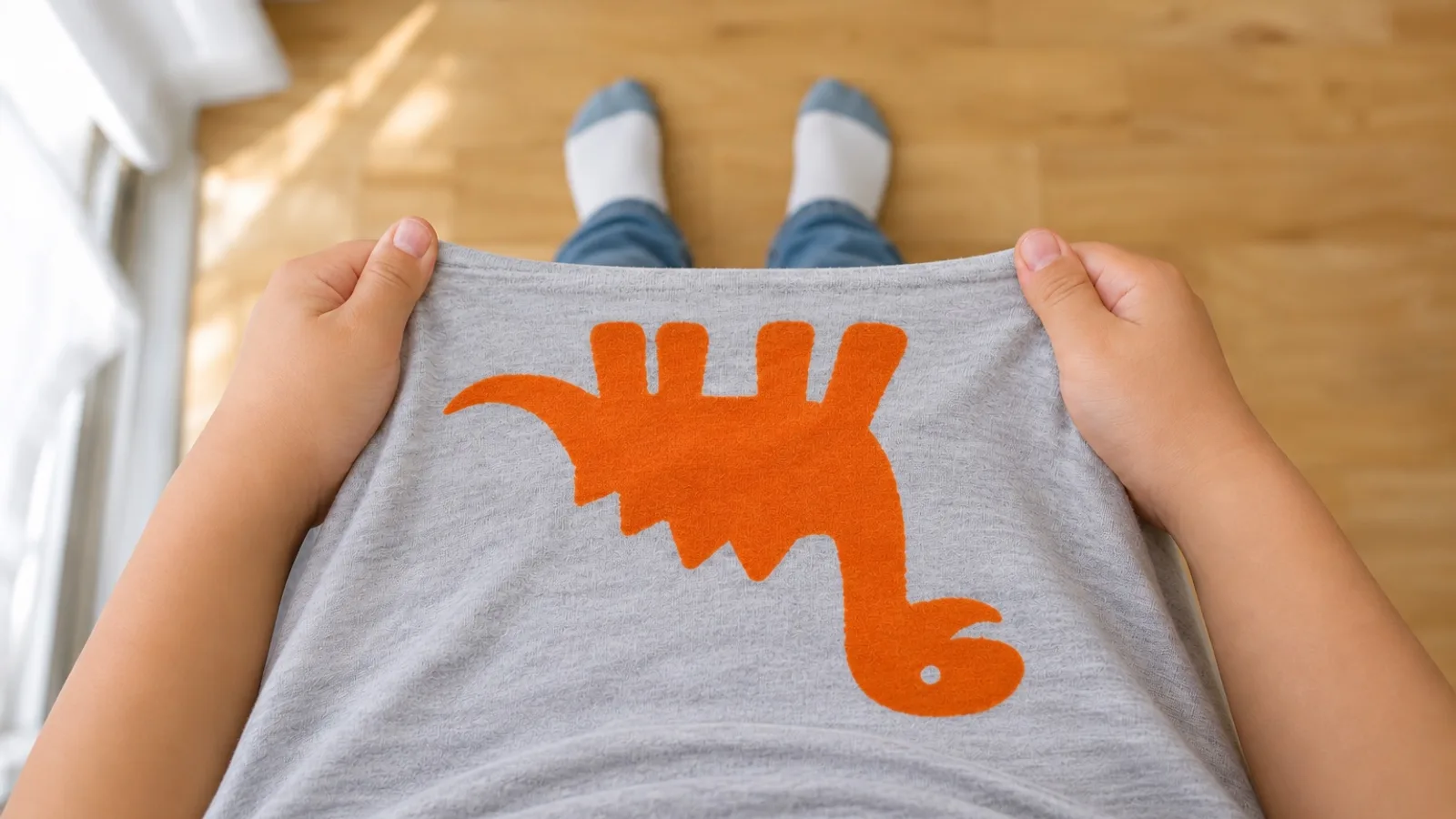
"Your shirt is on backwards again."After getting dressed, the picture on the T-shirt has ended up on the back, or the tag is peeking out under the chin.At the after-school day program for children with developmental needs where I work, this is a scene we see often at changing time.
It is tempting to say, "Look carefully when you put it on."But putting clothes on the right way involves several layers of looking and thinking.In this article, I focus mainly on clothes worn backwards, and share how to see where a child is getting stuck and how to add clues they can notice for themselves.At the end, I also touch briefly on clothes worn inside out and shoes on the wrong feet.
Getting dressed involves more "looking" than you might think
Let's slowly break down what happens between a T-shirt lying on the floor and a T-shirt being worn.
Up to putting on a T-shirt
- Finding the cluestell which side is the front from the tag, the shape of the neckline, a picture on the chest, and so on
- Matching the clothes to the body in the mindpicture which side will end up on the tummy, and turn the shirt to match
- The front and back of one's own bodyknow which side of one's own body is the "front"
Adults do all three almost without thinking, in an instant.For children, each one may still be a skill in progress.When a shirt goes on backwards, where the child got stuck differs from child to child.
The sticking points fall into three groups
Which of the three a child is stuck on changes which ideas will help.Let's look at them one at a time.
1. Finding the clues: tag, neckline, picture
The front and back of a T-shirt are almost the same shape.The differences are small: the tag at the back of the neck, a neckline that dips a little lower in front, a picture or buttons on the chest.
Finding a small tag on a shirt full of colors and patterns uses the same visual skill as finding a target shape among many lines and shapes (figure-ground perception).On a plain shirt with a tag the same color as the fabric, even adults have trouble finding it.
A child who gets stuck here may pick up the shirt and put their head straight in.The body moves before the eyes have compared front and back.
2. Matching the clothes to the body in the mind
Finding the tag is not the end.Looking at a shirt on the floor, the child needs to picture, "If I put my head in like this, this side will end up on my tummy."A shirt faces a completely different way on the floor than it does on the body.In the mind, we flip and turn the shirt to lay it over our own body.
For example, with the method of laying the shirt face down on the floor, putting the arms into the sleeves, and pulling it over the head, the side you see from above on the floor ends up on your back.The side you can see and the side you will see after putting it on trade places.

The ability to turn shapes in the mind develops little by little in early childhood.In a study using a touch-screen task in which children had to turn shapes in their minds, 5-year-olds showed the same pattern as adults (the bigger the turn, the longer it took), while in 4-year-olds this pattern was not yet clear.In another study, 6-year-olds turned shapes in their minds on their own without being taught, and could even explain in their own words how they had done it.
A child who gets stuck here may find the tag when asked "Where's the tag?" but still put the shirt on backwards.If a child can dress correctly when the shirt is laid out for them, this step may be where they are stuck.
3. The "front" and "back" of one's own body
To match the front of a shirt to the front of the body, a child needs to know which side of their own body is the "front" and which is the "back."The sense of where one's body is and which way it is facing is sometimes called body image.
A Japanese study of how children aged 3 to 11 understand direction words found that "up and down" came first, then "front and back," and "right and left" came last.Children named right and left correctly on their own bodies at around 7 to 8 years, and understood the right and left of a person facing them about two years after that.Another study also found that children began to use the words right and left correctly on their own bodies from around age 7, and on a person facing them later still.Telling which of two things matched came much earlier than being able to say "right" or "left" in words.
In the field of pediatric rehabilitation, researchers have studied how children who are clumsy in their movements (developmental coordination disorder, or DCD) picture their own bodies in their minds.In a task where children saw a picture of a hand and answered whether it was a right or left hand, other children seemed to move their own hands in their minds to work it out, while children with DCD seemed to use that approach less.In other words, some children find it harder to move their own body in their mind.
A child who gets stuck here may not notice that their shirt is on backwards even when they look in a mirror.
Inside out often starts with taking clothes off
Inside-out mix-ups are easier to notice than backwards ones.The seams and tag show on the outside, so the clues are clear.
Clothes often end up inside out because the sleeves or body were pulled inside out when they came off.The next time, the shirt in front of the child is already inside out.Making it part of the routine to turn clothes right side out before folding them gives the child a chance to look at the inside and outside before putting them on.
Shoes on the wrong feet work the same way
Young children also often put their shoes on the wrong feet.Left and right shoes are mirror images of each other, so the difference is very small.
Telling mirror-image shapes apart is hard for children.In a study of 5- to 7-year-olds, preschoolers had the most difficulty with mirror-image pairs in a task that compared the orientation of shapes.On top of that, deciding which shoe goes on the right foot also means matching it to the right and left of one's own body (point 3).
With shoes, children often slip their feet in without looking at the shoes at all.And when shoes are put away in a cubby, they often get switched, and the child puts them on just as they come out.What helps here is a little trick that gives the child a reason to look at the shoes before putting them on.
One idea I often see at the program, and think works well, is an insole sticker.Stick half of one picture on each insole so that the picture comes together as one when the shoes are placed side by side correctly.With a favorite character or vehicle, children start peeking in on their own to check that the picture matches.It is a clue the child can notice without an adult saying, "They're on the wrong feet."

Seeing where a child gets stuck
Watching dressing in these four moments can give clues about where a child is getting stuck.
| What to watch | If you see this | What it may mean |
|---|---|---|
| Does the child look at the shirt before putting it on? | Picks it up and puts the head straight in | 1. The body moves before the clues are found |
| Can the child answer "Where's the tag?" | Finds the tag but still puts the shirt on backwards | 2. Matching the clothes to the body in the mind |
| Can the child dress correctly when the shirt is laid out? | Gets it right when the shirt is placed the right way | 2. Deciding which way to turn the shirt |
| Does the child notice afterward? | Does not notice even when looking in a mirror | 3. The front and back of one's own body |
One look may not tell you much.Watching several times, you start to see that child's own "it always stops here."
Adding clues the child can notice on their own
If an adult lays out the clothes the right way every time, the child will dress correctly without looking at the clothes.That day goes smoothly, but the child gets no more experience of checking which way the clothes face.Rather than having an adult step in and set things right ahead of time, adding clues the child can notice for themselves lets the experience of checking build up.
Start with clothes that have a big picture on the front
In the early stages, the easiest clue for front and back is a shirt with a big picture or letters on the front.Right after putting it on, the child can look down and see the picture with their own eyes.Looking down, the picture appears upside down, but it is still easy to tell whether it is there.If the picture is not there, it becomes a chance to notice, "Huh, is it backwards?"
A tag is small, and once the shirt is on, it is at the back of the neck where the child cannot see it.While a child still often mixes up front and back, providing clothes with a big picture on the front is a very good clue.Once the child is wearing all kinds of clothes, move on to practicing with the tag, which nearly every shirt has.
What to say, and ideas for each sticking point
At changing time at the program, these are some of the things we say and do.
Examples of what to say at changing time
- Before dressingWhere's the tag?A cue to look for the clue, without giving the answer
- Laying it outLet's spread it out on the floor first.A shirt spread flat is easier to compare front and back than a crumpled one
- After dressingLet's look in the mirror. Where's the picture?Make time for the child to check with their own eyes after dressing
For a child stuck on point 1, starting by looking for the same single clue every time, such as the big picture or the tag, makes it less confusing.For a child stuck on point 2, you can split the task: the child lays the shirt out, then puts it on from there.Once laying it out becomes familiar, move to the next step of deciding which way to turn the shirt while holding it.For a child stuck on point 3, try adding play that helps them feel their tummy and back, outside of changing time.For example, being sandwiched between mats or futons so there is a firm, all-over squeeze, or crawling through tunnels or under tables and other tight spaces.Feeling which parts of the body are touching what is good practice for building an image of the front and back of one's own body.Whatever the activity, keep it fun for the child and take good care that it is safe.
Putting clothes on wrong is valuable experience too
A shirt on backwards feels tight at the neck, and the picture on the chest cannot be seen.That "something feels off" sensation is also a clue for checking next time.
If a backwards shirt will not cause real trouble, try looking back on it together after dressing is done.Ask questions like "How does it feel around your neck?" or "Where's the picture?" and value the experience of the child noticing and fixing it on their own.When they notice, put it into words: "You found it yourself!"
On busy mornings before leaving the house, there may be no time to change again.Looking back slowly is best saved for times with room to spare, such as changing after coming home or on a day off.
Worksheets that connect
Worksheets are not a substitute for practicing getting dressed.But they do give a child the experience, in a calm setting, of using the visual skills that dressing relies on.
- Spot the Difference: compare two very similar pictures and find the small differences
- Symmetry Coloring: picture the shape folded over the center line and color the other side
- Arrow Path: move your position in your mind by following up, down, left, and right arrows
For how much to do in a day and how to keep going, see "Every Day? How Much?."
Things to keep in mind
The reasons behind dressing mix-ups are different for every child.Besides the three described here, how the hands and body move, such as with buttons or getting arms into sleeves, can also play a part.
If getting dressed takes a long time overall, or clumsiness also stands out in other areas such as eating or handwriting, consider talking with your child's teacher, an occupational therapist, a physical therapist, or a pediatrician.
Final thoughts
Putting clothes on the right way combines finding the clues, matching the clothes to the body in the mind, and knowing the front and back of one's own body.Once you can see where a child is getting stuck, you can find ideas beyond "look carefully."
I hope this article offers a slightly different angle on getting dressed every day.
Studies referred to
- Katsui A. A developmental study of the concept of direction: children's understanding of the words of spatial direction. The Japanese Journal of Educational Psychology. 1968;16(1):42-49, 63.
- Rigal R. Right-left orientation: development of correct use of right and left terms. Perceptual and Motor Skills. 1994;79(3):1259-1278.
- Frick A, Ferrara K, Newcombe NS. Using a touch screen paradigm to assess the development of mental rotation between 3½ and 5½ years of age. Cognitive Processing. 2013;14(2):117-127.
- Estes D. Young children's awareness of their mental activity: the case of mental rotation. Child Development. 1998;69(5):1345-1360.
- Wilson PH, Maruff P, Butson M, Williams J, Lum J, Thomas PR. Internal representation of movement in children with developmental coordination disorder: a mental rotation task. Developmental Medicine & Child Neurology. 2004;46(11):754-759.
- Fernandes T, Leite I, Kolinsky R. Into the looking glass: literacy acquisition and mirror invariance in preschool and first-grade children. Child Development. 2016;87(6):2008-2025.