When a Child's Tracing Slips onto Another Shape: Understanding Figure-Ground Perception
A child is tracing a star among overlapping lines, and suddenly they are following the outline of the shape next to it.A child is following a path in a maze, and before they know it, they are on a different path.At the after-school day programs and early intervention programs for children with developmental needs where I work, I often see this kind of "slipping" onto another line.It is especially common in children who are not yet writing letters.
Slipping has to do with a property the eyes naturally have: seeing things as groups.In this article, using the idea of "figure and ground" as a guide, I'll explain why slipping happens, and share activities and ideas that help children explore how they see.
What is "figure and ground"?
When we look at something, the part that stands out is called the "figure," and the part that seems to sit behind it is called the "ground."When you read a book, the letters are the figure and the white paper is the ground.The Danish psychologist Edgar Rubin showed that in the same picture, what you see can switch depending on which part you take as the figure.
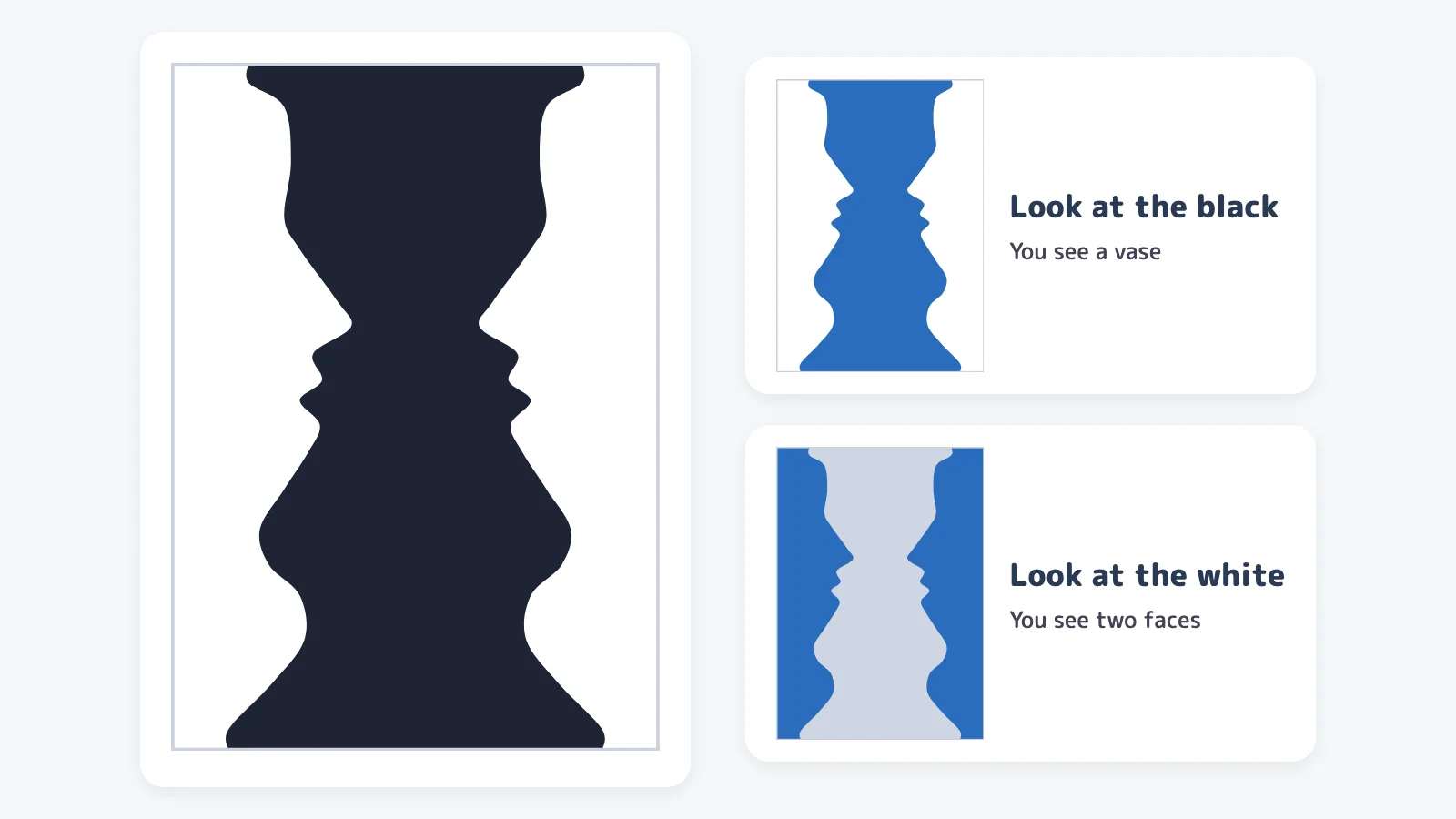
This picture can be seen as a vase, or as two faces looking at each other.But you cannot see both at the same time.While you see the vase, the faces sink back as the ground.
Interestingly, in a study with young children, when children were shown pictures that can be seen in two ways, they did not switch between the two views on their own until they were told that there were two things to see.Being given words for it may make it easier to switch.When you look at such a picture with your child, try adding, "There's something else in there too."
Shapes are seen as groups
Our eyes do not see lines and dots one by one, separately.They naturally group them, following a few rules.These rules were described about 100 years ago by German psychologists (Gestalt psychology), and they are still being studied today.
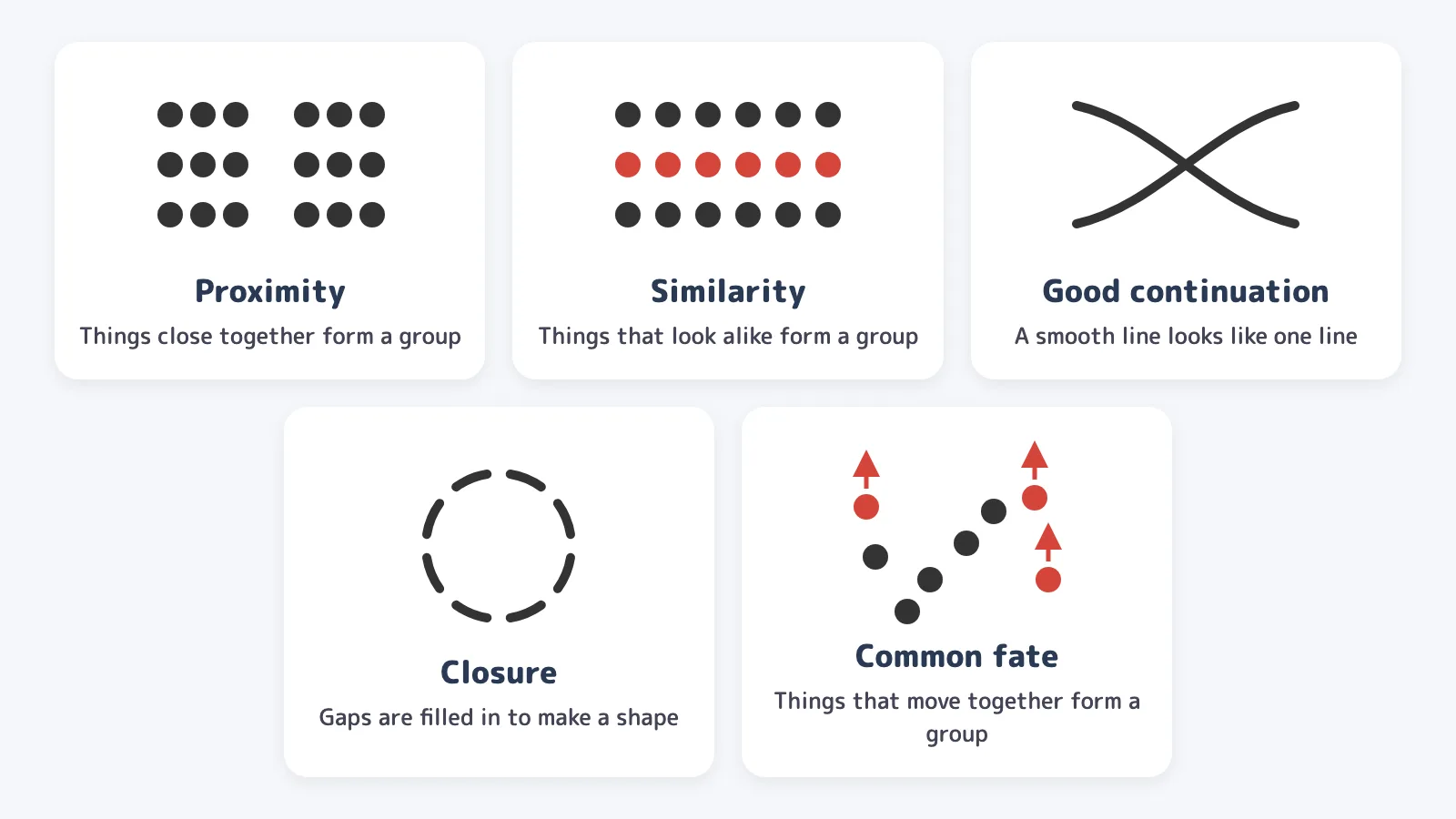
| Rule | How it looks | In everyday life |
|---|---|---|
| Proximity | Things close together look like a group | When letters are crowded, they blend with the letters next to them and are harder to read |
| Similarity | Things with similar color or shape look like a group | It is hard to pick one block out of a pile of blocks of the same color |
| Good continuation | A line that continues smoothly and straight looks like one line | At a crossing, it is easy to keep going in the straighter direction |
| Closure | Even with gaps, a shape looks closed | You can tell what something is even when part of it is hidden |
| Common fate | Things that move the same way look like a group | A person waving in the distance is easy to find, even in a crowd |
Telling figure from ground is a combination of these rules.When the lines of the target shape group together more strongly than the other lines, that shape stands out as the figure.When they group with the other lines instead, the target shape blends into the ground and is hard to see.
Slipping is caused by "good continuation"
The biggest reason for slipping is the third rule in the table, "good continuation."Our eyes tend to see a line that continues smoothly and straight as one connected line.Studies with adults have also shown that when short line segments with slightly different angles are lined up, they are easier to find as one line the more smoothly they connect.
When tracing overlapping shapes, this property can work against the child.
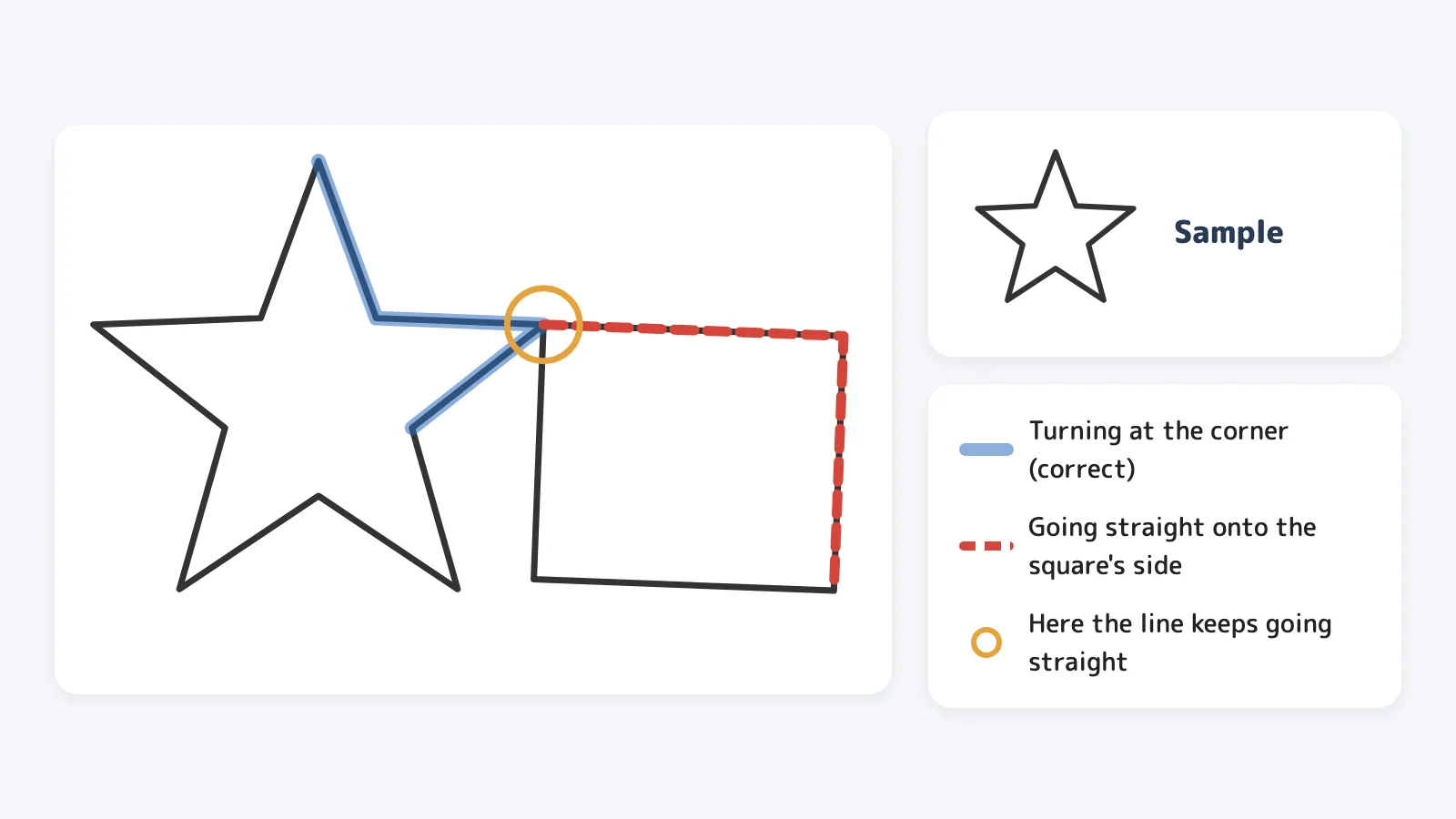
The star's outline turns sharply at its points.But if another shape's line continues straight from that point, the eyes naturally take the straight line as "the next part of the line."The pencil, pulled along by the eyes, keeps going straight too.That is why slipping tends to happen at corners and crossings.
There is one more thing: following a line with your eyes takes more effort than you might think.In studies with adults, the time it took to follow a line with the eyes and check it grew longer as the line got longer.The eyes move along the line little by little, checking "which way does it continue?"Following the line with a finger or the tip of a pencil supports this work, and it makes good sense.
Sharing a line is harder than overlapping
An older study with children compared how easy it was to find shapes when they overlapped, and when they shared part of their outline (a common border line).Overlapping shapes were easy to report, even for young children, while shapes that shared a border were much harder to find.The difficulty was thought to come from the shared border line.
When one line belongs to two shapes at once, the eyes have to decide which shape it belongs to.Children are most likely to hesitate on lines like these while tracing.
Seeing pieces as one line develops slowly
The ability to join pieces of a line into one outline is known to develop gradually throughout childhood.There is also research showing that in children, the area around a shape where nearby lines make it hard to read is wider than in adults.
So when a child slips often, you can think of it as a moment when they are using skills that are still developing, and using them a lot.
Seeing the whole even when part is missing: "closure"
The fourth rule in the table, closure, is the ability to join the gaps in your mind and picture the original shape, even when parts of the lines are missing.Like figure-ground perception, it is one of the skills of seeing things as groups.
In a study with children, when children practiced naming pictures drawn with missing parts, they came to recognize the pictures they had practiced more quickly.Pictures they had not practiced, however, did not get much quicker.In other words, the effects of practice tend to show up first in the shapes that were practiced.Working on a variety of shapes, a little at a time, is a good approach.
Figure and ground in pediatric therapy
Tests of visual perception used in pediatric therapy (such as occupational therapy) include items for finding a shape among overlapping figures and for recognizing incomplete shapes.The Developmental Test of Visual Perception (DTVP), which began with Marianne Frostig's work, includes a figure-ground subtest.
At the same time, an analysis that pulled together many studies reported that practicing visual perception or movement skills tends not to carry over to reading, writing, or math.Practicing visual perception on paper is not, on its own, a way to do better at school.Please use worksheets as one tool for noticing how your child sees, and for enjoying the activity.
Moving the body, and better scores on visual perception tests
On the other hand, there is also a study in which an activity that moved the whole body led to better scores on visual perception tests.Thirty-one middle school students whose movements were clumsy practiced table tennis for eight weeks. Compared with a group that only had regular PE classes, they improved not only in motor skills but also on tests of figure-ground perception and closure.In table tennis, you spot a flying ball against a moving background and hit it, so it uses vision and movement together.Visual perception does not only develop on paper.
In ball games, choosing a ball in a color that does not blend into the wall or floor helps the ball stand out as the "figure."A study with young children also reported that children caught balls in their own favorite color better.
Figure and ground with string: what you see changes with viewpoint
Here is an activity I recommend.It lets children feel with their hands how the same thing can look completely different depending on where you look from and how you move.
How to make it
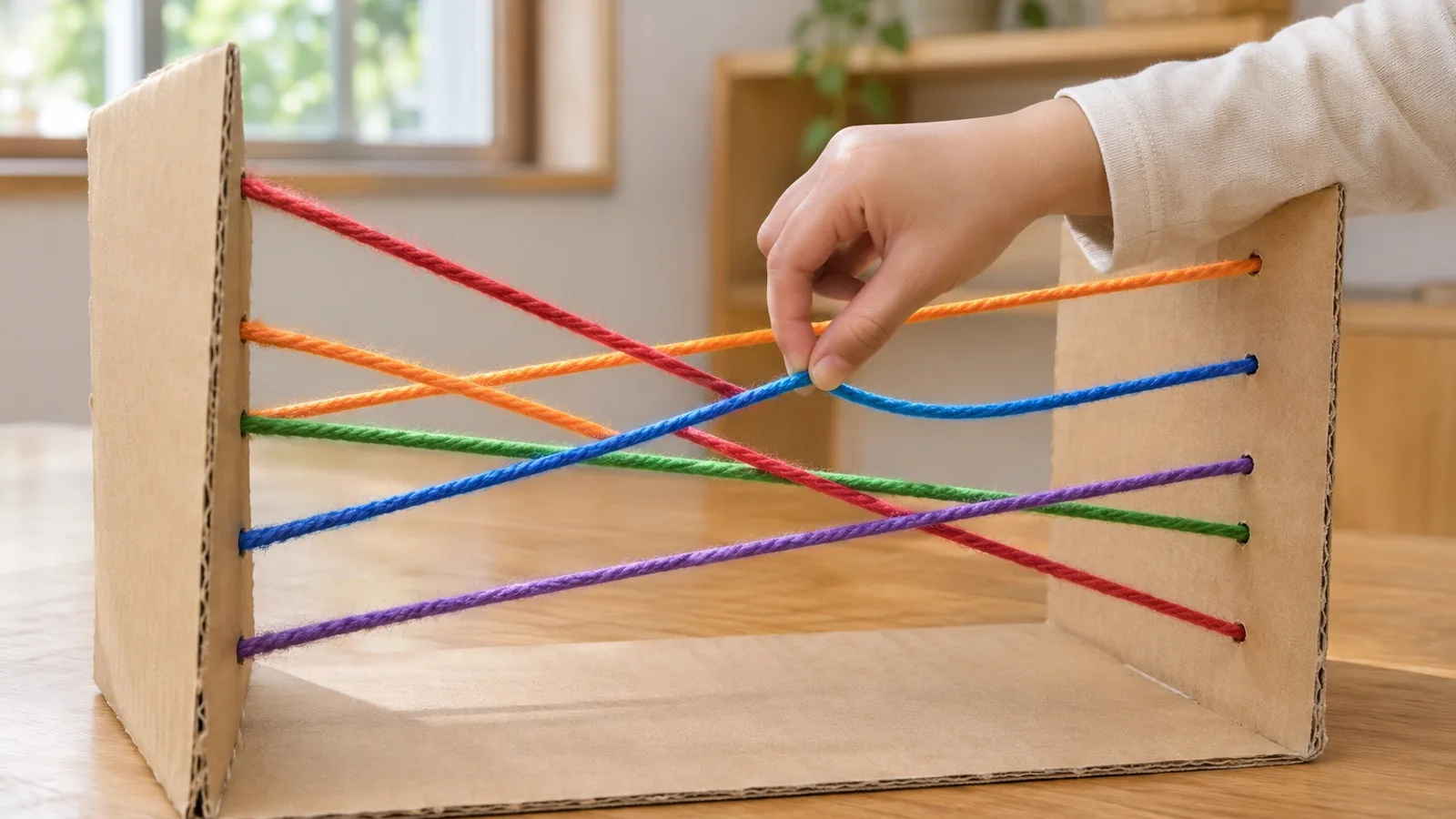
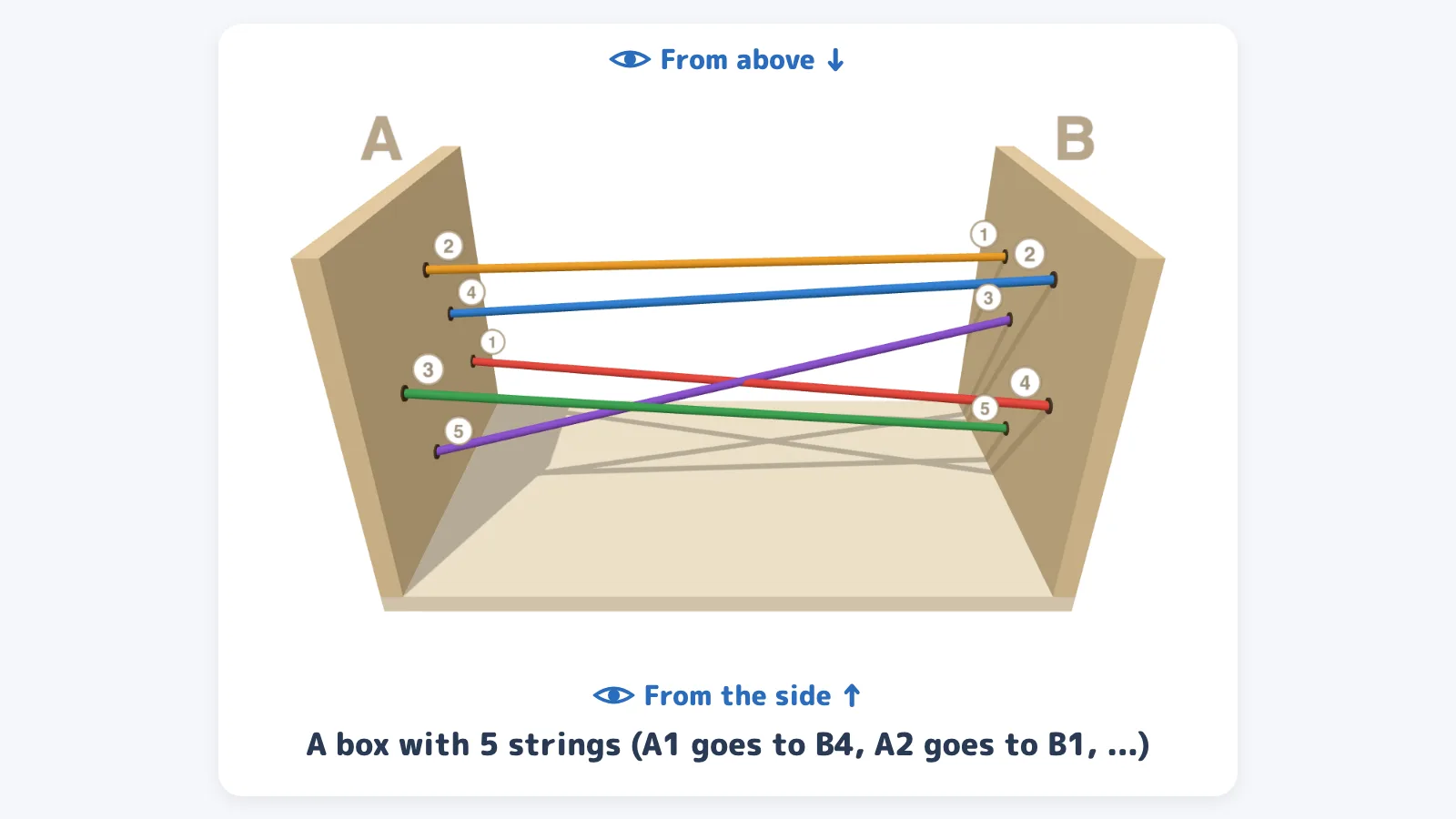
- Take a box (an empty tissue box or a small cardboard box) and call two facing sides "side A" and "side B." Cut away the top and the front so you can see inside from above and from the side
- Make 5 holes on each side, at different heights and different positions, and number them 1 to 5
- Take 5 pieces of yarn and connect the holes on A to the holes on B in a mixed-up order (A1 to B4, A2 to B1, and so on)
- Make one more box with the same connections, using a different color of yarn for each strand
Starting with 3 strands, and adding one at a time as your child gets used to it, works well.
How to play
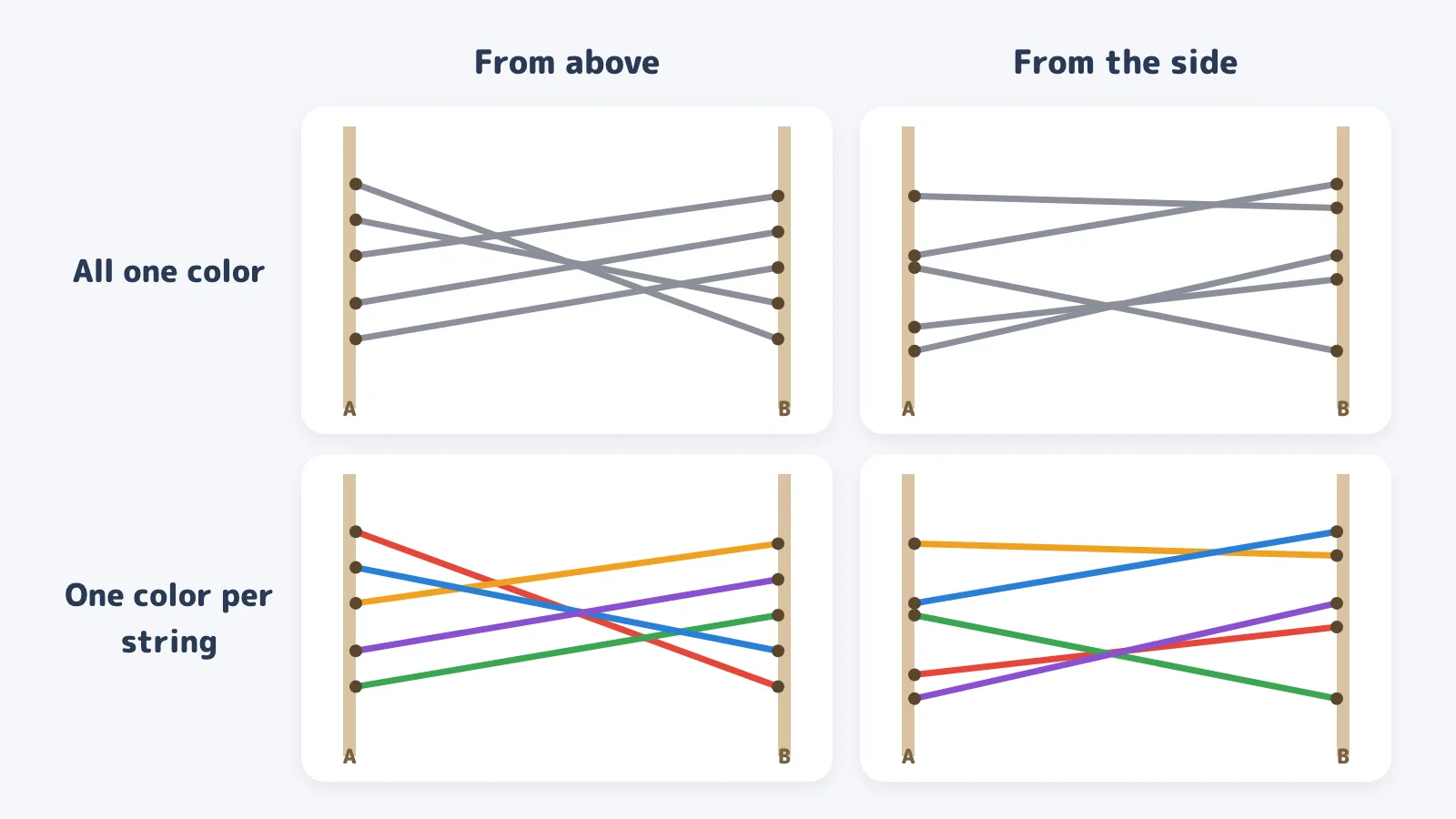
How the string activity goes
- Look from aboveLook down at the one-color box and ask, "A3 goes to which number on B?"
- Look from the sideLook at the same box from the side and answer the same question. The order of the strings looks different from when you looked from above
- Move your headLook while slowly moving your head from side to side. The strings in front and the strings behind start to separate
- Wiggle one stringGently pull and wiggle the string from A3 with a finger. Only the wiggling string stands out
- Compare with the colored boxAnswer the same question with the colored box. Compare the two boxes to see where you got confused
Two strings that seemed to cross when seen from above turn out, from the side, to be at different heights and far apart.With strings all one color, the eyes slide onto the string that continues straight at a crossing.With different colors, "things that look alike form a group" kicks in, and you can follow each string one at a time.You can see the same slipping that happens on paper happening right in front of you with string.
Changing what you see by moving
When you move your head, nearby things seem to move a lot and faraway things seem to move only a little.Research has confirmed that this difference in movement alone is enough to tell what is in front and what is behind.When you wiggle one string and only that string stands out, that is the fifth rule in the table at work: "things that move together look like a group."
What we see depends not only on our eyes, but also on how we move.Discoveries like "I crouched down and could tell" or "I moved my head and could tell" become the child's own strategies that they can use when they get confused on paper too.
Putting discoveries into words
Examples of words for the string activity
- After comparing"What was different when you looked from above and from the side?"Value noticing the difference more than getting the right answer
- When they got confused"What made it easier to see?"Put the child's own strategy into words, like "I wiggled it" or "I crouched down"
- With the colored box"What changed when the colors were different?"This connects to tracing with a different color for each shape on paper
Ideas to try at home
Trace each shape in a different color
When tracing overlapping shapes, try changing the colored pencil for each shape.If the child slips, a different color ends up on another shape's line, so the child can see it and notice it themselves.Asking "Where did it change color?" shows where they got confused at a corner or crossing.
Stop at the corners
Slipping tends to happen at corners and crossings.Agree on "When you reach a corner, stop for a moment." When they stop, they look at the sample, check which way to turn, and then continue.
Fade the hints little by little
If finding everything on their own from the start is too hard, at first an adult lightly traces the target shape in a pale color.As the child gets used to it, mark only the corners.Finally, work without any marks.Studies with children have shown that making the hints clear at first and then fading them gradually helps children learn to tell things apart with fewer mistakes.The key is to keep going until the hints are gone completely.
Name the shape while searching
Familiar shapes are known to stand out as the figure more easily (when the same shapes were turned upside down, this effect became weaker).Putting the target shape into words before searching, like "A star has five points," helps the child keep the shape clearly in mind.
Make the ground disappear with red film
A sheet of red cellophane, like the lens of a "secret decoder" viewer, makes writing in orange or red ink almost disappear.You can use this to make your own figure-ground activity.Draw the target shape in black pen and the distracting lines in orange pen.When you lay the red film over it, only the distracting lines vanish, and the target shape stands out.The child can check their own answers.
Slip it into a clear sleeve
If you put a worksheet in a clear plastic sleeve and trace with a dry-erase marker, the child can wipe it off and try again as many times as they like.This combines well with tracing in a different color for each shape.
Add space between letters
Shapes being harder to read when other lines are close by applies to letters too.In a study of children with reading difficulties, widening the space between letters reduced reading errors and increased reading speed.When letters look crowded and hard to read, rewriting them with more space or showing them enlarged is one option.
Things to do beyond worksheets
- "What does it look like?" with clouds or wood grain: The same thing can look like different things to different people. Like pictures that can be seen two ways, this is a game of switching how you see
- Finding constellations: A game of seeing scattered stars as a group. Looking at the constellation lines in a picture book first makes them easier to find in the night sky
- Shadow puppets and silhouette guessing: Guessing what something is from its outline alone. A closure game
- Finding pairs of socks in a pile of laundry: Spotting matching patterns among overlapping clothes and pulling them out. Figure and ground in three dimensions
- Looking for insects hidden in grass and leaves: Grasshoppers and mantises blend into the colors around them. Figure and ground in nature
Choosing a worksheet
MIRU LAB KIDS has worksheets that work on figure-ground perception and seeing things as groups.
| Worksheet | What it works on | When to use it |
|---|---|---|
| Hidden Shapes | Picking out the target shape among overlapping lines (figure-ground) | When slipping is a concern. From level 3, trace each kind of shape in a different color |
| Follow the Lines | Following a tangled line without losing it at crossings | When the child keeps going straight at crossings. A paper version of the string activity |
| Incomplete Shapes | Picturing the original shape from a shape with missing parts (closure) | When the child has trouble telling what something is when part of it is hidden |
| Find the Same Shape | Telling the sample shape apart from many other shapes | When you want to start by telling shapes apart where nothing overlaps |
If slipping happens often, start with level 1 of Hidden Shapes and try tracing each shape in a different color.If the way your child searches (how they miss things) is a concern, see also "A Child Who Often Misses Things."
Final thoughts: some children are great at finding things
So far I have focused on slipping and things being hard to see.But some children are very good at finding hidden shapes.A study of autistic children reported that many of them did very well on a task of finding a shape hidden in a complex picture.A tendency to notice small details can show up as a strength in some situations.
The same picture looks different depending on who is looking and where they look from.Slipping, too, is a sign that the child's eyes are working hard to make groups.Try exploring together with your child where, and how, they are seeing.
Studies referred to
- Wagemans J, Elder JH, Kubovy M, Palmer SE, Peterson MA, Singh M, von der Heydt R. A century of Gestalt psychology in visual perception: I. Perceptual grouping and figure–ground organization. Psychological Bulletin. 2012;138(6):1172-1217.
- Gopnik A, Rosati A. Duck or rabbit? Reversing ambiguous figures and understanding ambiguous representations. Developmental Science. 2001;4(2):175-183.
- Field DJ, Hayes A, Hess RF. Contour integration by the human visual system: evidence for a local "association field". Vision Research. 1993;33(2):173-193.
- Jolicoeur P, Ullman S, Mackay M. Curve tracing: a possible basic operation in the perception of spatial relations. Memory & Cognition. 1986;14(2):129-140.
- Houtkamp R, Spekreijse H, Roelfsema PR. A gradual spread of attention during mental curve tracing. Perception & Psychophysics. 2003;65(7):1136-1144.
- Ghent L. Perception of overlapping and embedded figures by children of different ages. American Journal of Psychology. 1956;69(4):575-587.
- Kovács I, Kozma P, Fehér Á, Benedek G. Late maturation of visual spatial integration in humans. Proceedings of the National Academy of Sciences of the USA. 1999;96(21):12204-12209.
- Jeon ST, Hamid J, Maurer D, Lewis TL. Developmental changes during childhood in single-letter acuity and its crowding by surrounding contours. Journal of Experimental Child Psychology. 2010;107(4):423-437.
- Gollin ES. Developmental studies of visual recognition of incomplete objects. Perceptual and Motor Skills. 1960;11:289-298.
- Kavale K, Mattson PD. "One jumped off the balance beam": meta-analysis of perceptual-motor training. Journal of Learning Disabilities. 1983;16(3):165-173.
- Kim D, Roh W, Lee Y, Yim S. The effect of a table tennis exercise program with a task-oriented approach on visual perception and motor performance of adolescents with developmental coordination disorder. Perceptual and Motor Skills. 2024;131(4):1183-1206.
- Isaacs LD. Effects of ball size, ball color, and preferred color on catching by young children. Perceptual and Motor Skills. 1980;51(2):583-586.
- Rogers B, Graham M. Motion parallax as an independent cue for depth perception. Perception. 1979;8(2):125-134.
- Moore R, Goldiamond I. Errorless establishment of visual discrimination using fading procedures. Journal of the Experimental Analysis of Behavior. 1964;7(3):269-272.
- Sidman M, Stoddard LT. The effectiveness of fading in programming a simultaneous form discrimination for retarded children. Journal of the Experimental Analysis of Behavior. 1967;10(1):3-15.
- Peterson MA, Gibson BS. Must figure-ground organization precede object recognition? An assumption in peril. Psychological Science. 1994;5(5):253-259.
- Zorzi M, Barbiero C, Facoetti A, Lonciari I, Carrozzi M, Montico M, Bravar L, George F, Pech-Georgel C, Ziegler JC. Extra-large letter spacing improves reading in dyslexia. Proceedings of the National Academy of Sciences of the USA. 2012;109(28):11455-11459.
- Shah A, Frith U. An islet of ability in autistic children: a research note. Journal of Child Psychology and Psychiatry. 1983;24(4):613-620.
Materials referred to
- Rubin E. Synsoplevede Figurer. Copenhagen: Gyldendal; 1915.
- Hammill DD, Pearson NA, Voress JK. Developmental Test of Visual Perception—Third Edition (DTVP-3). Austin, TX: PRO-ED; 2014.