When Handwriting Won't Stay on the Lines: It May Not Be Just Fine Motor Skills
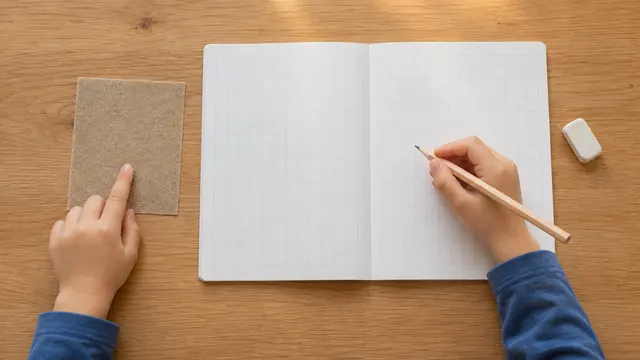
"I keep telling them to write on the lines, but the letters still go everywhere.""They're trying to be neat, but the letters keep getting bigger and bigger."When handwriting won't stay on the lines, people tend to think, "Maybe they're clumsy," or "Maybe they're being careless."But keeping letters on the lines takes many skills besides fine motor skills.This article looks for clues in how the letters go off the lines, and shares ideas the adults around a child can try, from three angles: vision, finger movement, and posture.
Keeping letters on the lines takes many skills
When we write a letter on lined paper, we do all of these things, almost without thinking:
Writing one letter on the lines
- Seenotice the lines and the space between them
- Pictureimagine the shape of the letter, and how big it should be between the lines
- Decidedecide where to start
- Writemove the pencil while checking the direction and length of each line with the eyes
- Stopstop the line at just the right spot
If any one of these doesn't work well, letters easily go off the lines.In pediatric therapy as well, handwriting is seen as a task built from a combination of many skills: fine finger movements, visual perception, eye-hand coordination, moving the pencil within the hand, the sense of touch in the fingers, sustained attention, and more (Feder & Majnemer, 2007).The surroundings also play a part, such as the height of the desk and chair and how the paper is placed.When "Write neatly!" doesn't change anything, it may be because the child is struggling at a point that willpower alone can't easily fix.
Looking for clues in how letters go off the lines
Looking closely at how the letters go off the lines can give clues about where the child is struggling.
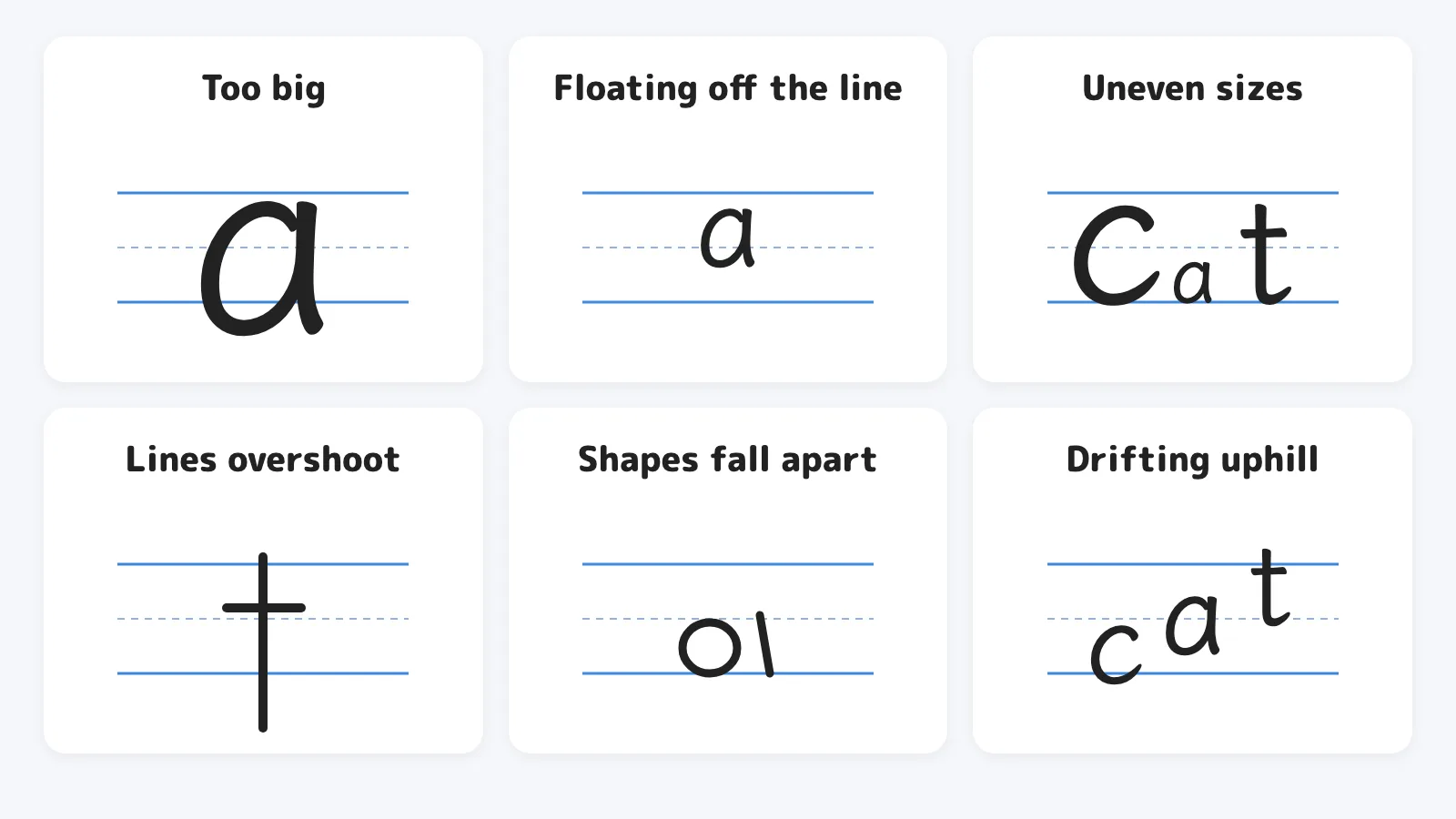
| Pattern | Skills that may be involved |
|---|---|
| Letters too big, going past the top line | Moving the pencil in small steps with the fingers (explained under "Finger movement" below) |
| Letters floating above the line or sinking below it | Deciding where to start, judging position (spatial perception) |
| Letter sizes all different | Comparing with nearby letters and the lines, checking with the eyes while writing |
| Lines that overshoot and don't stop | Stopping the hand while watching (eye-hand coordination), controlling pressure |
| Letter shapes falling apart | Seeing the shape of the letter (form perception) |
| Writing drifting uphill or downhill | Judging position, posture, the hand holding the paper |
Several patterns can also be mixed together.Please use this table as just one clue when watching your child.
Looking at vision
Keeping letters on the lines uses visual skills like these:
- Judging position (spatial perception): seeing where to start the letter, and how far to take each line
- Seeing shape (form perception): telling apart similar letters, like b and d or n and h, and writing them differently
- Using the eyes and hands together (eye-hand coordination): drawing a line while watching the pencil tip, and stopping it
Studies have reported a link between the ability to copy shapes by hand (visual-motor integration) and handwriting (Daly et al., 2003).Handwriting is described as involving many skills, including vision, hand movement, body senses, and attention (Feder & Majnemer, 2007).
Looking at finger movement: writing with the wrist or arm makes letters bigger
A child whose letters get too big may find it hard to move the pencil with the fingers.
When we write small letters, the pencil is moved mainly by the finger joints.Each finger has three joints:
- The joint nearest the fingertip (the DIP joint)
- The middle joint (the PIP joint)
- The joint at the base of the finger (the MP joint)
By bending and straightening these three joints in tiny amounts, we move the pencil tip just a little and draw small lines.
When it's hard to make these small movements with the finger joints, the child makes up for it with movement from other, larger joints.In therapy, this is called "compensation."There are two main patterns.
Compensating with the wrist (common)
The fingers barely move, and the child holds the pencil tightly and writes by bending the wrist up and down or swinging it side to side.In my experience, this pattern is the more common one.
The wrist makes bigger movements than the finger joints, so letters tend to get bigger.Also, because the pencil moves around the wrist as a pivot, lines that should be straight tend to curve like an arc, and small loops, like those in e and a, get squashed.The wrist stays tense the whole time, so the child may tire easily.
Compensating with the elbow or shoulder
With the wrist held stiff too, the child writes by moving the elbow or shoulder, using the whole arm.With large arm movements, making the small adjustments needed to move the pencil tip just a little becomes even harder.Letters get even bigger and go off the lines more easily.
In both patterns, the child is making up for small finger movements with larger joints, so letters get bigger and are harder to keep on the lines.

| Main moving part | Letters that are easy to write |
|---|---|
| Finger joints (DIP, PIP, MP) | Small, detailed letters |
| Wrist | Medium-sized letters. Lines tend to curve, since the wrist is the pivot |
| Elbow, shoulder (whole arm) | Big letters. Fine adjustments are hard |
When your child is writing, see whether the fingers barely move while the wrist swings, or the whole arm moves.Whether the pencil grip makes it easy to move with the fingers is also a clue.
Looking at the body's foundation: posture and the hand holding the paper
This is something I especially want to share as a physical therapist.Fine finger movements work best when the body is steady.When the body is wobbly, the hands get used for balance, which makes fine movements harder.
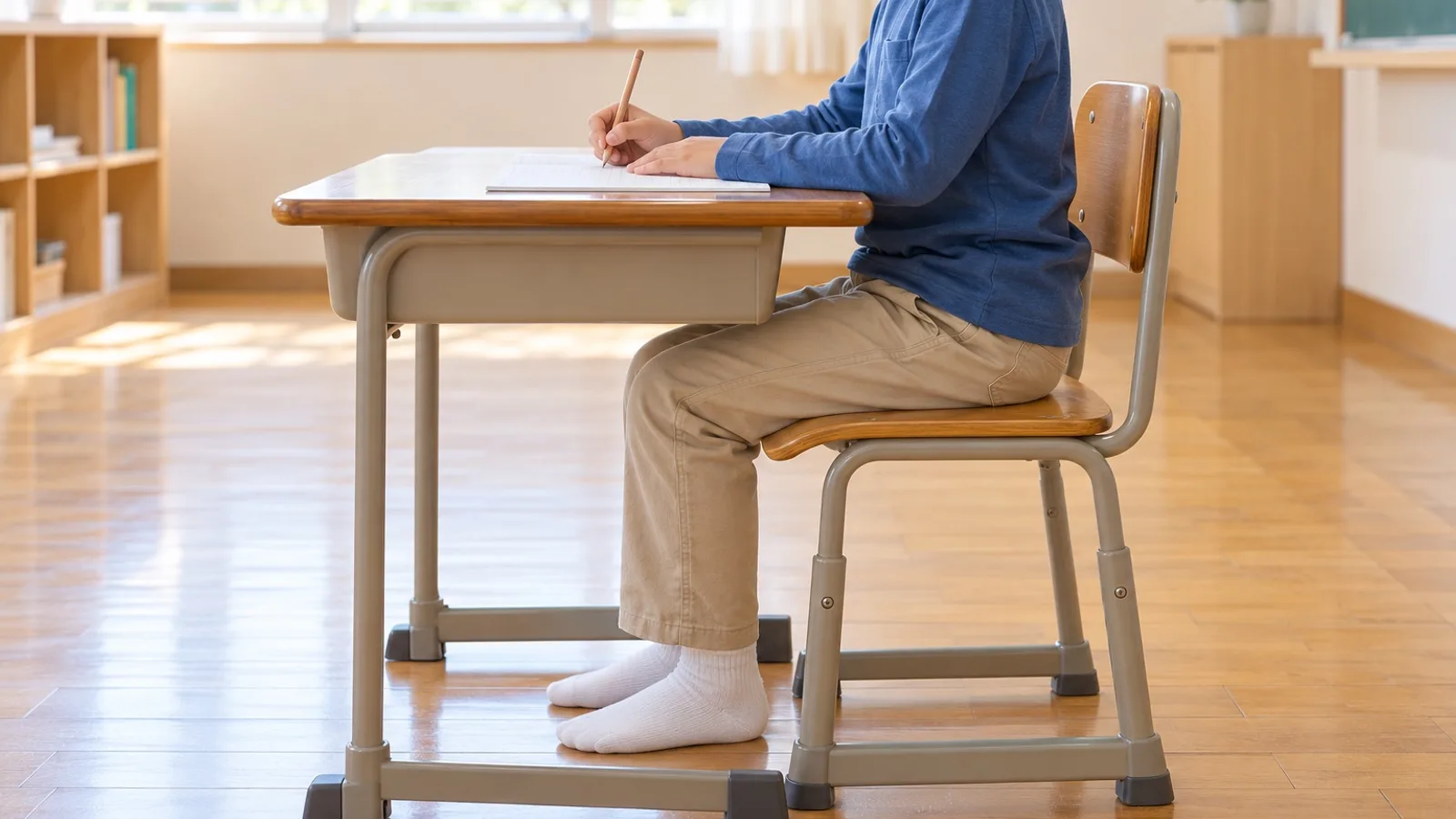
Use these points as a guide for posture when writing:
| What to check | Guide |
|---|---|
| Feet | The whole sole of each foot rests firmly on the floor (or a footrest) |
| Chair | The child can sit all the way back. Knees bend at about a right angle |
| Desk | With elbows bent and forearms on the desk, the shoulders don't hunch up and the back doesn't round too much |
| Distance from the desk | About a fist's width between the belly and the desk |
| Hand holding the paper | The non-writing hand holds the paper down firmly |
Two things that are especially easy to overlook are the soles of the feet and the hand holding the paper.When the feet dangle without reaching the floor, the body is harder to keep steady.When the paper isn't held down, it moves with every stroke, and lines don't land where the child intends.
Things to keep in mind
Every child's reasons for writing off the lines are different.Besides vision, finger movement, and posture, attention and still being in the middle of learning letter shapes can also play a part.
- First, check that there are no problems with eyesight.
- If clumsiness in how your child moves stands out in situations other than writing too, talk to their teacher, or to an occupational therapist or physical therapist.
Ideas and activities to try at home
Set up the writing space
- Use wider lines: start with spacing your child can write in, and narrow it gradually as they get used to it
- Use paper with a dotted middle line: handwriting paper with a top line, a dotted middle line, and a baseline makes it easier to see where each part of a letter goes
- Mark the starting point: show where the first stroke begins with a small dot
- Adjust posture with a footrest or cushion: if the feet don't reach the floor, add a footrest
Play that uses the fingertips
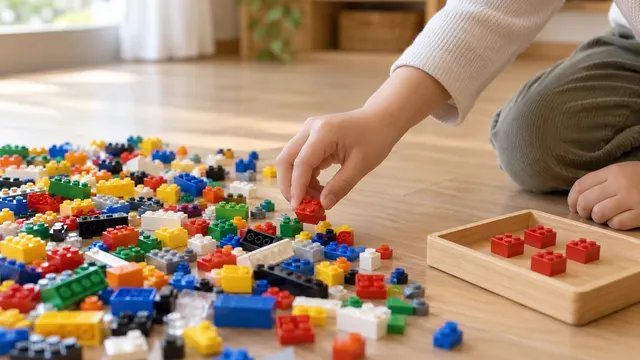
- Pick up small things: pick up beads or small counters with the fingertips and move them into a container
- Draw with short pencils or crayons: short tools can only be held with the fingertips, so the child naturally uses them
- Clothespin play: open and close clothespins, using finger strength and movement
Practice drawing lines and stopping
Play like mazes and line-following, where the child "draws a line without going outside the path" and "stops at just the right spot," helps prepare for writing on the lines.
Related worksheets
These MIRU LAB KIDS worksheets work on skills close to those used in keeping letters on the lines.
- Symmetry Coloring: find the right squares and color them without going outside
- Dot Grid Copying and Dot Grid Copying: Pictures: use the dots as clues to see the position and direction of each line, and copy it
- Mazes and Number Mazes: draw a line without going outside a narrow path
- Follow the Lines: follow one line all the way with the eyes and a fingertip
- Dot-to-Dot: draw lines toward dots and stop at just the right spot
For trouble with copying, see "Slow at Copying from the Board?"For how much to do in a day and how to keep going, see "Every Day? How Much?"
Final thoughts
Letters going off the lines doesn't always mean the child is being careless.Somewhere in vision, finger movement, or the body's foundation, there may be a point where the child is trying hard but it just doesn't work well.
Once you know where the child is struggling, you can see more ideas to try besides "Write neatly."I hope this article gives you a new clue when looking at your child's handwriting.
Studies referred to
- Daly CJ, Kelley GT, Krauss A. Relationship between visual-motor integration and handwriting skills of children in kindergarten: a modified replication study. American Journal of Occupational Therapy. 2003;57(4):459-462.
- Feder KP, Majnemer A. Handwriting development, competency, and intervention. Developmental Medicine & Child Neurology. 2007;49(4):312-317.