Slow at Copying from the Board? It May Be the Eyes, Not the Writing

"My child doesn't have trouble writing, but copying from the board takes forever."At the after-school day program for children with developmental needs where I work, this is something I often hear from parents and teachers.When a child is slow at copying, people tend to think, "Maybe writing is hard for them," or "Maybe they're not trying."But copying is not just writing.This article breaks down, one step at a time, what happens in the eyes and the head when copying from the board, along with where children tend to get stuck and what the adults around them can do.
Copying is a round trip between the eyes and the brain
When we copy text from the board into a notebook, we repeat these steps over and over:
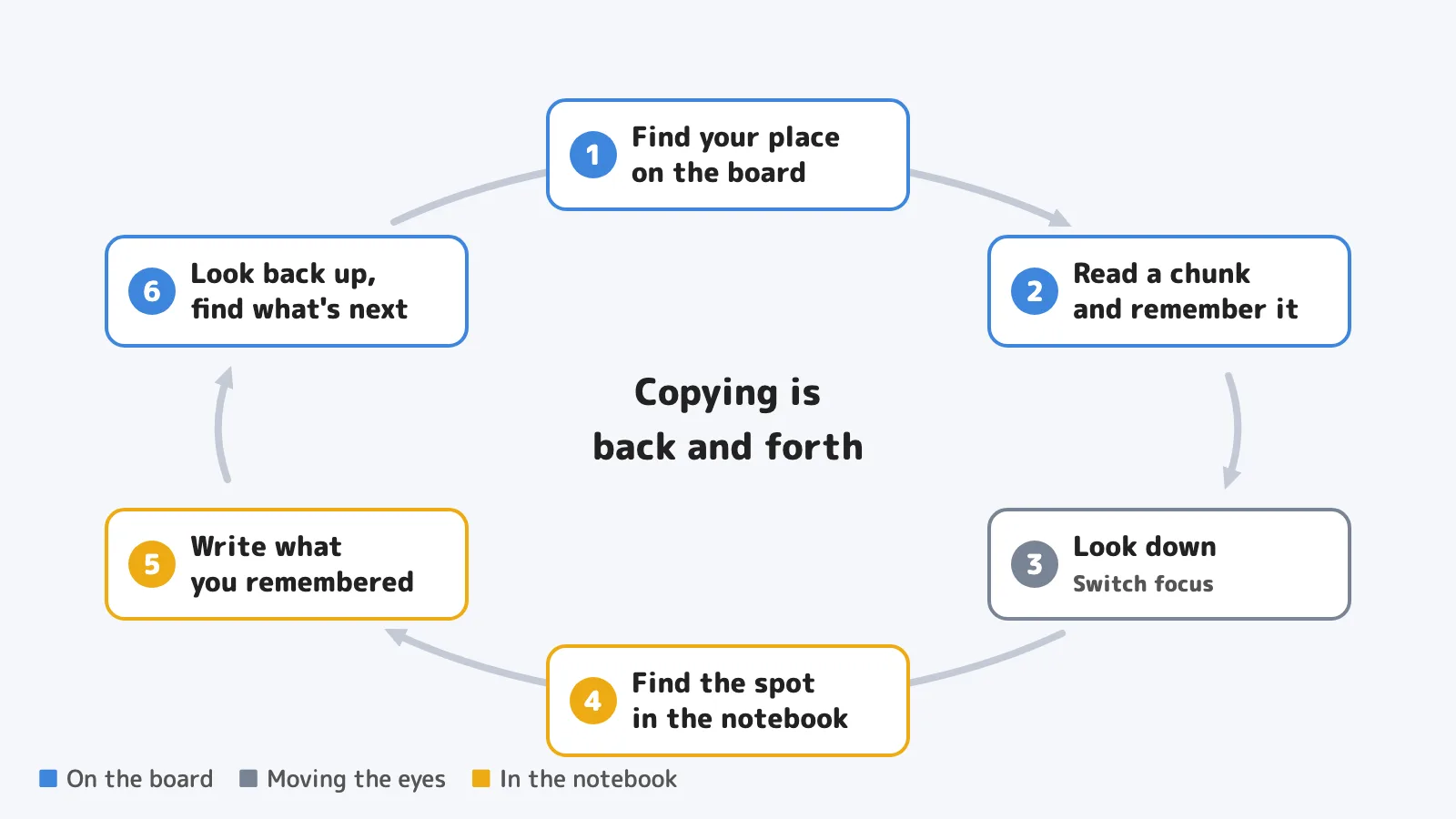
- Find your place on the board: remember how far you've copied and find that spot on the board
- Read a chunk and remember it: read a few letters or words and hold them in your head
- Move the eyes down to the desk: switch focus from the faraway board to the nearby notebook
- Find where to write in the notebook: find which line, and where on it, to write
- Write what you remembered: write the letters while recalling them
- Look back at the board and find what comes next: return to the board and start again at step 1
If any one of these six steps takes time, the whole process slows down."Writing" is only one of the six.
Switching focus from far to near
At step 3, moving the eyes down to the desk, the eyes refocus (accommodation) and turn inward together (convergence).While copying, a child repeats this switch dozens of times.These eye functions are also covered in "Visual Perception Shows Up in Unexpected Places."
Children copy in smaller chunks
A research group in the UK compared the eye movements of children and adults as they copied words from a board into a notebook (Laishley et al., 2015).Adults remembered each word as a single chunk and copied it.Children, on the other hand, appeared to break longer words into several parts, remembering and copying one part at a time.Copying in smaller pieces also means more trips back and forth between the board and the notebook.
A study in France had third and fifth graders copy the same text, and counted how many times they looked up at the board (Bosse et al., 2014).It found that children who could take in more letters at a single glance copied more letters each time they looked up.This relationship held even after accounting for differences in reading ability.
A child still learning letter shapes may copy in even smaller pieces
The studies looked at words and groups of letters.But for a child who hasn't yet firmly learned letter shapes, the chunks can get even smaller.They may copy letter by letter, and some children look up at the board for each stroke of a letter.
For example, when copying "school bus" from the board, the number of looks up at the board changes like this:
| How the child copies | Looks up at the board |
|---|---|
| Remembers the whole phrase | 1 |
| Remembers one word at a time | 2 |
| Remembers one letter at a time | 9 |
Copying letter by letter turns two short words into nine round trips. Stroke by stroke would be even more.Each time, the child has to search the board again for "where was I?" and search the notebook again for where to write.Imagine copying a whole board's worth of text this way. You can see how hard that would be.
For an adult, it might be like copying writing in a script you can't read from a board.Try copying "学校" (the Japanese word for "school") from across the room.Because the shapes have no meaning for you, you would likely look at each line, copy it, look again, copy again.A child who looks "slow" is often trying as hard as they can.
So when copying is slow, two things may be involved:
- Many round trips: the child can hold only a little at a time, so they look up at the board again and again
- Each round trip takes a long time: it takes time to find their place on the board, or to find where to write on the page
Often, it isn't that "the writing hand is slow," but that "the round trips before writing" take time.
Where is the child getting stuck? Clues from what you see
Watching your child copy closely can give clues about where they are getting stuck.
| What you might see | Where the child may be stuck | Skills involved |
|---|---|---|
| Loses track of where they were. Copies the same part twice, or skips a line | Steps 1 and 6: finding their place on the board | Jumping the eyes to a new spot (saccades), searching (visual search) |
| Looks up at the board for each letter, or each stroke | Step 2: remembering a chunk | Visual memory, reading skills, how well letter shapes are learned |
| Rubs the eyes while copying, tires easily | Step 3: switching focus | Focusing and turning the eyes inward (accommodation and convergence) |
| Writing drifts off the line, letters go outside the lines | Step 4: finding where to write in the notebook | Judging position (spatial perception) |
| Copied letters lose their shape, or become hard to read when copied | Step 5: writing what they remembered | Using the eyes and hands together (eye-hand coordination) |
A child may also be getting a little stuck at several points.Please use this table as just one clue when watching your child.
For more about eye movements, see "Smooth Pursuit and Saccades."
Many other reasons besides the eyes
Copying uses many skills besides the eyes:
- Reading: being able to sound out words makes it easier to remember them as chunks
- Hand movement while writing: how the pencil is held, and how the fingers move
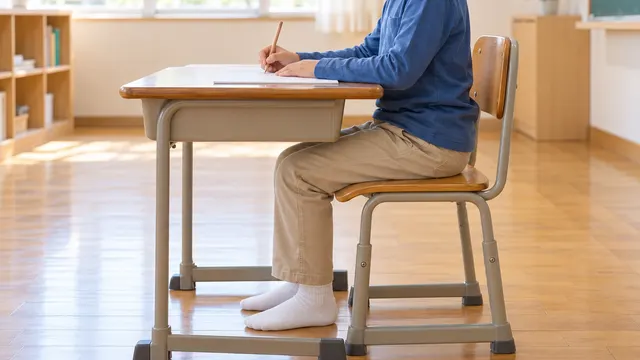
- Posture: if the body is leaning, or the desk and chair don't fit, looking back and forth between the board and the notebook is harder
- Attention: if sounds or movement nearby are distracting, it's easier to forget where they were
Every child's reasons for slow copying are different.Try looking at your child from many angles, not just the eyes.
Activities to try at home
Start close, then gradually move farther away
Copying from something far away, like a board, is a hard place to start.Begin by copying from a book or card on the desk into a notebook.As your child gets used to it, prop the example up on the far side of the desk, then tape it to a wall, moving it farther away step by step.
Look, cover, write
This activity builds memory by gradually increasing how much is copied at once.
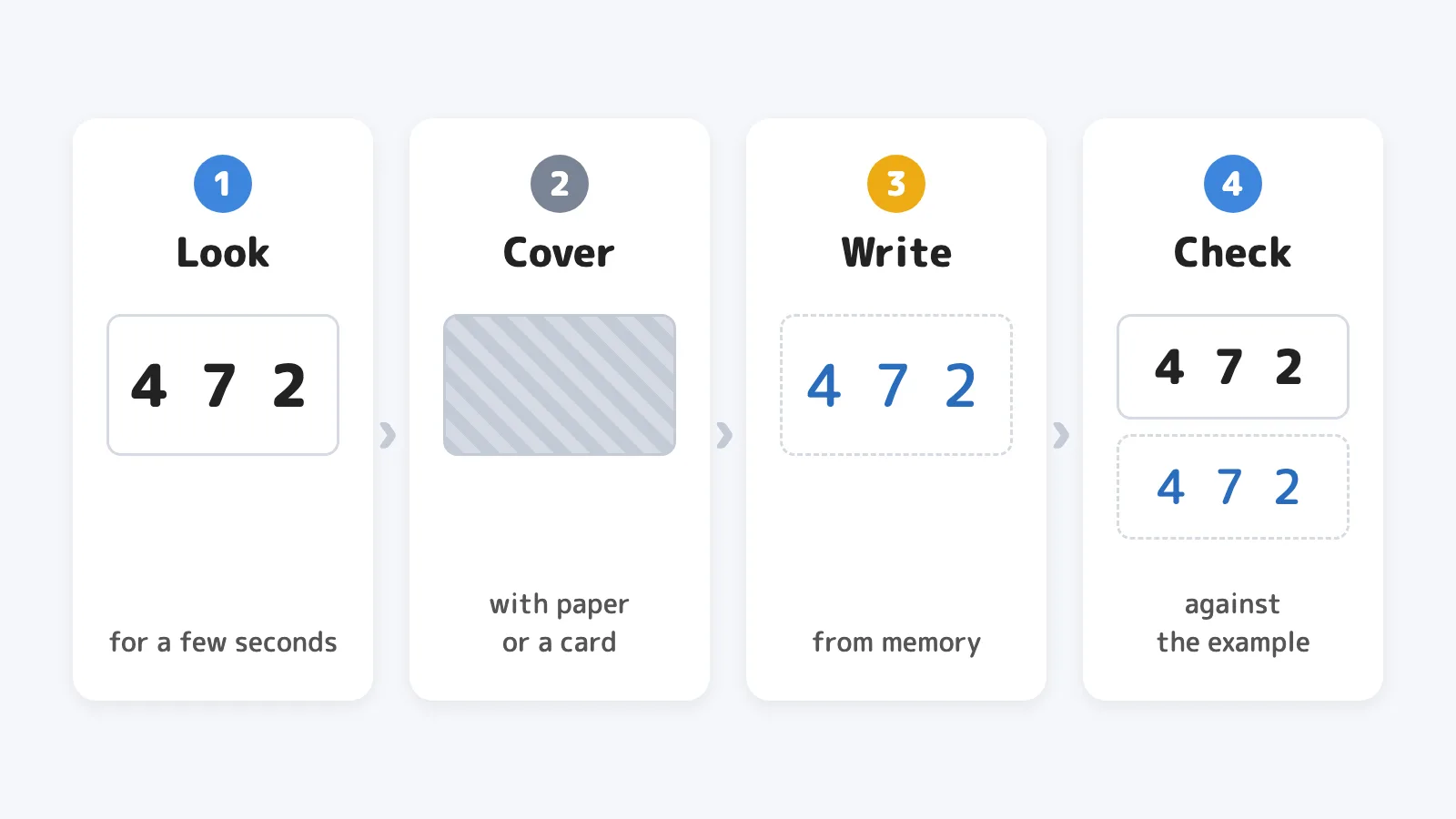
- Show an example (numbers, letters, or a short word) for just a few seconds
- Cover the example with paper or a card
- Write what you remembered
- Uncover the example and check
Start with about two or three characters.For a child still learning letter shapes, starting with a familiar letter, or letters with simple shapes, makes it easier.Once they can do it, add one more character at a time, or shorten the time the example is shown.Children who can't read yet can do the same activity with colored stickers or simple shapes.
Ways to keep track of the place
- Put a finger on the part of the example being copied right now
- Make a small pencil mark where copying has finished
- Put the same color mark on the line in the example and the line in the notebook
At first, an adult helps. Then the child gradually learns to do it on their own.
Supports you can ask the school about
If copying at school seems hard, talking with your child's teacher is one option.Supports like these (often called accommodations) can help:
- Seating near the front: the board is easier to see, and switching focus becomes a little easier
- A printed copy of what's on the board, or a photo of it: the child can copy from something on their desk
- Copying less: copying only the most important parts
- More time for copying: so the child doesn't have to rush
Which supports fit will depend on the child.Sharing what you see at home with the teacher, and thinking it through together, can help.
Related worksheets
These MIRU LAB KIDS worksheets work on skills close to those used in copying.
- Dot Grid Copying and Dot Grid Copying: Pictures: copy lines while moving the eyes back and forth between the example and the grid. Close to the round trip of copying
- Remember the Order: Shapes and Remember the Order: Pictures: remember the order of what you saw, then recall it
- Remember and Find: Shapes and Remember and Find: Pictures: remember what you saw, then find it among many
- Number Hunt and Circle the Numbers: quickly find where the target is on the page
- Symmetry Coloring: compare the example with your own page and find the same position
The worksheets are not copying practice in themselves.Use them as a playful way to work on each of the skills that copying uses.For how much to do in a day and how to keep going, see "Every Day? How Much?"
Final thoughts
Copying from the board may seem like nothing for an adult.But for a child, it is very hard work that uses the eyes, the brain, and the hands to the fullest.
Behind "slow," there is often a child doing their best, and a point somewhere where they're getting stuck.Once you know where that is, the way you talk with them and help them changes too.I hope this article gives you a chance to take a fresh look at how your child copies.
Studies referred to
- Laishley AE, Liversedge SP, Kirkby JA. Lexical processing in children and adults during word copying. Journal of Cognitive Psychology. 2015;27(5):578-593.
- Bosse ML, Kandel S, Prado C, Valdois S. Does visual attention span relate to eye movements during reading and copying? International Journal of Behavioral Development. 2014;38(1):81-85.