Visual Perception Shows Up in Unexpected Places

When people hear "visual perception," most of them think of schoolwork, like reading and writing.But visual perception is not only used at a desk.This article introduces five situations where you might think, "Really? Even there?"
For what visual perception includes (moving the eyes, using both eyes together, seeing shapes and positions, and more), see "What Is Visual Perception?"
1. Emotional control
Frequent meltdowns.Having a hard time moving on from play to the next activity.These are often seen as purely emotional issues.
But visual perception can sometimes be part of the picture.
One reason is fatigue.For a child who finds seeing hard work, doing the same things as other children takes a lot of effort from the eyes and the brain.When that energy runs out, small things can easily cause frustration.Even adults have less patience after reading small print for a long time in an unfamiliar place.
Another reason is how hard it can be to read what is going on around them.We take in much of what others are doing, and what is about to happen next, through our eyes.When that is hard, changes can feel sudden, and children can become anxious or startled more easily.
Brakes for the eyes, brakes for feelings
Looking a little more closely, there is one more important connection:the link between controlling eye movements and putting the brakes on one's own actions and feelings.
Our eyes tend to jump toward things that move or flash.Holding back that urge and keeping the eyes on what we need to look at takes control,and the front part of the brain (the frontal lobe) is deeply involved in it.
In research, a task in which you look away from a flash of light (the antisaccade task) has been used to measure how well we can stop our eyes from jumping toward something (Munoz & Everling, 2004).Performance on this task improves gradually from childhood to adulthood, as the frontal lobe matures (Luna et al., 2004).Studies have also reported that children with ADHD (attention-deficit/hyperactivity disorder) have more difficulty holding back these automatic eye movements (Munoz et al., 2003).
In other words, putting the brakes on eye movements and putting the brakes on actions and feelings are thought to share part of the same system in the brain.
Going one step further, some researchers have suggested that practicing eye movements might also help build self-control.For example, a research group in Hong Kong had 32 children with ADHD do eye-movement practice for two weeks (four hours in total), and reported improved scores on tests of attention and inhibition (Lee et al., 2021).However, this was a small, short study, carried out by the same people who created the training materials.It did not show changes in daily life, such as fewer meltdowns.
Even so, working with children as a physical therapist, I do come across children who have fewer meltdowns, or switch between activities more smoothly, as their control of their eyes develops.While we wait for research to confirm this, I think the link between visual perception and emotional calm is a perspective worth keeping in mind.
2. Tiring easily and trouble staying focused
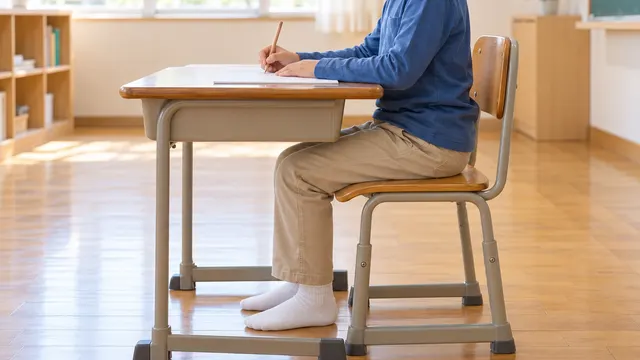
Slumping in the chair partway through a lesson.Looking away quickly, or rubbing the eyes.Working with the face very close to the desk.These are often taken as "not trying" or "can't concentrate."
But seeing itself may be a burden, causing tiredness to come early.For example, if keeping both eyes pointed together, or moving the eyes from line to line, is hard for a child, the same amount of work can be far more tiring for them than for other children.
What happens in the eyes during close work
When we look at a notebook or textbook on the desk, the eyes are doing two jobs at the same time.One is turning both eyes inward so they point at the same thing (convergence).The other is changing the thickness of the lens inside the eye to keep things in focus (accommodation).
These two work together, linked in the brain.When we look at something close, turning in and focusing happen as a pair.If one of them is weak, the other has to work harder to make up for it, which adds strain to the eyes and the head.
In fact, children whose eyes have trouble turning inward often report eye strain, headaches, losing their place while reading, and trouble staying focused (Borsting et al., 2003).What looks like "poor concentration" can sometimes come from how hard the eyes are working.
3. Tidying up and keeping track of things
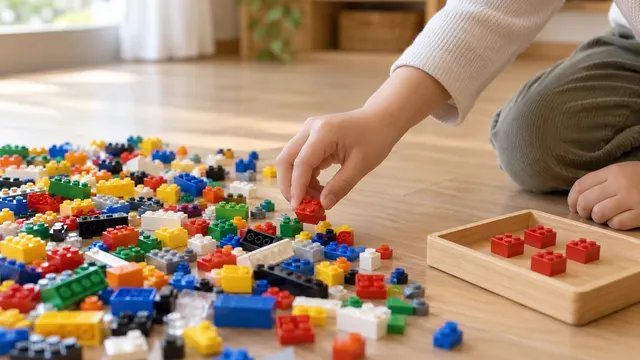
A desk or drawer that is always a mess.Not being able to find things.Often forgetting or losing things.
Finding one item among many is actually quite a demanding visual task.It takes telling shapes and colors apart, and scanning the whole area without missing anything.Remembering where you put things also uses visual skills.
A child may look disorganized from the outside, while actually struggling because they look and still can't find it.
4. Learning routes and getting lost
Taking the same route many times and still not remembering it.Getting lost easily in big stores or buildings.
When we learn a route, we remember landmarks like buildings and signs, and connect their positions in our head like a map.This uses the ability to judge positions and directions, and visual memory.
5. Movement and balance
Tripping and falling often.Having trouble catching a ball.Looking a little nervous on the stairs.
Balance is kept using information from three sources: the eyes, the inner ear, and the body's own senses.The eyes provide a lot of this. We look at our surroundings to know how much our body is tilting.Try standing on one foot with your eyes closed. You will probably wobble much more than with your eyes open.
To catch a ball, we follow it with our eyes, judge the distance with both eyes, and time our hands to meet it.Going up and down steps also requires judging the height and depth of each step correctly with the eyes.
Eyes and inner ear, working as a team
When we walk or run, our head bobs up, down, and side to side.So why doesn't the world look shaky?
The vestibular system in the inner ear senses the head's movement, and right after that, the eyes move in the opposite direction to keep our gaze on what we are looking at (the vestibulo-ocular reflex).Without noticing, we "see while moving" thanks to teamwork between the eyes and the inner ear.
When this system does not work smoothly, it becomes harder to keep things steady in view, for example when looking at a ball while running, or looking around while on swinging playground equipment.Behind frequent falls, or a fear of active play, there may be this kind of difficulty seeing while moving.
The connection between the vestibular system and the eyes develops through moving the body.Spinning, swinging, jumping, running.Whole-body play like this is an important experience for visual perception too.
Watching children move as a physical therapist, I often feel that a difficulty I thought was "about movement" has a difficulty "about seeing" hidden behind it.
Research on children whose movements are noticeably clumsy (developmental coordination disorder, or DCD), a group often seen in pediatric rehabilitation, has reported findings that overlap with this.An analysis that pooled 50 studies found that the biggest difference from other children was in visual-spatial processing (understanding space through the eyes) (Wilson & McKenzie, 1998).And the difference appeared even in tasks that did not require moving the hands or body to answer.
Here is a summary of the five situations.
| Situation | What you might see | Visual skills that may be involved |
|---|---|---|
| Emotional control | Frequent meltdowns, hard to switch activities | Visual fatigue, difficulty reading what is going on, putting the brakes on eye movements |
| Tiring easily, focus | Slumping, rubbing the eyes, face close to the page | Turning the eyes inward and focusing, moving the eyes from line to line |
| Tidying up, belongings | Can't find things, often loses things | Telling shapes and colors apart, scanning without gaps, visual memory |
| Routes | Hard to learn routes, gets lost easily | Judging positions and directions, visual memory |
| Movement, balance | Falls often, finds catching hard | Following with the eyes, judging distance with both eyes, seeing while moving (eyes and vestibular system) |
What adults around the child can do
When you notice signs like these, try adding one more question: "Could seeing be a burden for this child?"
Then you can try ideas like these:
- Reduce clutter: Fewer things on desks, shelves, and walls make it easier to find what you need.
- Give things a home: Decide where things go, and label each spot with a photo or picture.
- Show what's coming: Show what happens next with a few words or a picture, in a way that is easy to understand.
- Build in breaks: Between tasks that use the eyes, add time to move around or to look at something far away.
Visual perception is one of many perspectives
The signs in this article can have many other causes besides visual perception.How a child uses their body, how they take in sensations, their feelings, their environment. Often several reasons overlap.
Please keep visual perception as "one of many perspectives" for understanding your child.If concerns continue, talk to an eye doctor, your child's pediatrician, or your child's school.
Final thoughts
Visual perception is deeply connected not only to schoolwork, but also to feelings, movement, and everyday life.Behind what looks like "problem behavior," the child may be the one who is struggling.
I hope this article helps you notice when your child is having a hard time.
Studies referred to
- Munoz DP, Everling S. Look away: the anti-saccade task and the voluntary control of eye movement. Nature Reviews Neuroscience. 2004;5(3):218-228.
- Luna B, Garver KE, Urban TA, Lazar NA, Sweeney JA. Maturation of cognitive processes from late childhood to adulthood. Child Development. 2004;75(5):1357-1372.
- Munoz DP, Armstrong IT, Hampton KA, Moore KD. Altered control of visual fixation and saccadic eye movements in attention-deficit hyperactivity disorder. Journal of Neurophysiology. 2003;90(2):503-514.
- Lee TL, Yeung MK, Sze SL, Chan AS. Eye-tracking training improves inhibitory control in children with attention-deficit/hyperactivity disorder. Brain Sciences. 2021;11(3):314.
- Wilson PH, McKenzie BE. Information processing deficits associated with developmental coordination disorder: a meta-analysis of research findings. Journal of Child Psychology and Psychiatry. 1998;39(6):829-840.
- Borsting EJ, Rouse MW, Mitchell GL, et al. Validity and reliability of the revised convergence insufficiency symptom survey in children aged 9 to 18 years. Optometry and Vision Science. 2003;80(12):832-838.