 Visual Scanning
Number HuntFree printable worksheets
Aims
- Finding the number you are looking for among many (visual search)
- Jumping the eyes quickly from spot to spot across the page (saccades)
- Staying focused until the last number (sustained attention)
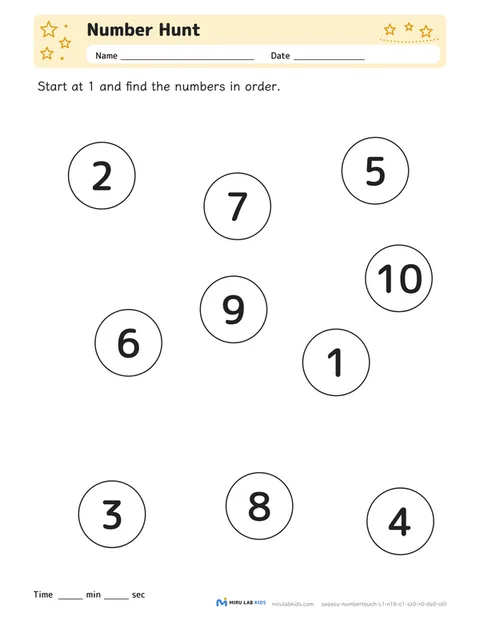
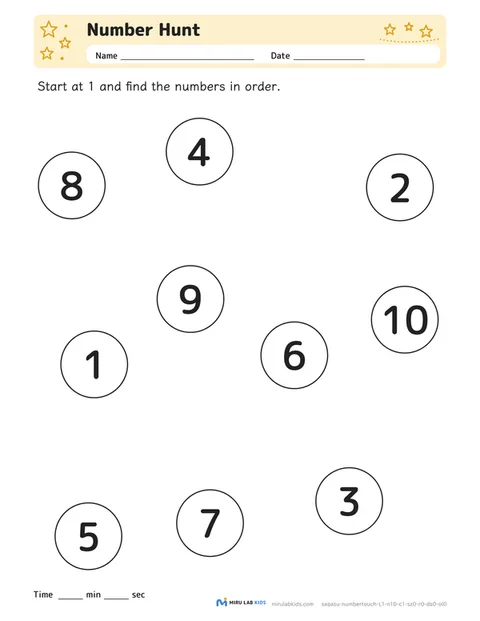
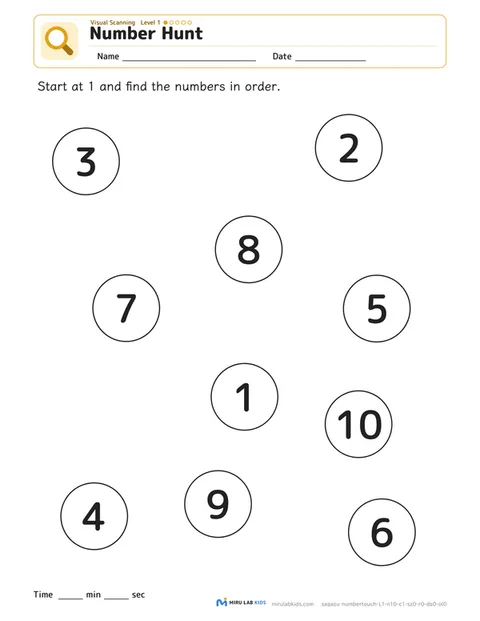
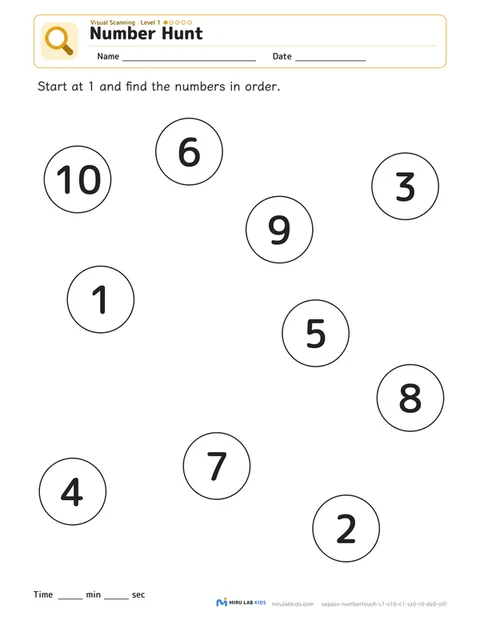
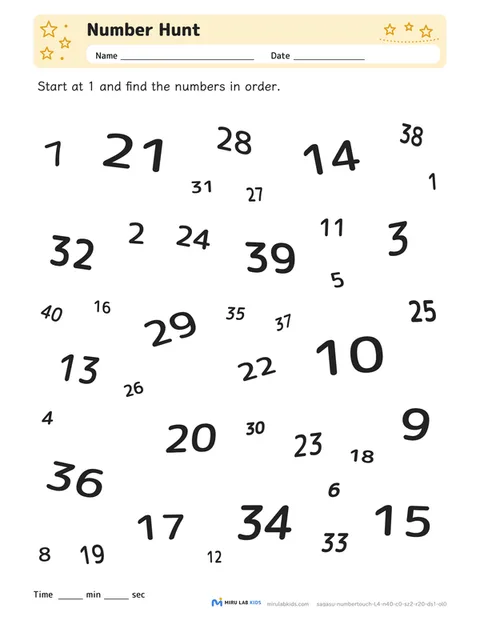
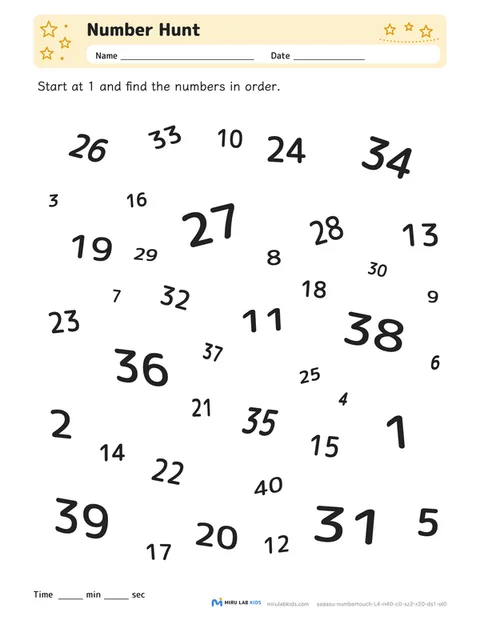
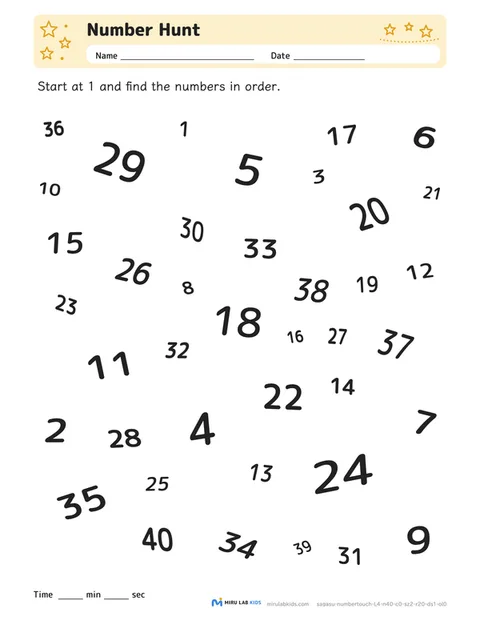
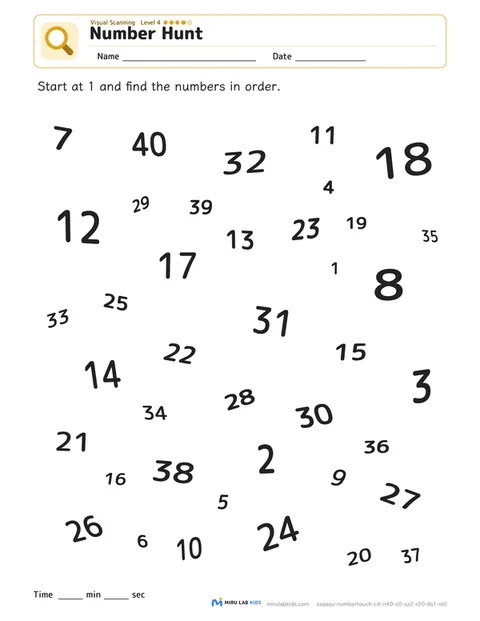
Numbers are scattered all over the page, and your child finds them in order: 1, 2, 3, and so on.The next number is never right next to the last one, so the eyes need to move all around the page.The activity aims to build the ability to find a target among many things, to scan the page with the eyes, and to keep searching until the end.There is no answer page, so the same sheet can be used again and again.
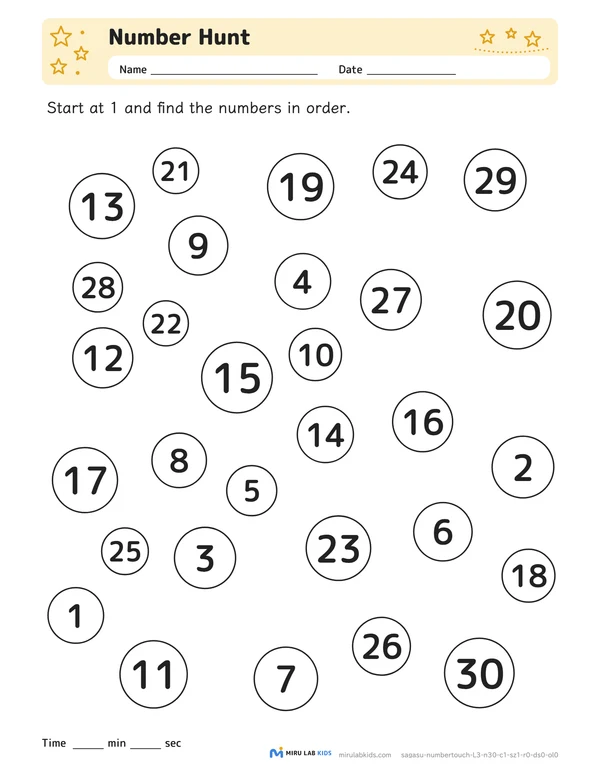 Level 3 example ›
Levels
| Level 1 | 1 to 10. Every number is in a circle, and all are the same size. | 10 worksheets |
|---|---|---|
| Level 2 | 1 to 20. Every number is in a circle, and all are the same size. | 10 worksheets |
| Level 3 | 1 to 30. The circles come in different sizes. | 10 worksheets |
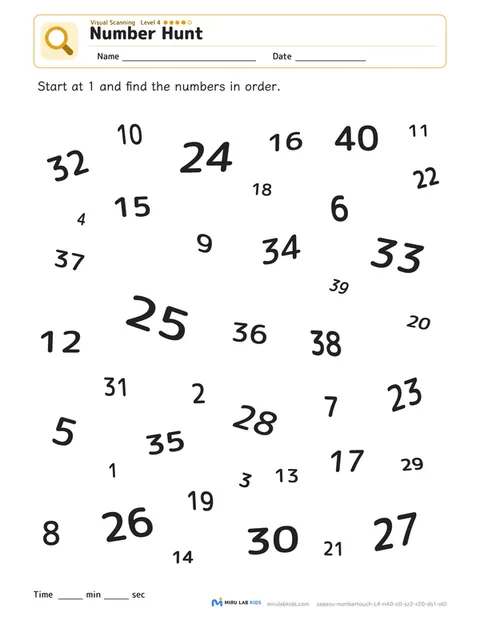
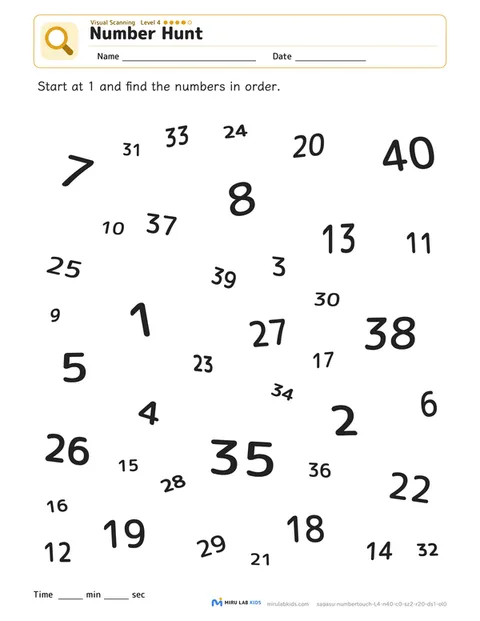
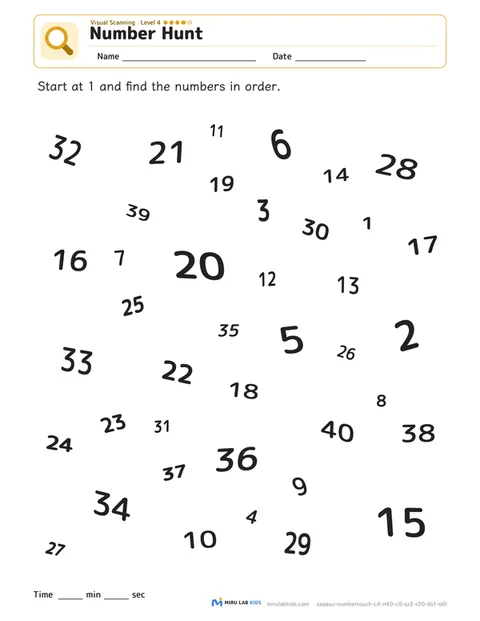
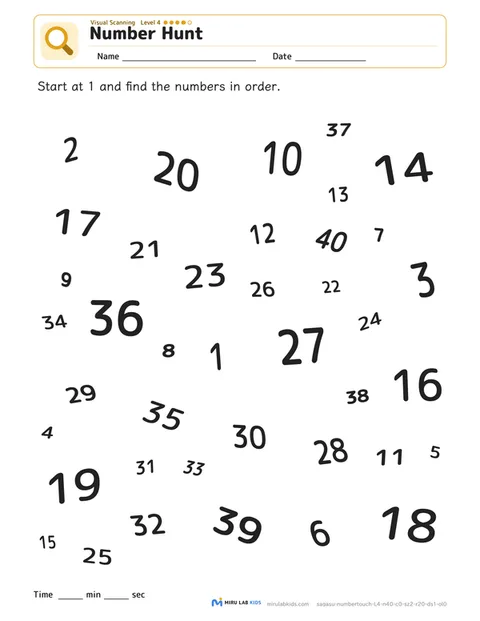
| Level 4 | 1 to 40. No circles, and number sizes vary a lot. Some numbers are slightly tilted, narrow, or bold. | 10 worksheets |
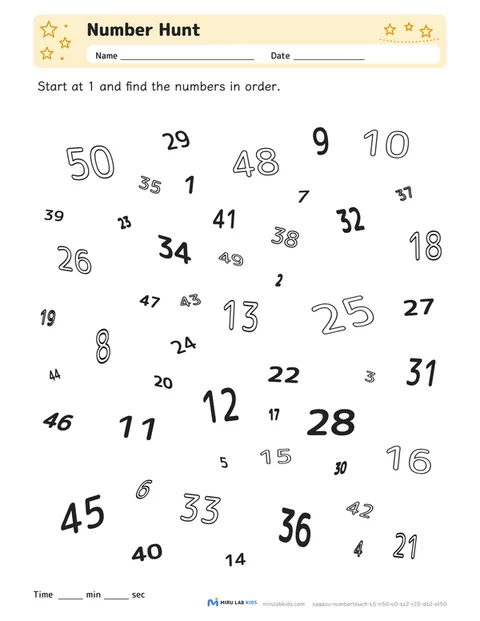
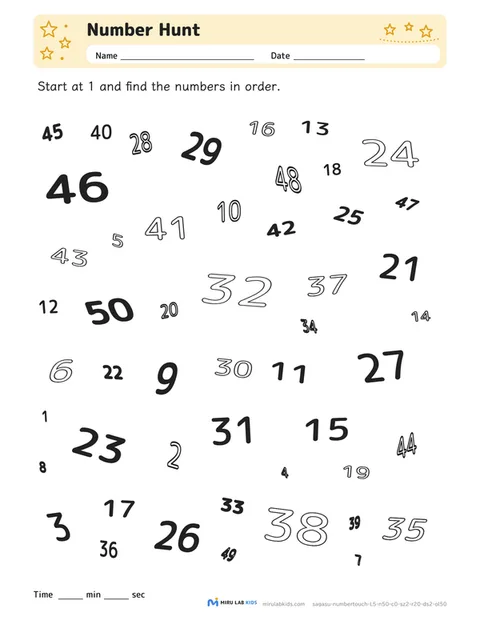
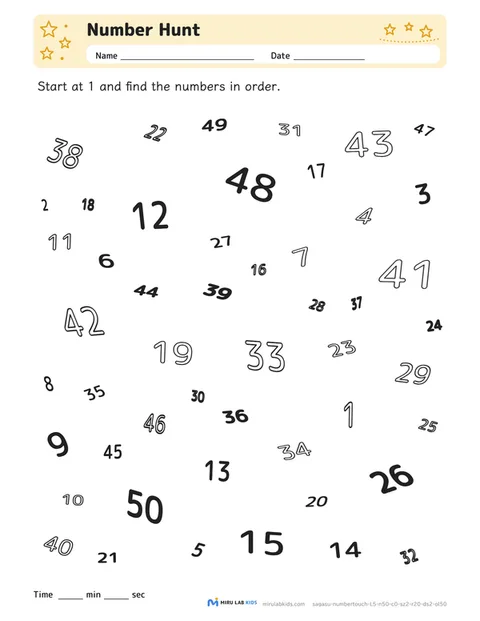
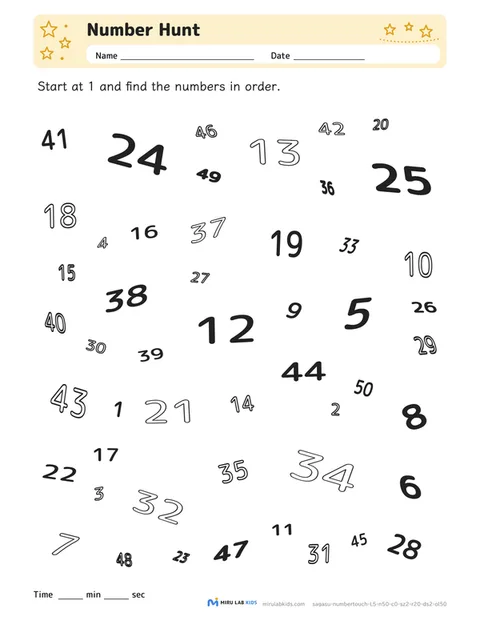
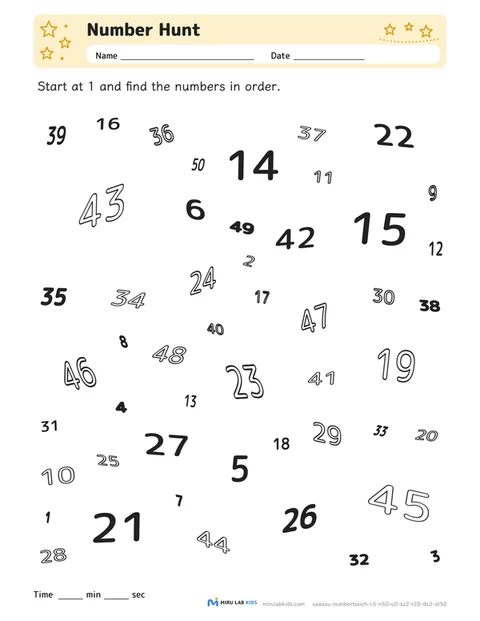
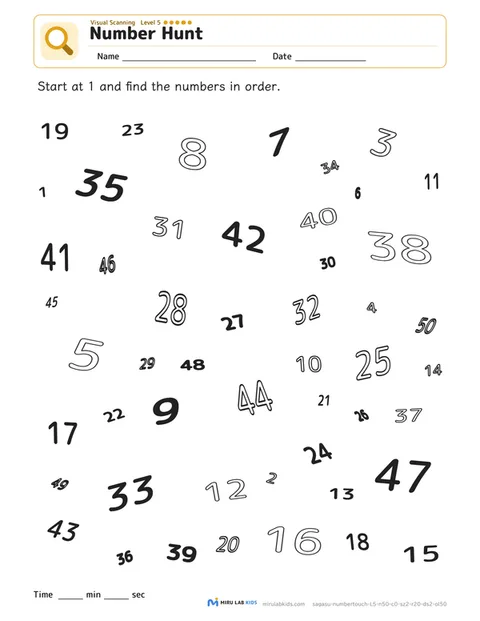
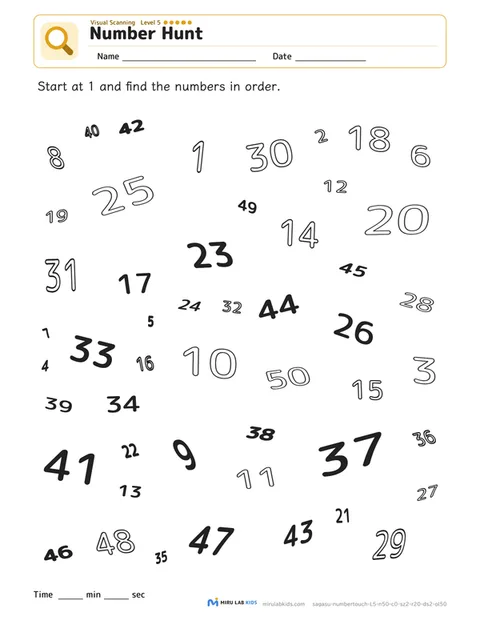
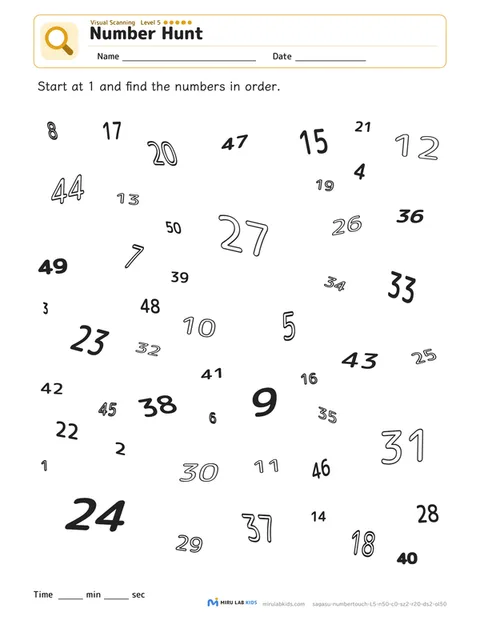
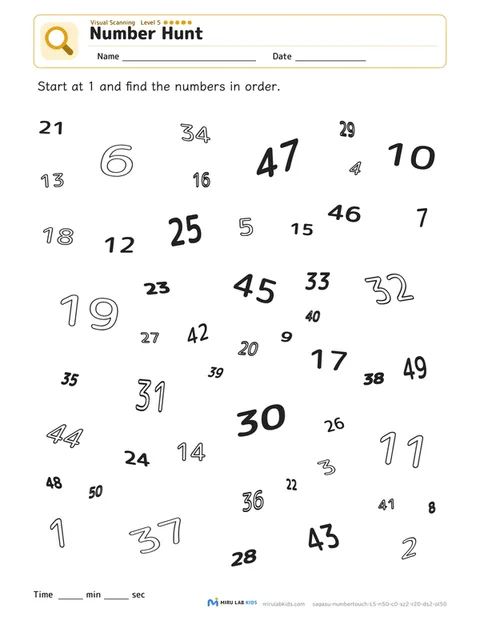
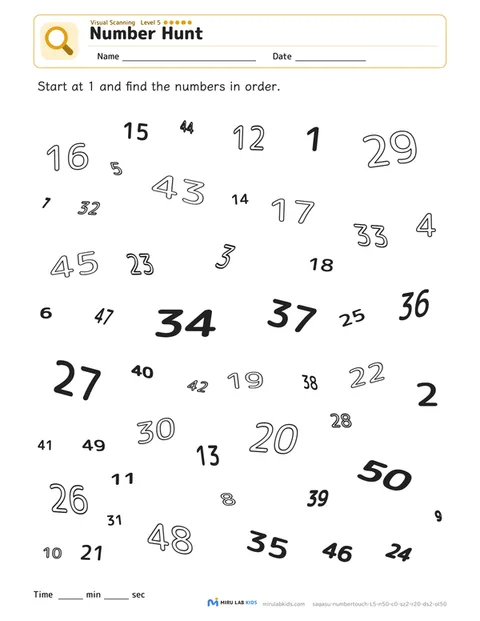
| Level 5 | 1 to 50. The numbers vary even more, and about half are outlined (hollow) numbers. | 10 worksheets |
Tips
- There are two ways to play. Touching each number with a finger lets your child use the same sheet many times. Drawing a slash through each number with a pencil also works.
For what to say, choosing a level and what to do if it is too hard, see Number Hunt: a guide for grown-ups.
Worksheets
Choose a worksheet to open its printing page.
Print in bulk
Level 11 to 10. Every number is in a circle, and all are the same size.
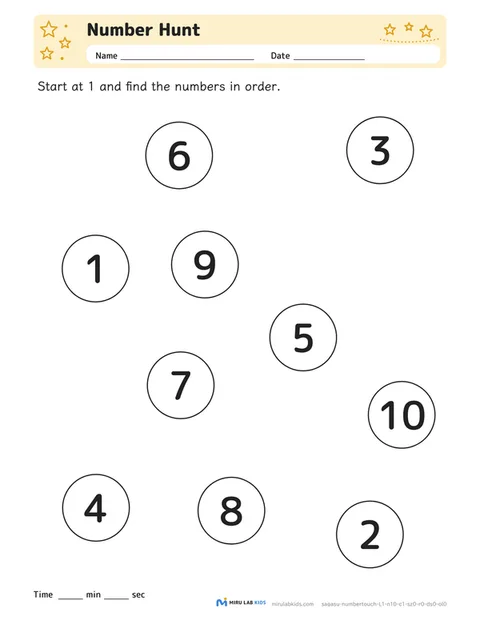
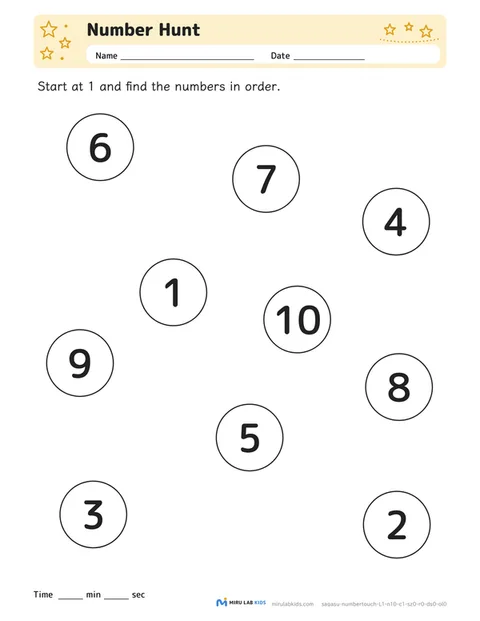
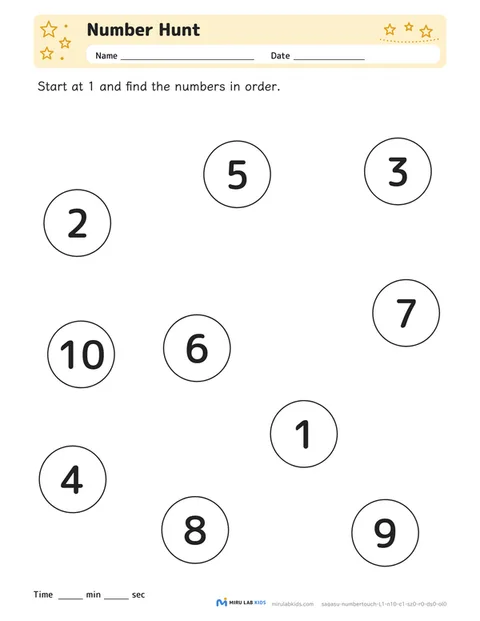
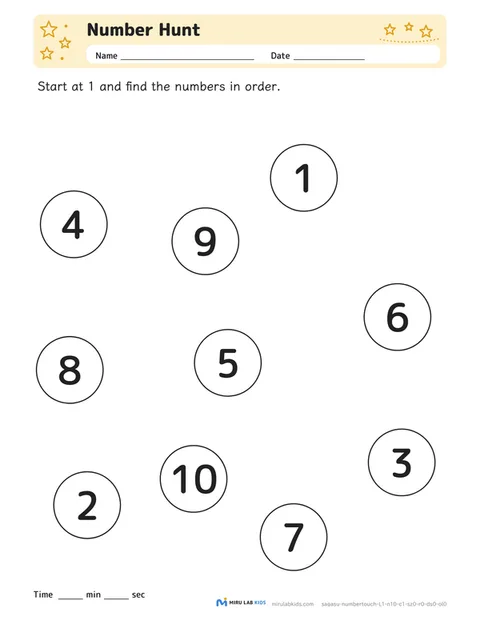
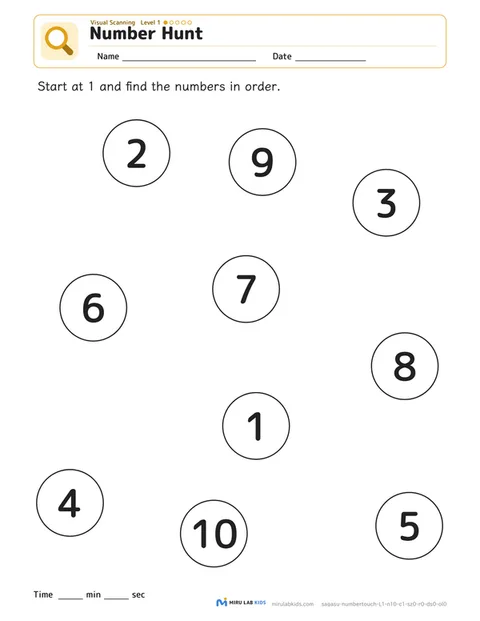
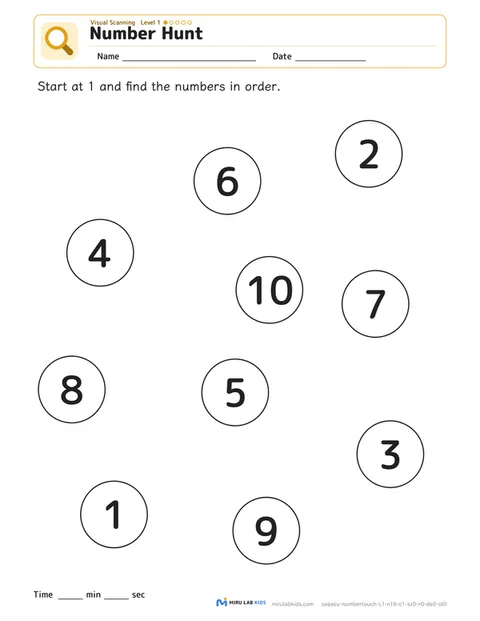
Level 21 to 20. Every number is in a circle, and all are the same size.
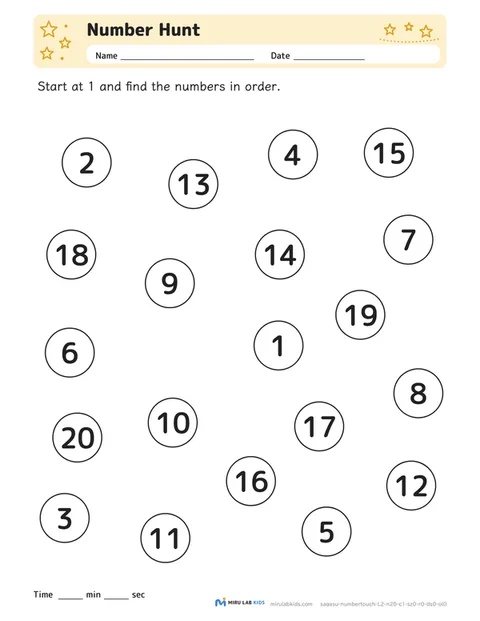
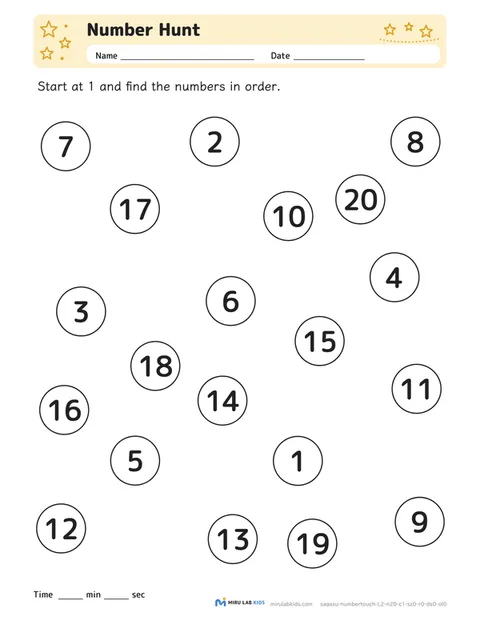
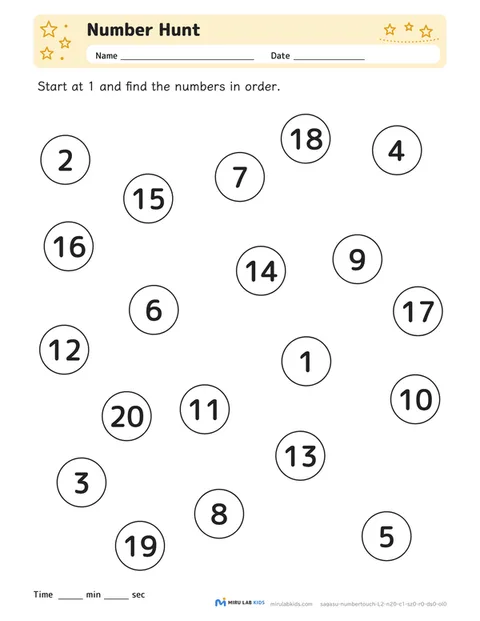
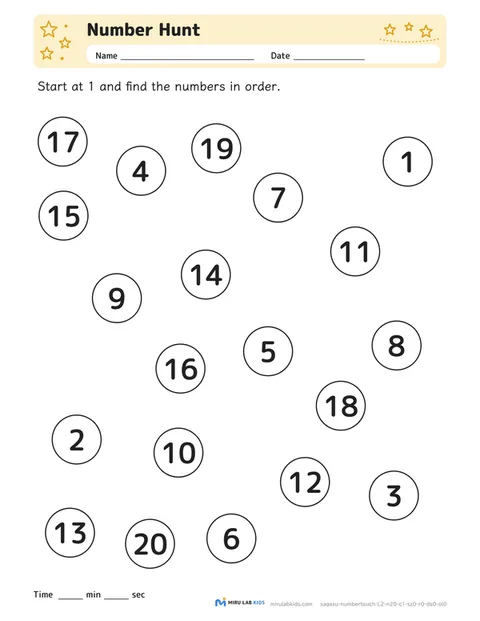
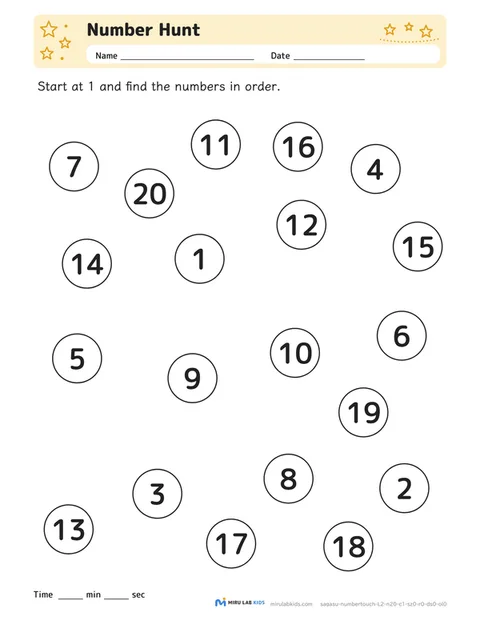
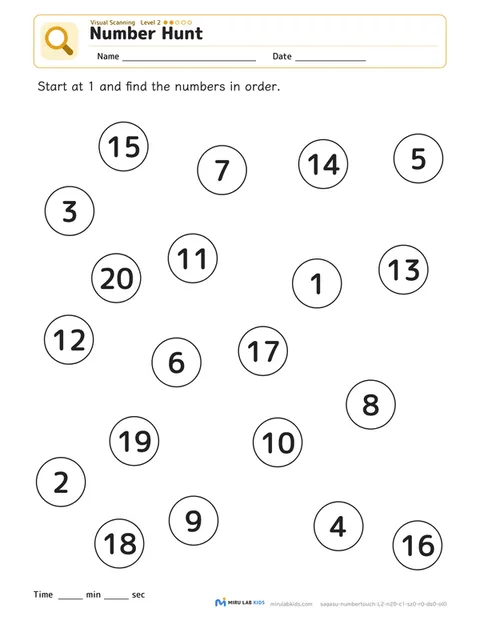
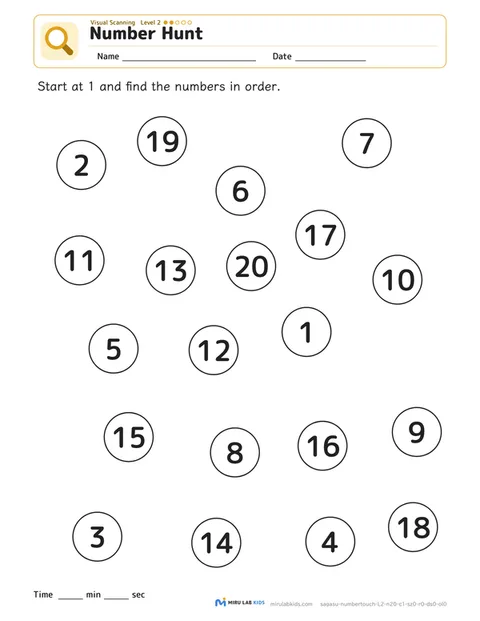
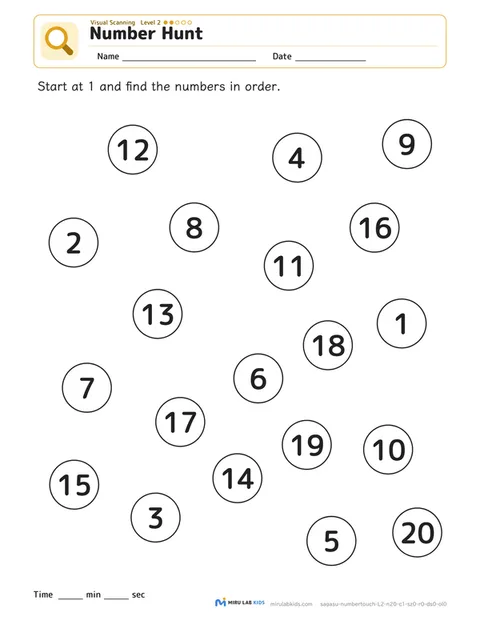
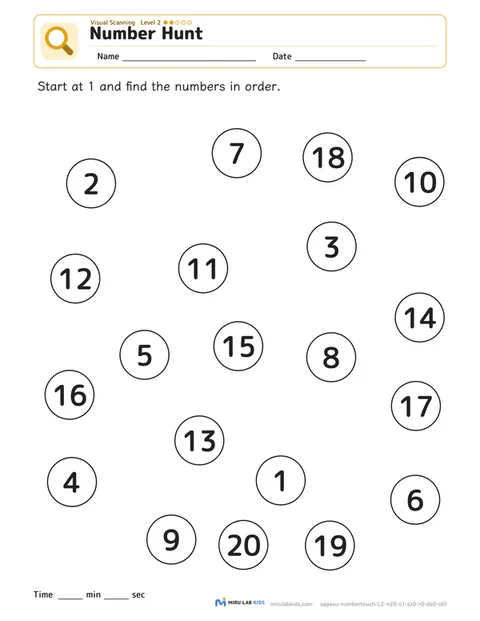
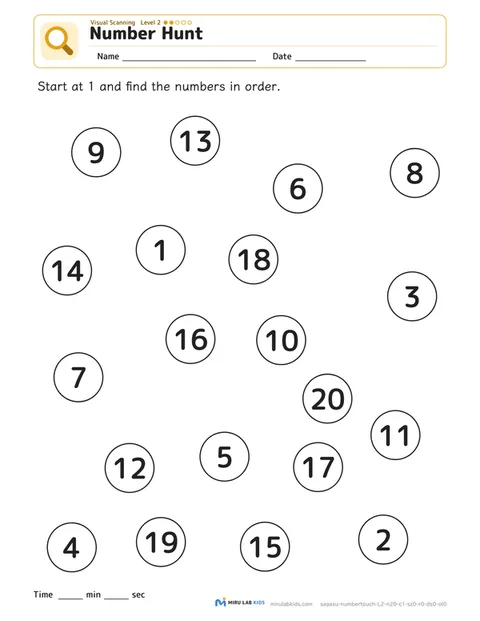
Level 31 to 30. The circles come in different sizes.
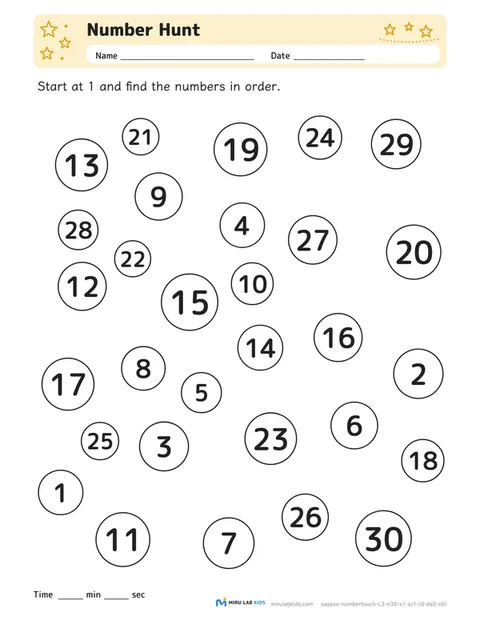
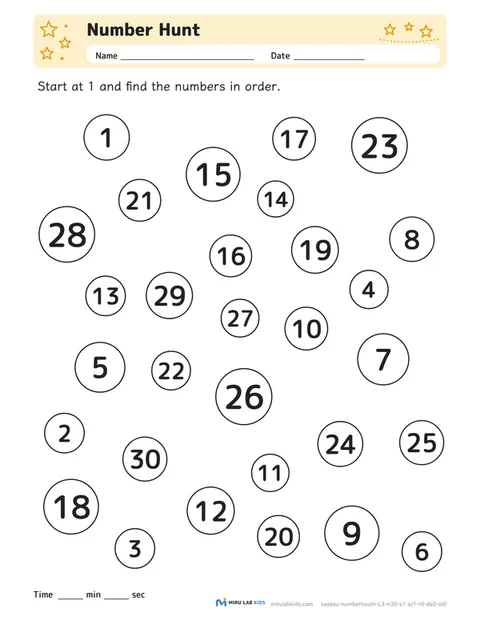
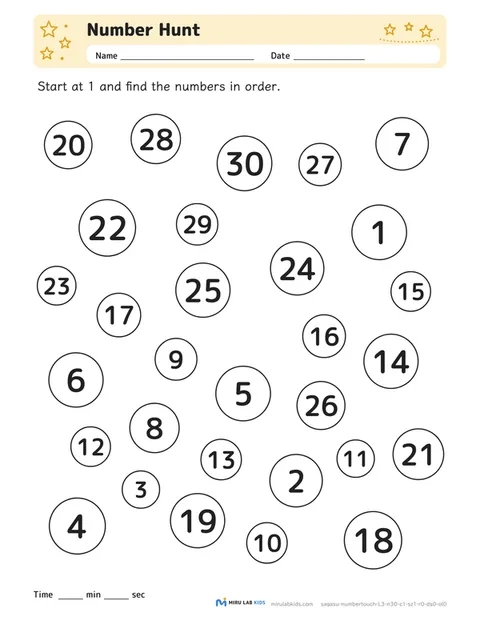
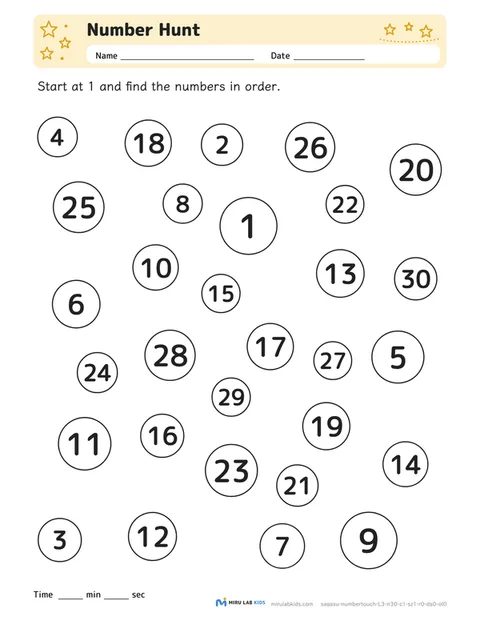
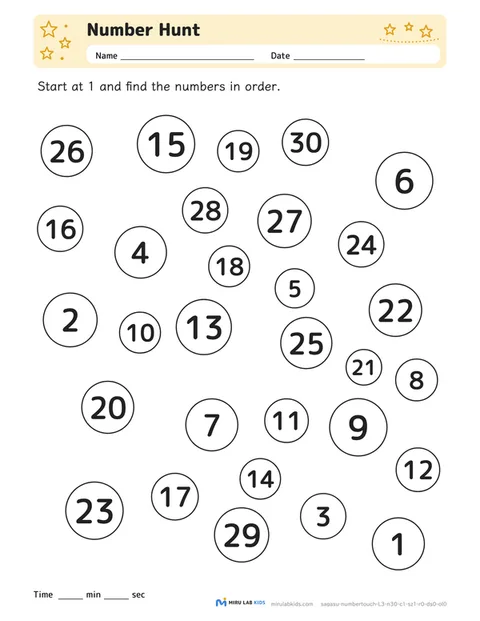
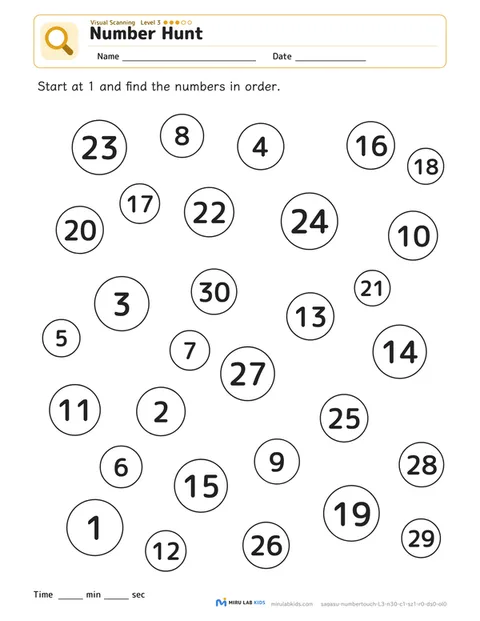
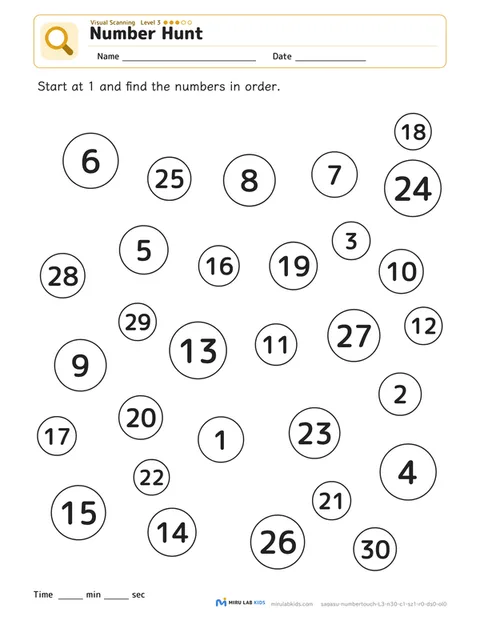
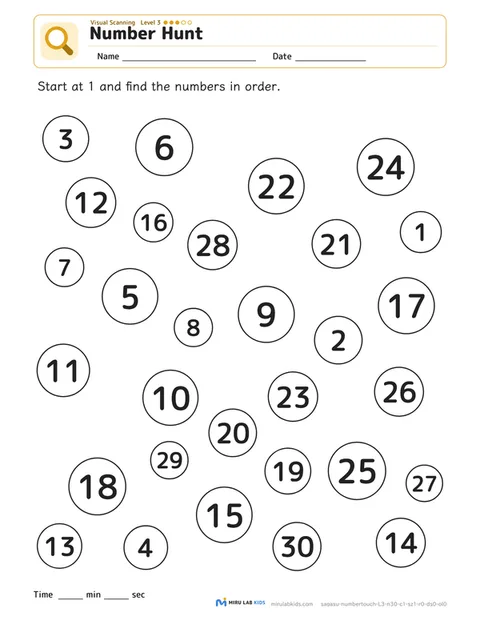
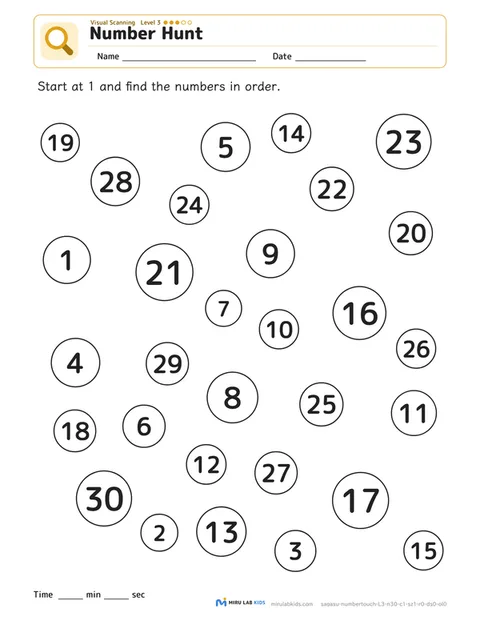
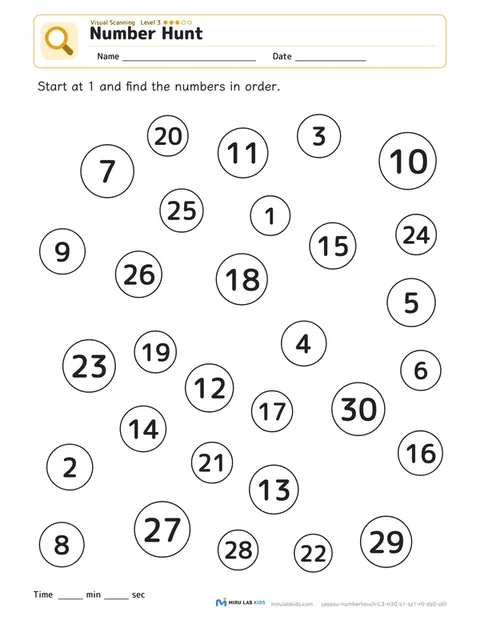
Level 41 to 40. No circles, and number sizes vary a lot. Some numbers are slightly tilted, narrow, or bold.
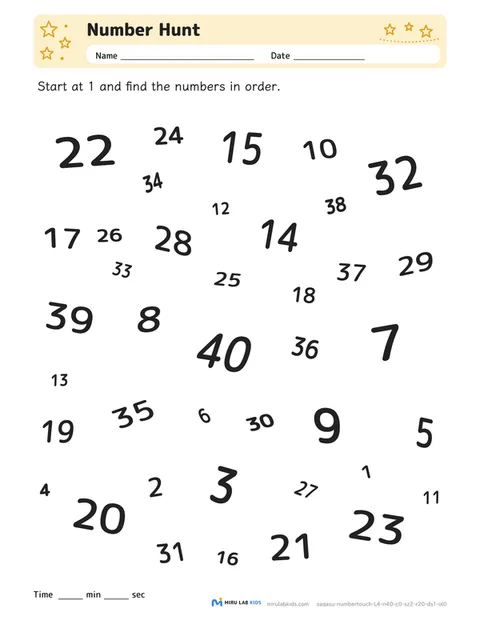
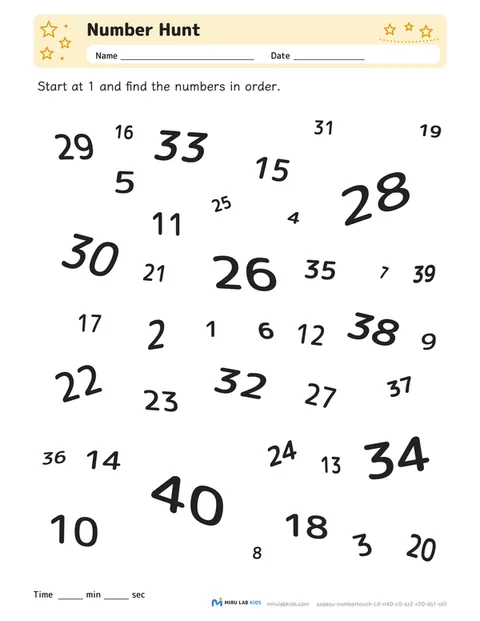
Level 51 to 50. The numbers vary even more, and about half are outlined (hollow) numbers.
Number Hunt: a guide for grown-ups
Who it is for
- ReadingFor children who skip lines or reread the same spot, as one way to practice moving the eyes.
- Finding things by lookingFor children who have trouble finding things, or who are slow to copy from the board.
- Short attention spanThe end is clear, and one page is quick to finish.
- Beating their own timeFor children who like timing themselves and getting a little faster.
- Therapy and classroom sessionsAll you need is one sheet of paper.
- Still learning numbersIf your child can count from 1 in order, they can start.
Choosing a level
Finished happily without getting stuck
- Go up one level.
- Record the time and see whether your child can finish a little faster than last time.
- Switch from slashes to touching, so found numbers are not marked.
Gets stuck often or cannot reach the end
- Go down one level.
- Choose a stopping point, such as "up to 15."
- Switch from touching to drawing slashes, so found numbers are marked and the search area shrinks.
What to watch for
| Search | Does your child look from the top down in order, or do the eyes jump all over the page? |
|---|---|
| Head and body | Can your child search with the eyes alone, or does the whole head move a lot? |
| Missed areas | Does your child always miss the same area, such as the left or right edge or the bottom of the page? |
| Look-alikes | Does your child hesitate at numbers that look alike, such as 6 and 9 or 1 and 7? |
| Posture | Is the face very close to the page? Is the body leaning a lot? |
| Time | Writing the time at the bottom of the page each time makes small changes easier to notice. When reusing a sheet, add new times in the margin. Copying it onto the Time Log lets you line up results at the same level. |
If something keeps worrying you, it can help to talk with an eye doctor or another specialist rather than deciding on your own.
Things you can say
- Before startingWhere is 1?Finding the first number together shows how the activity works.
- When stuckMaybe it's near the top.Give only a general area. Do not point to the number itself.
- On finding oneYou found it!Keep it short and share the moment of finding it.
- When finishedYou found them all!Before talking about time, praise your child for finishing.
- Next timeYou didn't get stuck on 8 today!Compare with your child's own last try.
FAQ
Why is there no answer page?
Your child finds the numbers in order, so the order itself is the answer.
Can I print in black and white?
Yes. The sheets use no color, so black and white printing does not change the difficulty.
Can my child do this before reading all the numbers?
Yes. Counting "1, 2, ..." out loud together while searching makes it easier to start.
Can we reuse the same sheet?
Yes. But with repetition, children may start to remember where the numbers are. When that happens, switch to another sheet at the same level.
How much should we do at a time?
There is no set amount. One or two sheets at a time is a good guide, and it is best to stop while your child still wants a little more. See "Every Day? How Much?" for more.
How long does it take?
It varies a lot by child and by level. Use the time to compare with your child's own past tries, not with other children.
Articles
- What Is Visual Perception? More Than Good Eyesight
- Why Does My Child Put Clothes On Backwards or Inside Out? Getting Dressed Uses More Visual Skills Than You Think
- When a Child Has Trouble Catching a Ball: Breaking It Down from "Tracking" to "Reaching"
- When a Child's Tracing Slips onto Another Shape: Understanding Figure-Ground Perception
About the code at the bottom right
The code at the bottom right of each worksheet (for example, sagasu-numbertouch-L1-n10-c1-sz0-r0-ds0-ol0) shows its difficulty settings. Worksheets with the same code have the same difficulty. If you contact us about a worksheet, including this code helps us find it right away.
 Shape Recognition
 Spatial Relations
 Visual Memory
 Visual-Motor Skills
 Visual Planning