How Many Blocks?Free printable worksheets
Turn the blocks in 3D
Tap a problem on any worksheet to turn its blocks in 3D. Lift the layers apart to see the hidden blocks.
Try it ›Aims
- Picturing a 3D shape with depth from a flat drawing (spatial reasoning)
- Counting hidden blocks by thinking "this block must be holding up the one on top"
- Counting layer by layer or row by row to avoid missing or double-counting blocks
- Understanding front and back, top and bottom (spatial relations)
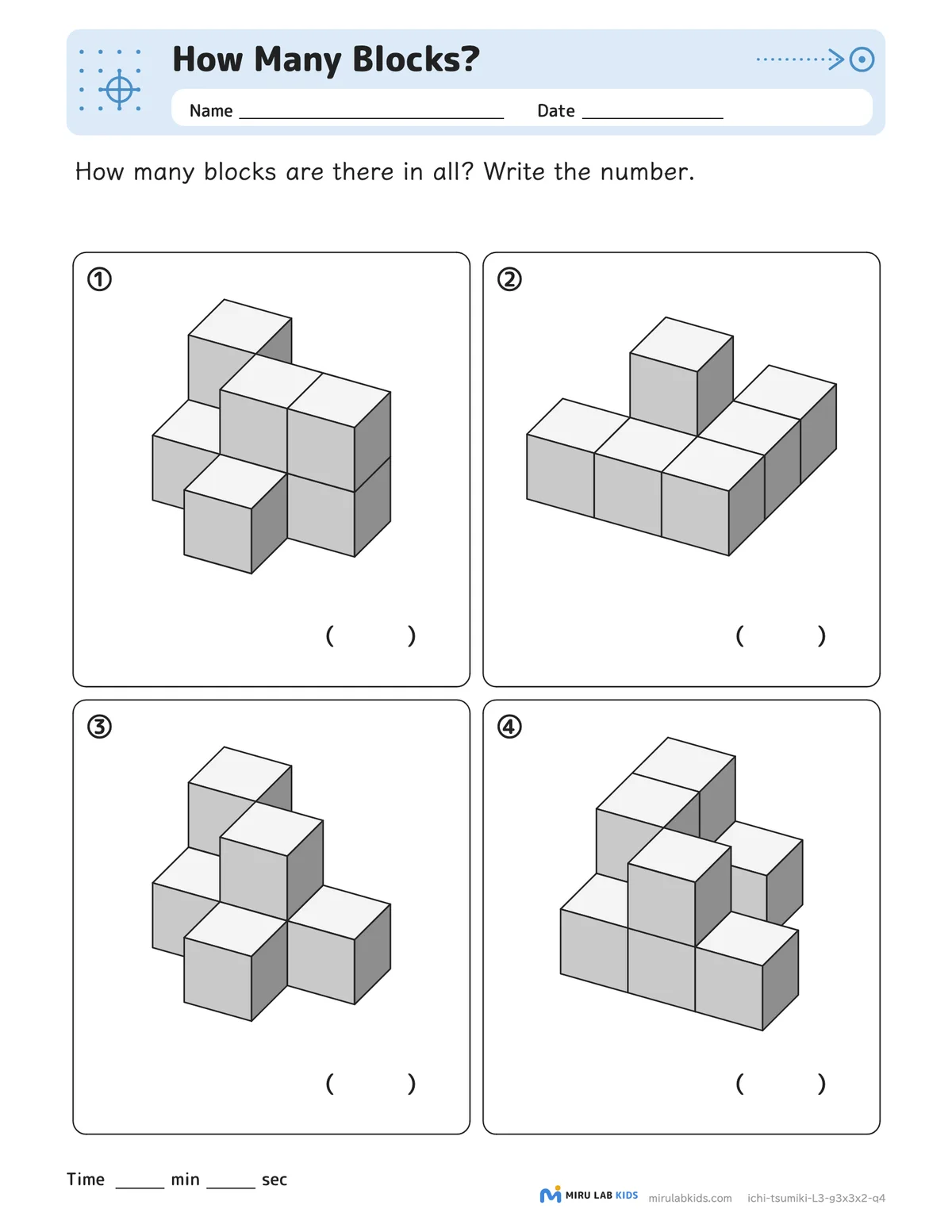
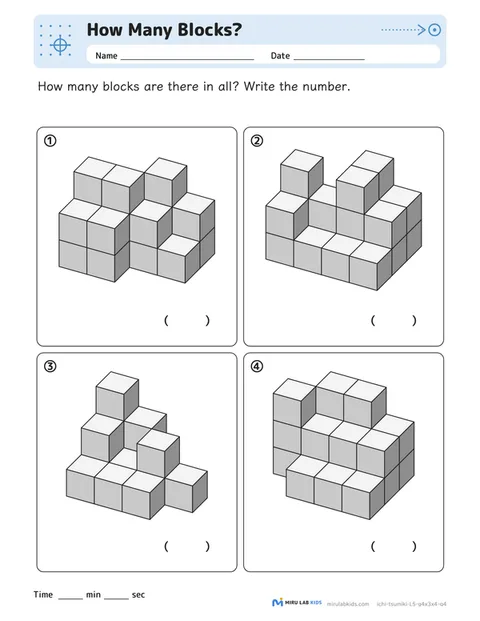
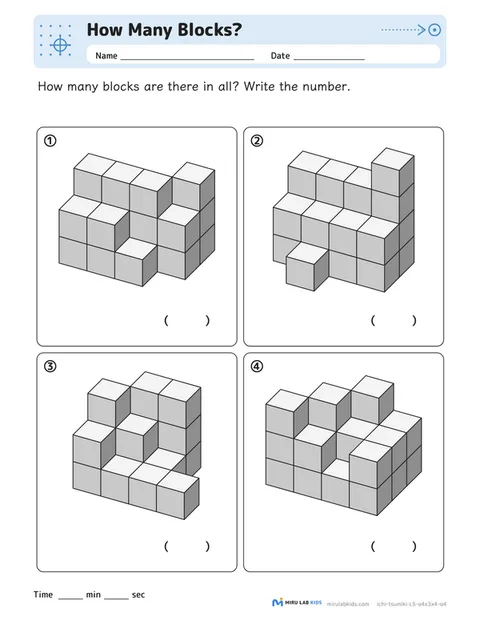
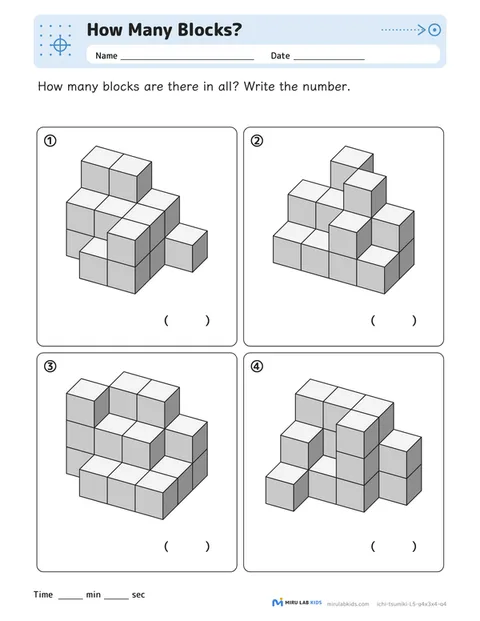
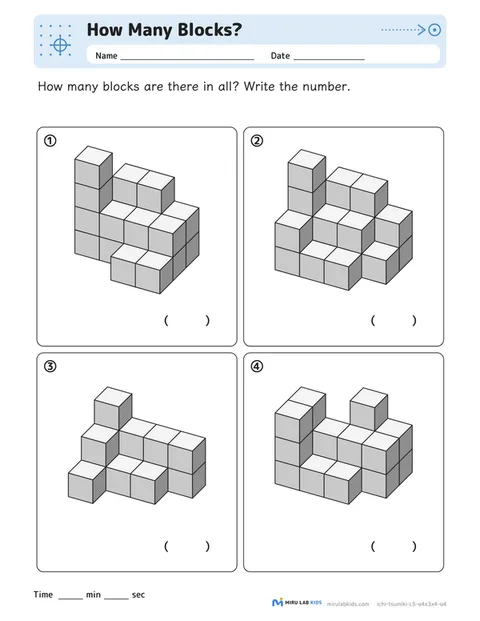
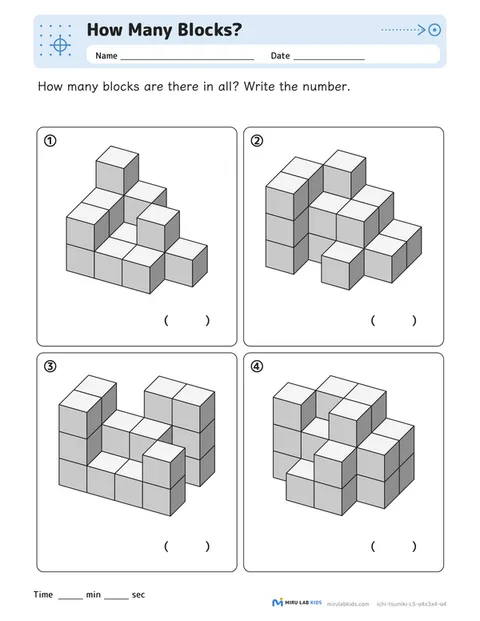
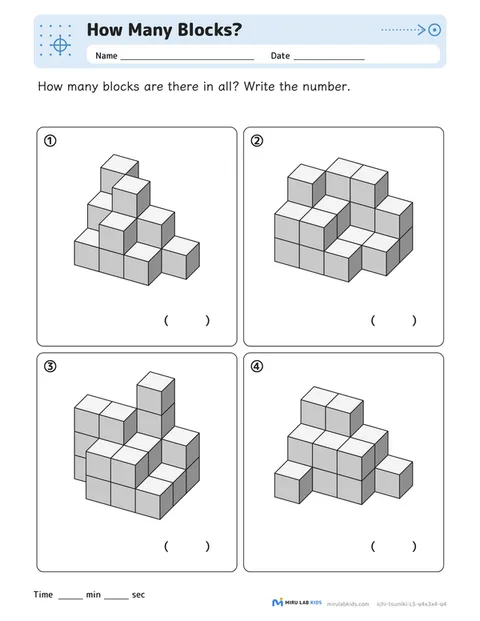
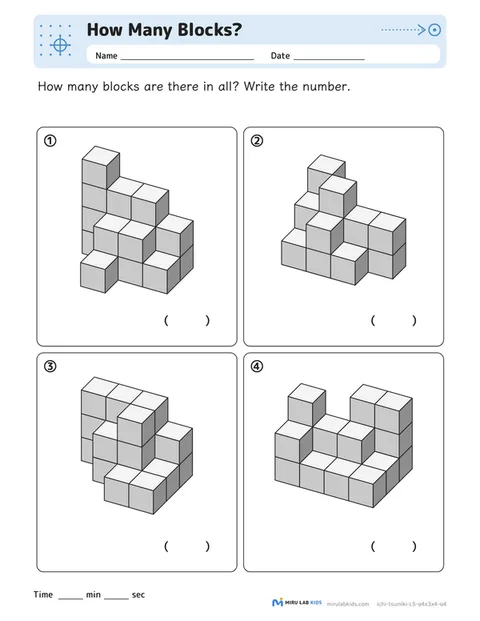
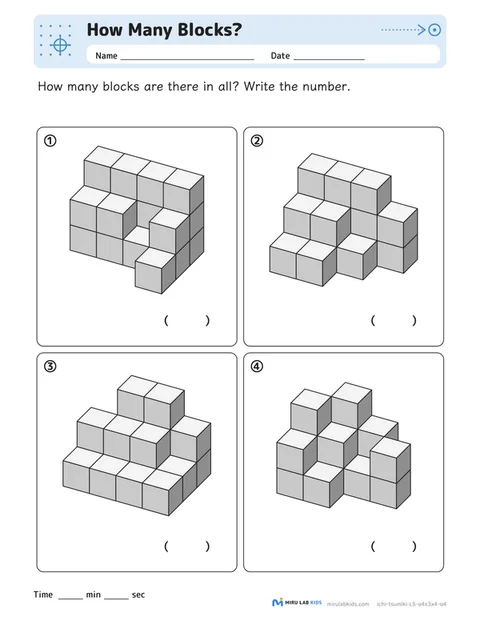
Your child looks at a drawing of stacked blocks seen from above at an angle, counts how many blocks there are in all, and writes the number in the parentheses.Blocks never float, so if a block is visible on top, there are blocks underneath it too.At higher levels the stacks get taller, and more blocks are hidden behind or under the blocks in front.Instead of counting the faces they can see, your child pictures the parts they cannot see and counts blocks.The activity aims to build the ability to understand 3D shapes.
The questions print fine in black and white. The answer page colors each layer differently, so color printing is recommended for it.
 Level 3 example ›
Levels
| Level 1 | One layer only. 5 to 7 blocks, all visible. 6 questions per page. | 10 worksheets |
|---|---|---|
| Level 2 | Up to 2 layers. 5 to 7 blocks, all visible. 6 questions per page. | 10 worksheets |
| Level 3 | Up to 2 layers. 6 to 9 blocks, with 1 or 2 hidden. 4 questions per page. | 10 worksheets |
| Level 4 | Up to 3 layers. 8 to 12 blocks, with 3 or 4 hidden. 4 questions per page. | 10 worksheets |
| Level 5 | Up to 4 layers. 14 to 22 blocks, with 5 or more hidden. 4 questions per page. | 10 worksheets |
Tips
- Look at the drawing, count, and write the number in the parentheses. If it is hard, it is fine to build the same shape with real blocks.
For what to say, choosing a level and what to do if it is too hard, see How Many Blocks?: a guide for grown-ups.
Worksheets
Choose a worksheet to open its printing page.
Print in bulk
Level 1One layer only. 5 to 7 blocks, all visible. 6 questions per page.
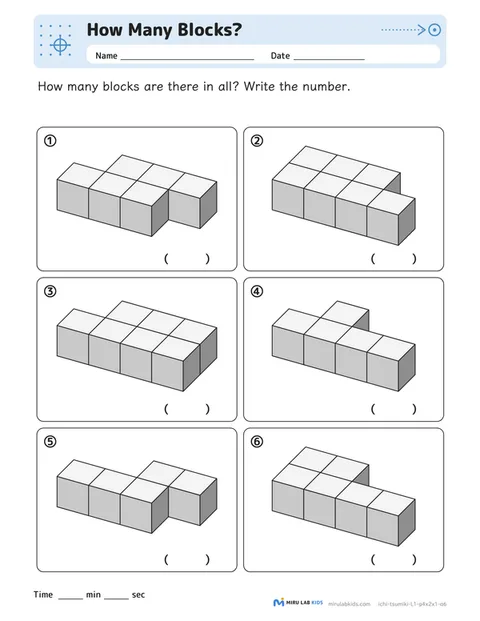
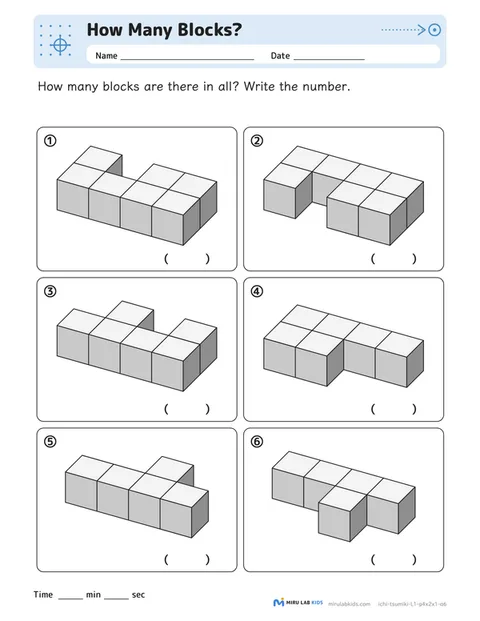
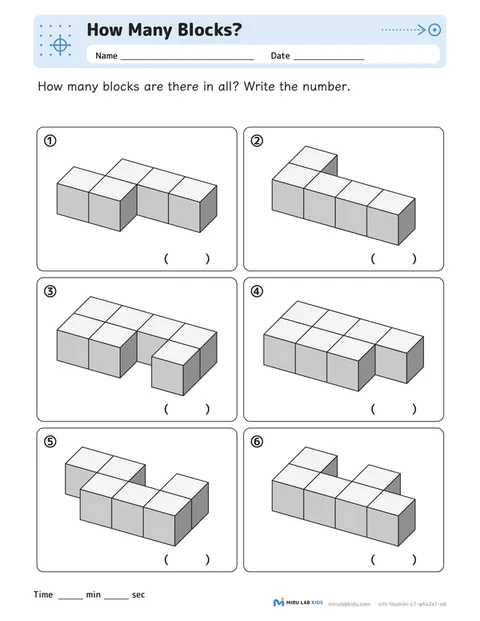
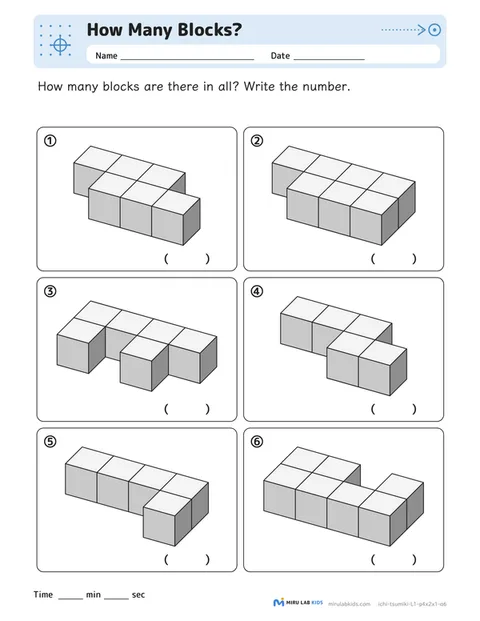
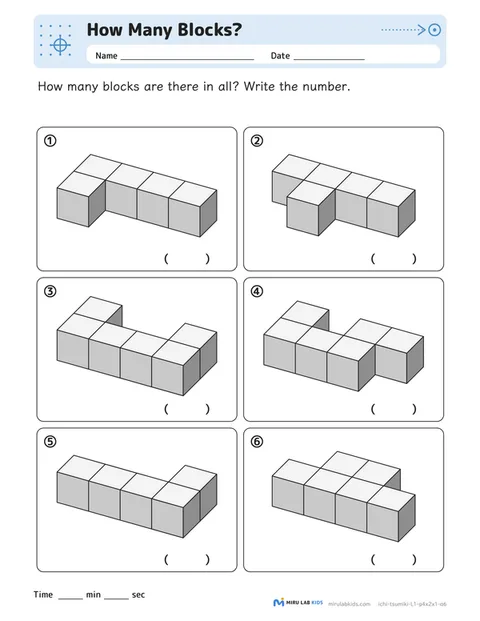
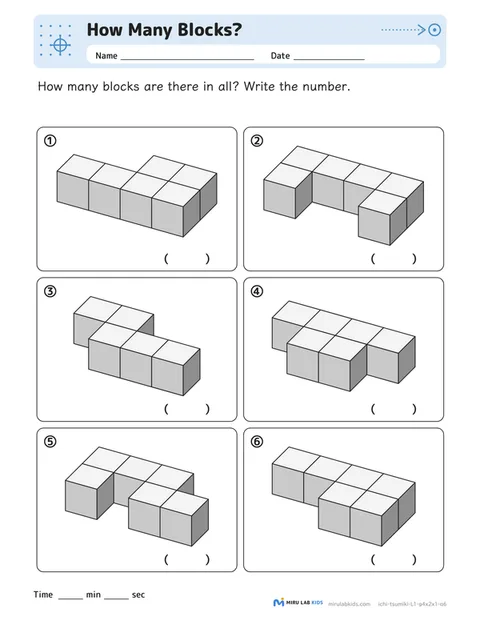
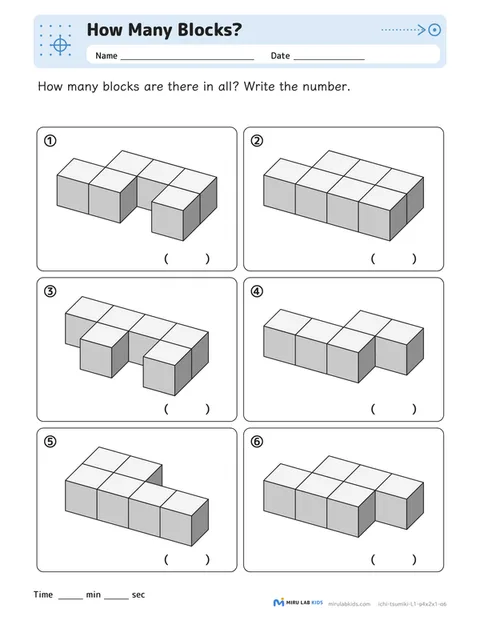
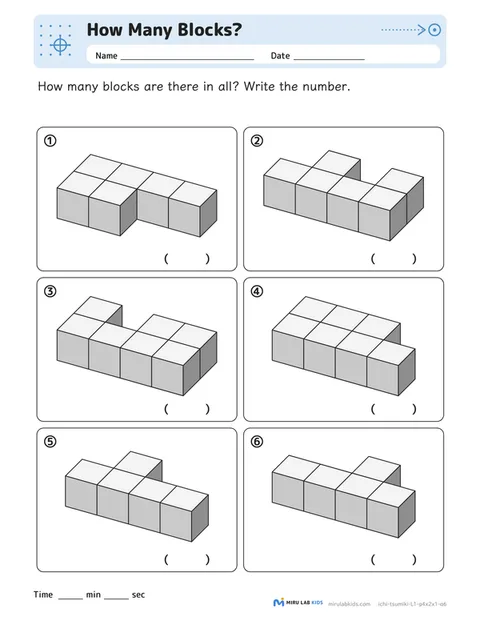
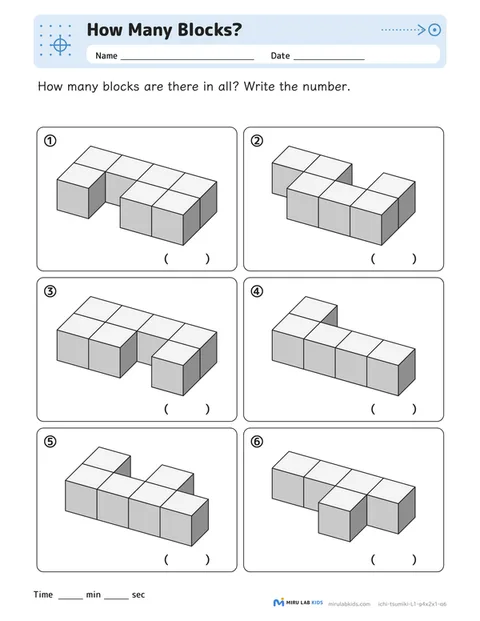
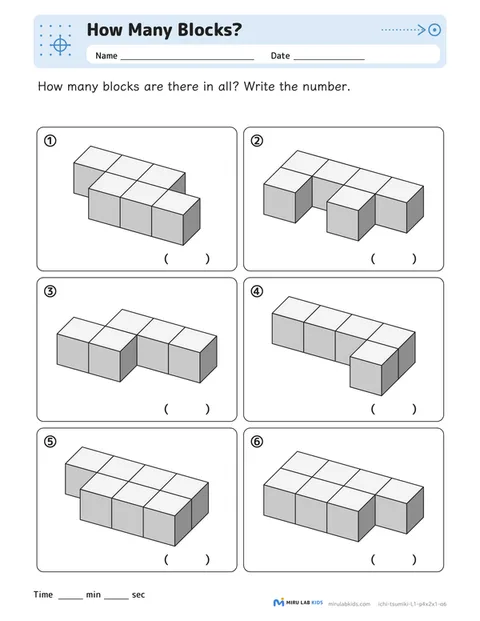
Level 2Up to 2 layers. 5 to 7 blocks, all visible. 6 questions per page.
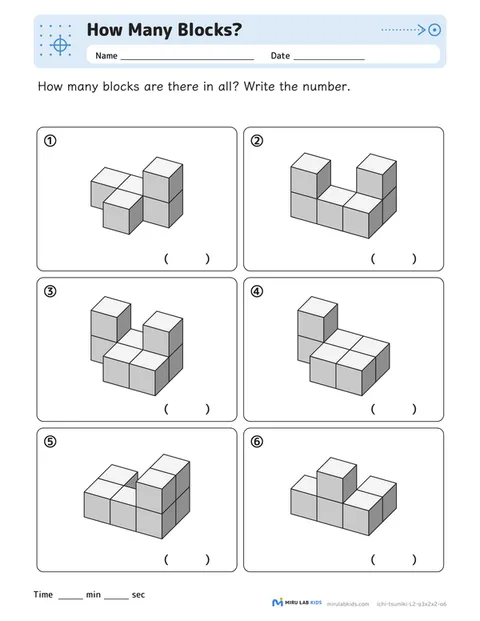
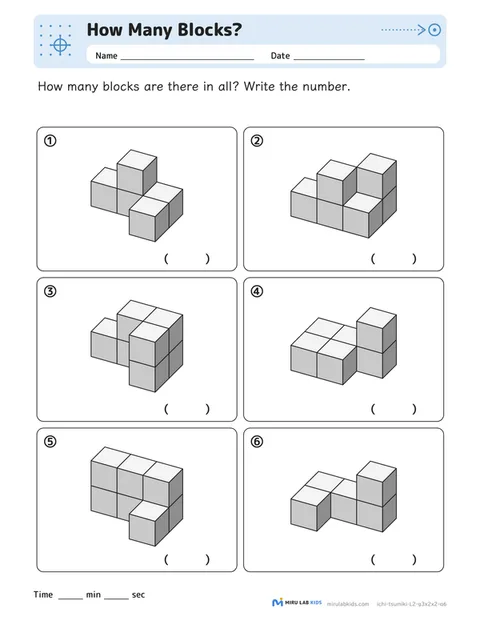
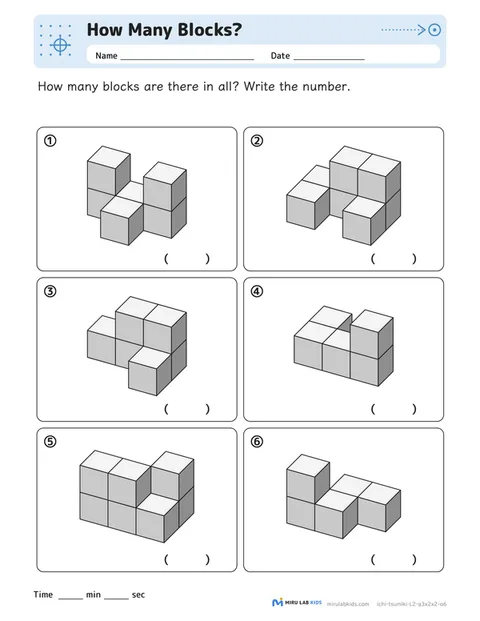
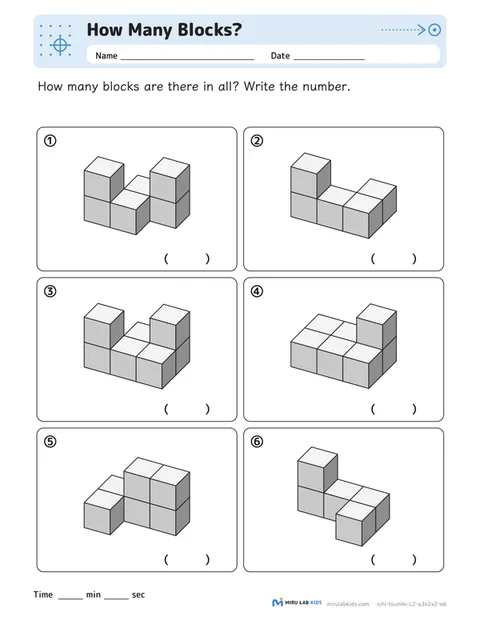
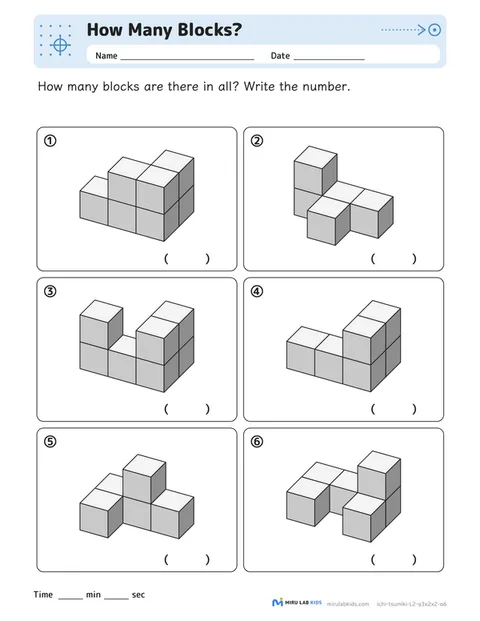
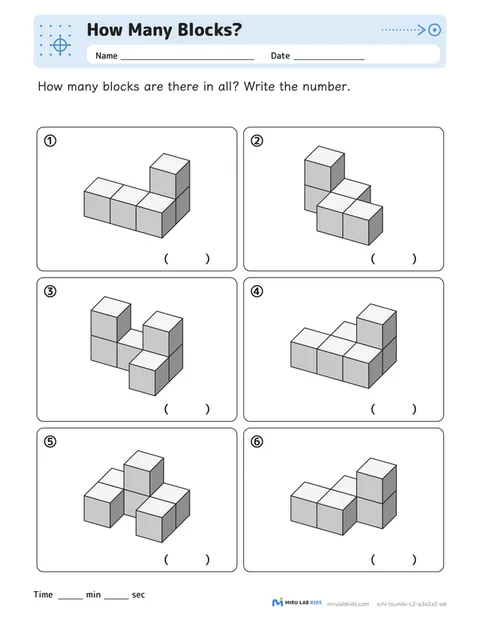
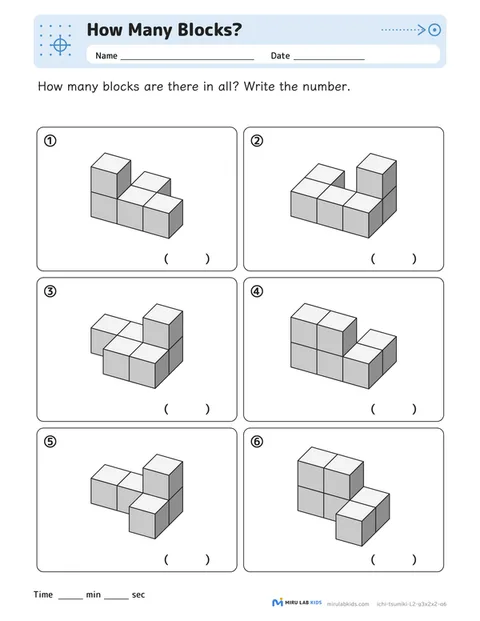
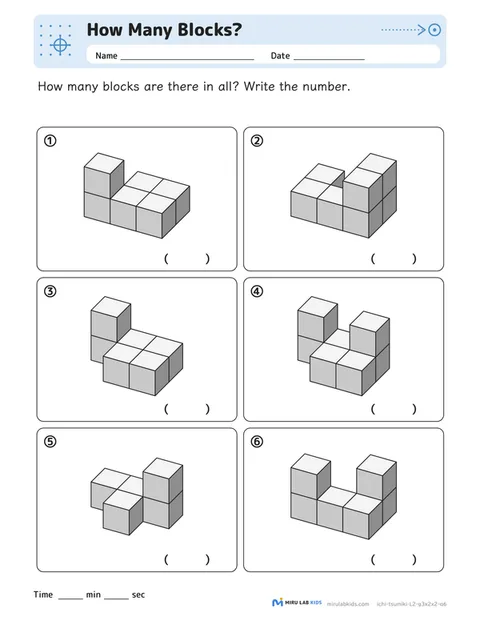
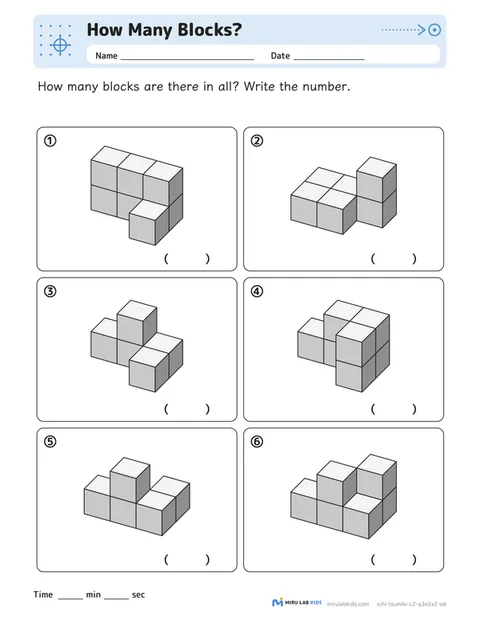
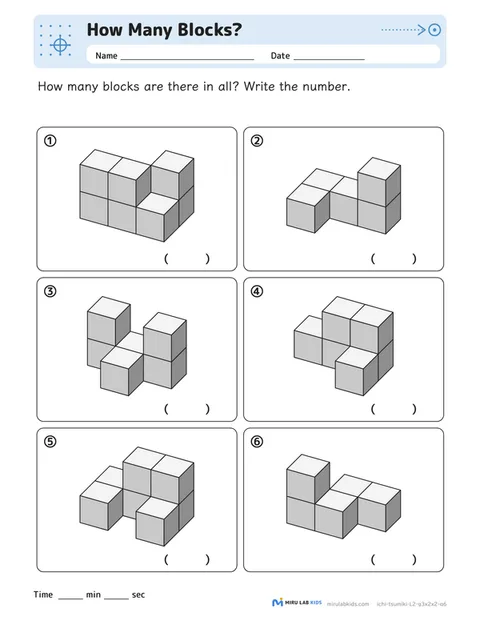
Level 3Up to 2 layers. 6 to 9 blocks, with 1 or 2 hidden. 4 questions per page.
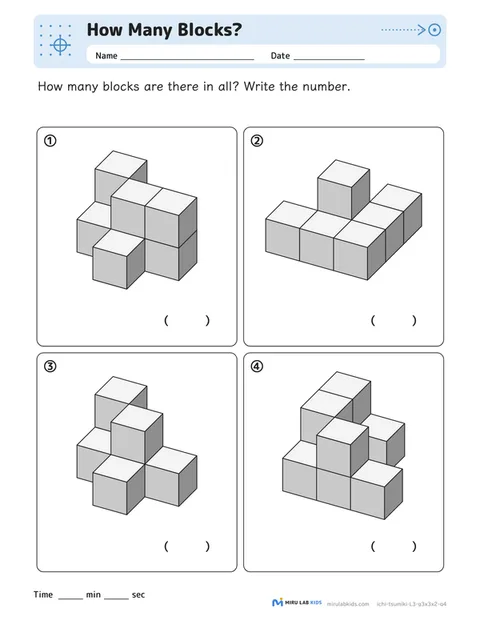
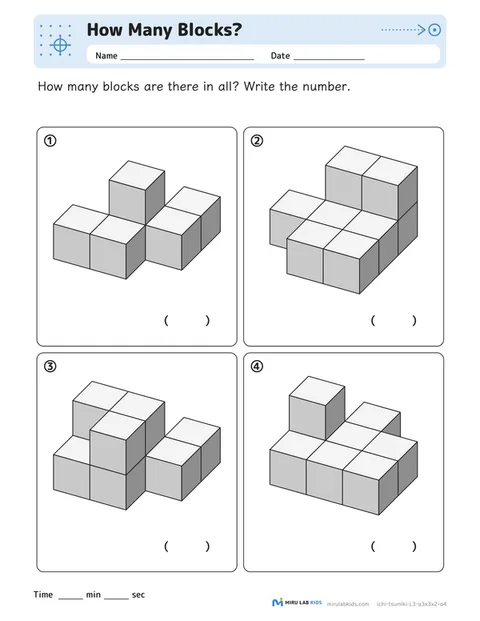
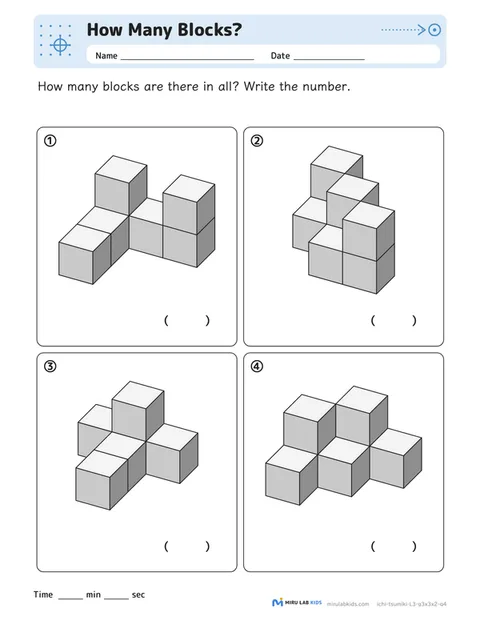
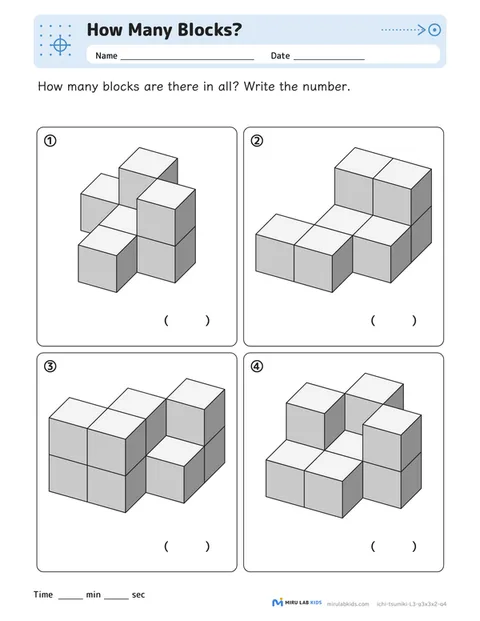
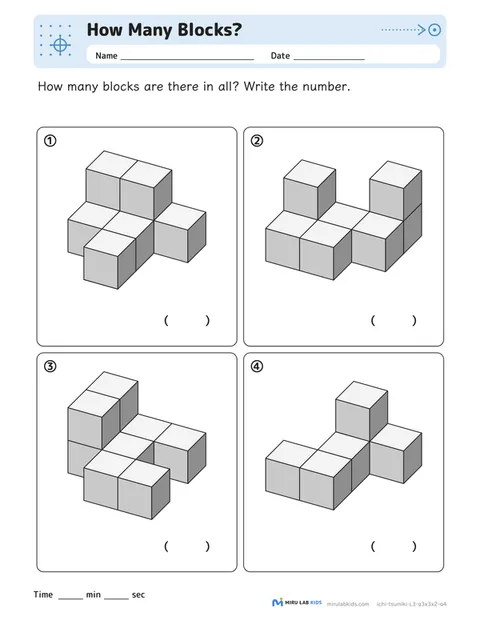
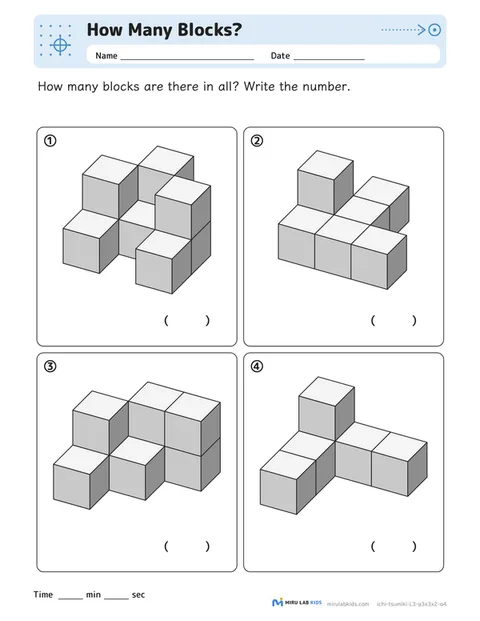
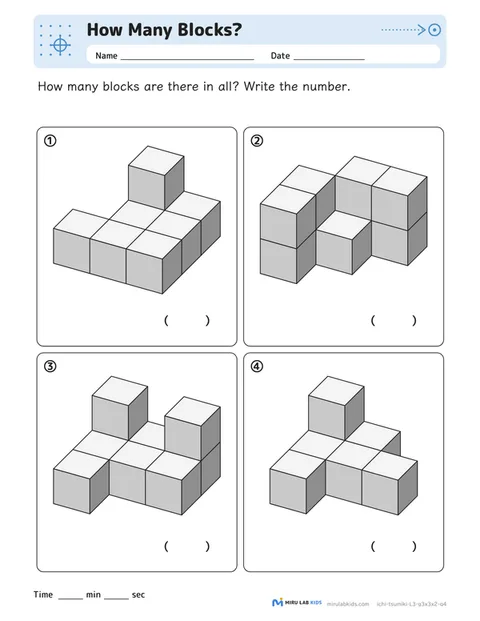
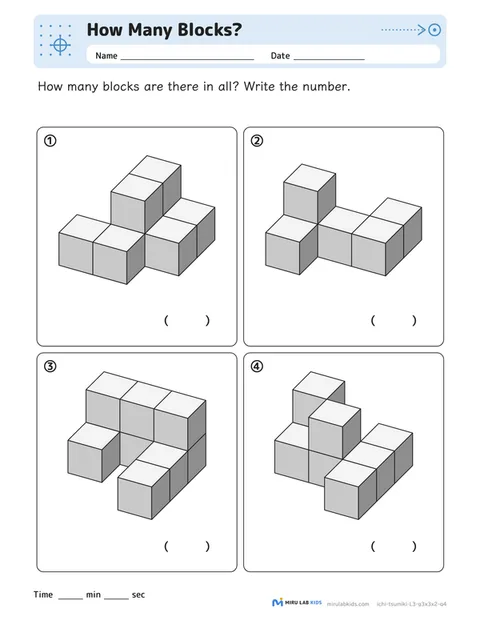
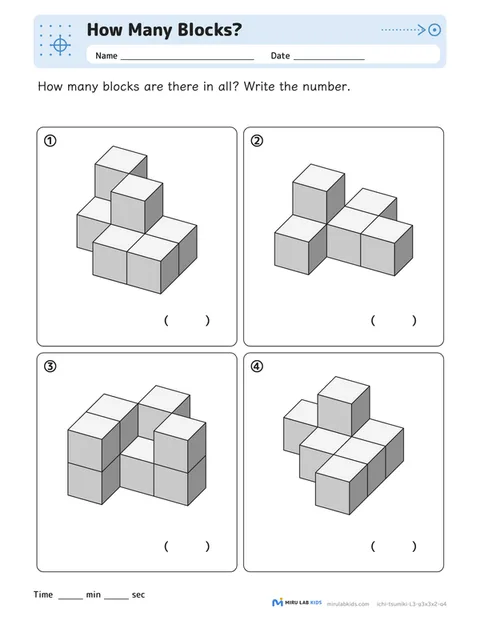
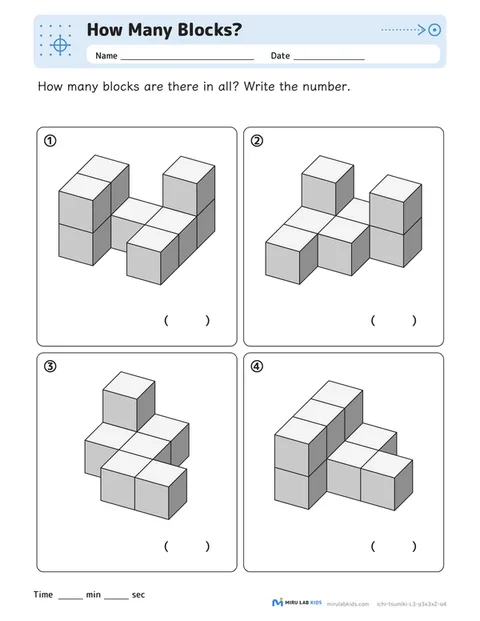
Level 4Up to 3 layers. 8 to 12 blocks, with 3 or 4 hidden. 4 questions per page.
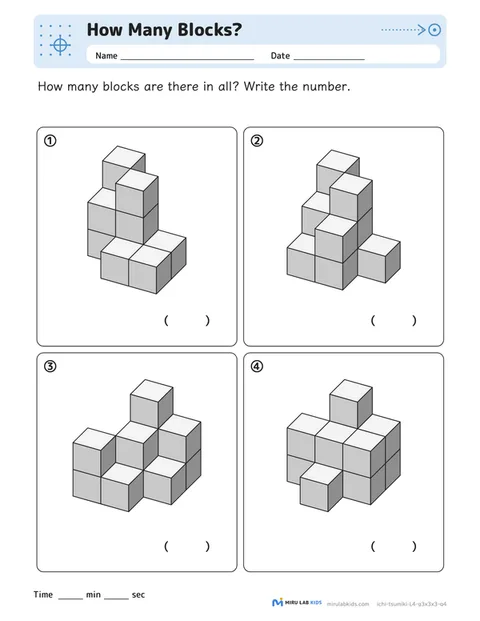
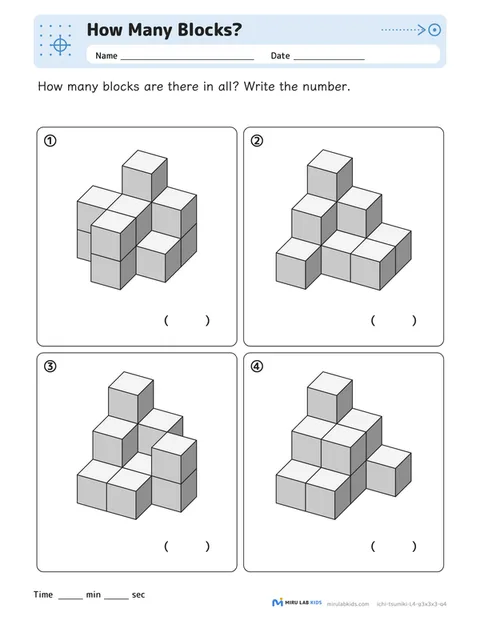
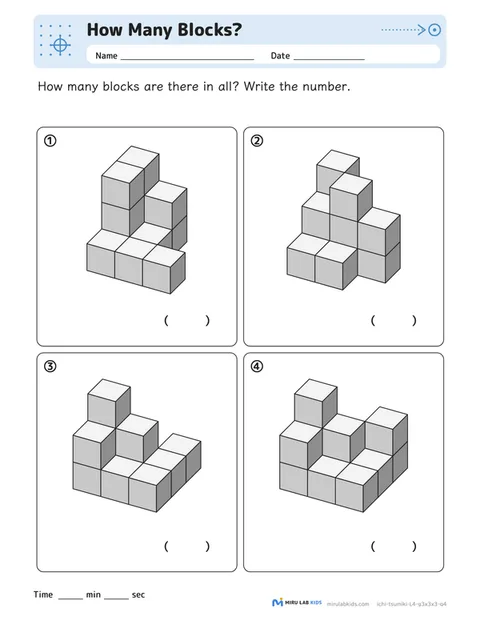
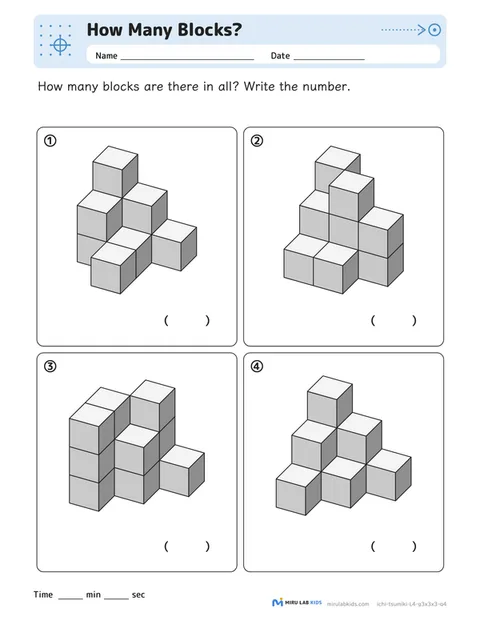
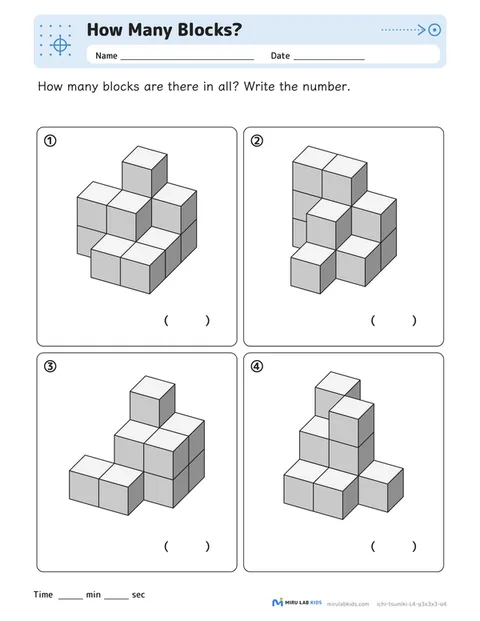
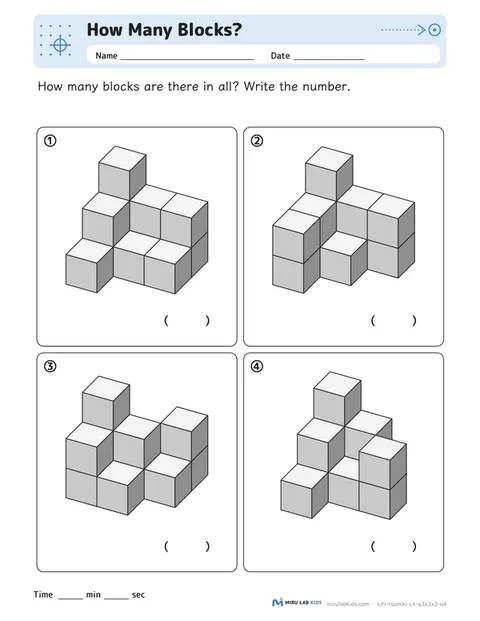
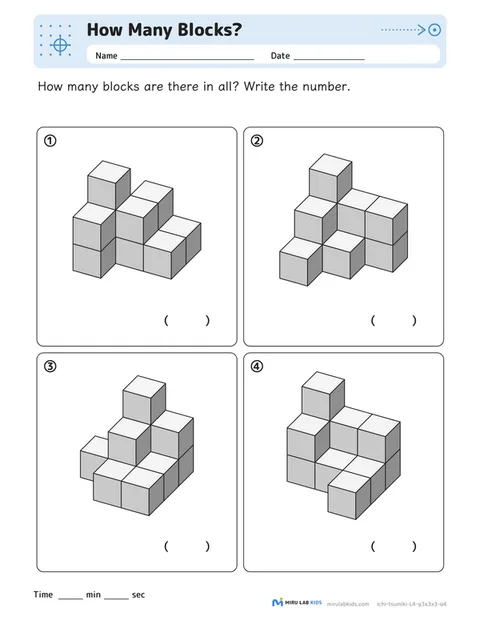
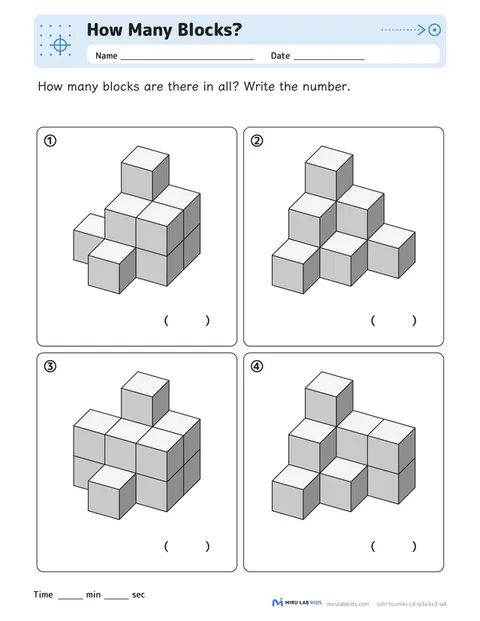
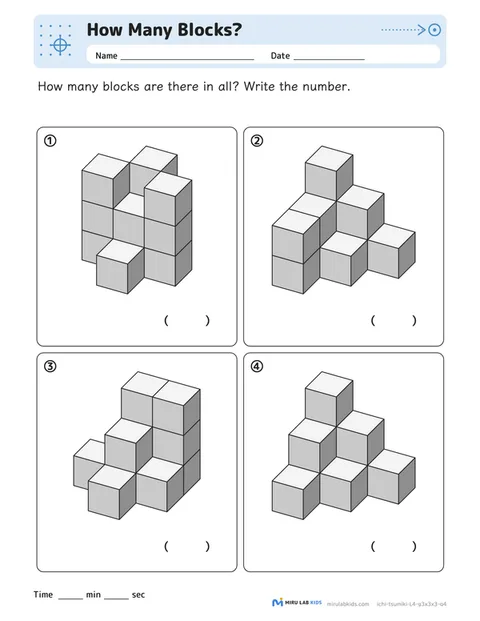
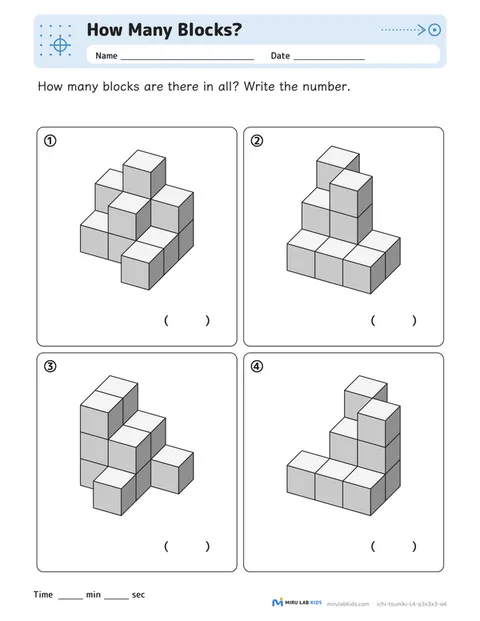
Level 5Up to 4 layers. 14 to 22 blocks, with 5 or more hidden. 4 questions per page.
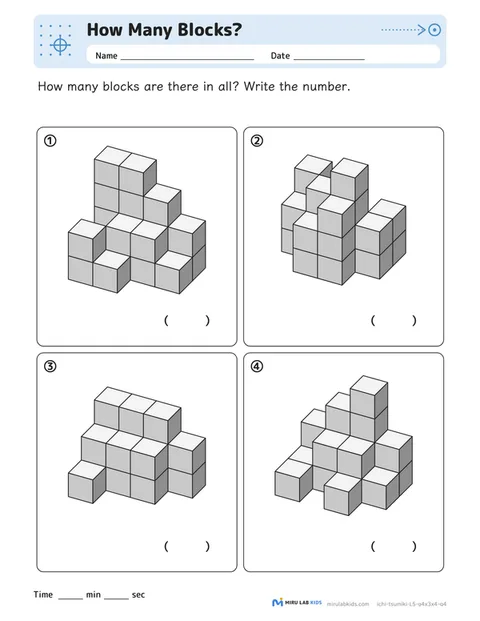
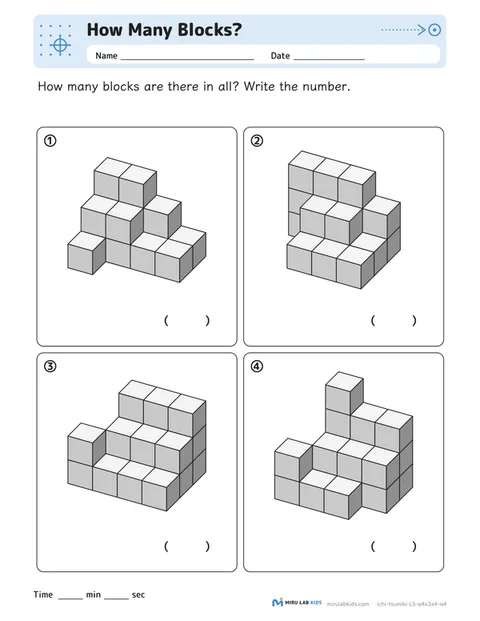
How Many Blocks?: a guide for grown-ups
Who it is for
- Finds shape problems hardPractice picturing a 3D shape from a drawing.
- Thinks only about what is visiblePractice thinking "there must be a block here."
- Often misses some when countingPractice counting layer by layer or row by row.
- Loves building blocksYour child can go back and forth between the page and real blocks.
Choosing a level
Counted on their own and matched the answer
- Go up one level.
- Count with the eyes only, without pointing.
- Ask your child to point to where the hidden blocks are and explain.
Counts visible faces, or does not count the hidden blocks
- Go down one level.
- Build the same shape with real blocks, count them, then go back to the page.
- Count one layer at a time: layer 1, layer 2, and so on.
What to watch for
| How they count | Does your child count blocks one by one at random? Or layer by layer, row by row? |
|---|---|
| Mistakes | Research describes common mistakes when counting blocks, such as counting the visible faces, leaving out hidden blocks, or counting the same block twice (Ben-Chaim et al. 1985; Battista & Clements 1996). Compare with the layer colors and the "View from above" on the answer page. |
| Time | Writing the time at the bottom of the page each time makes small changes easier to notice. Copying it onto the Time Log lets you line up results at the same level. |
If something keeps worrying you, it can help to talk with an eye doctor or another specialist rather than deciding on your own.
Things you can say
- Before startingBlocks don't float. If there's a block on top, there's one underneath too.Check this rule about hidden blocks together first.
- When unsureHow many are in layer 1?Counting one layer at a time makes missed blocks easier to notice.
- Checking answersLet's turn it around in 3D.On each worksheet page, tap a problem to turn its blocks around and check the hidden ones.
FAQ
Is there an answer page?
Yes. Page 2 of the PDF is the answer page. Each layer of blocks has its own color, and a "View from above" shows how many blocks are stacked in each spot.
Where can we see the blocks in 3D?
On each worksheet page, tap a problem on the worksheet and its blocks appear in 3D. You can turn them with a finger or mouse, color them by layer, and lift the layers apart to see the hidden blocks.
How are the hidden blocks decided?
Blocks never float, so if a block is visible on top, there are blocks underneath it. In every spot, the top face of the top block can be seen, so no block is hidden with nothing visible above it.
How much should we do at a time?
There is no set amount. Each page has 4 to 6 questions. See "Every Day? How Much?" for more.
Articles
- What Is Visual Perception? More Than Good Eyesight
- When a Child's Tracing Slips onto Another Shape: Understanding Figure-Ground Perception
- A Child Who Often Misses Things: Before Saying "Look Carefully," Look at How They Miss
- Can Read Letters but Can't Write Them? Four Ways to See Where Writing Gets Stuck
About the code at the bottom right
The code at the bottom right of each worksheet (for example, ichi-tsumiki-L1-g4x2x1-q6) shows its difficulty settings. Worksheets with the same code have the same difficulty. If you contact us about a worksheet, including this code helps us find it right away.