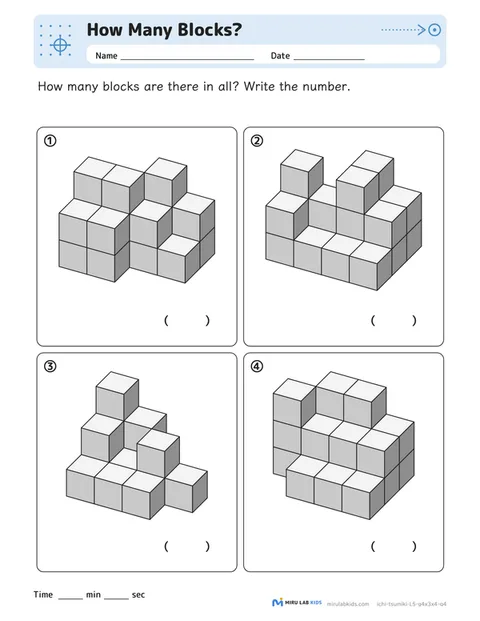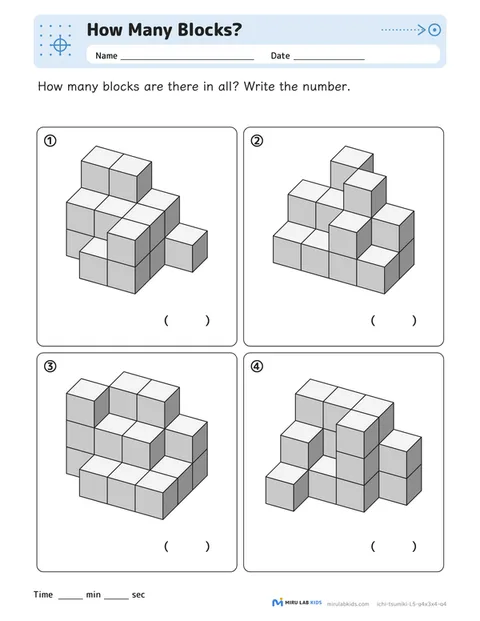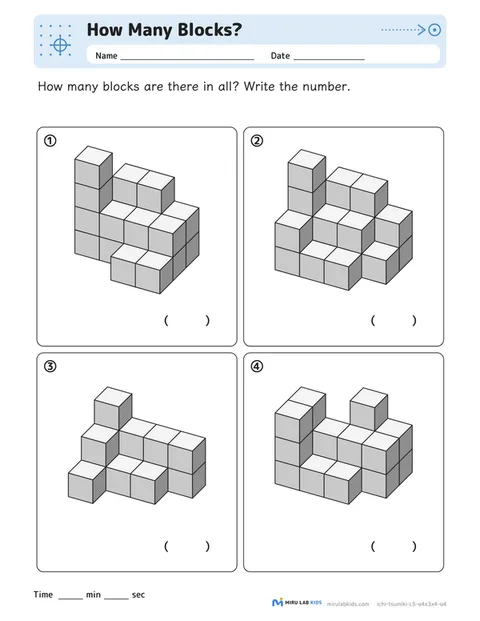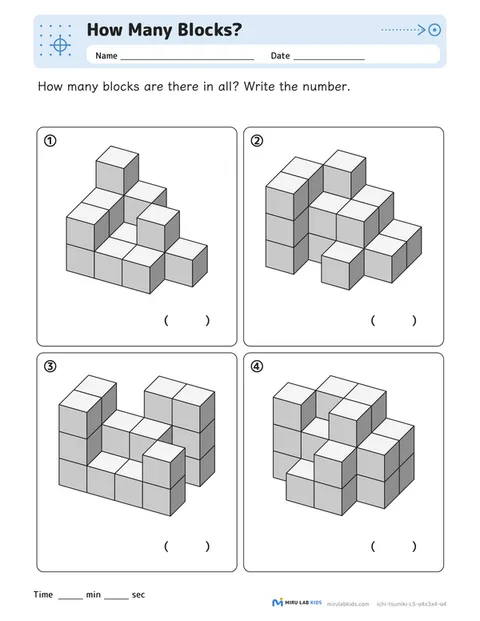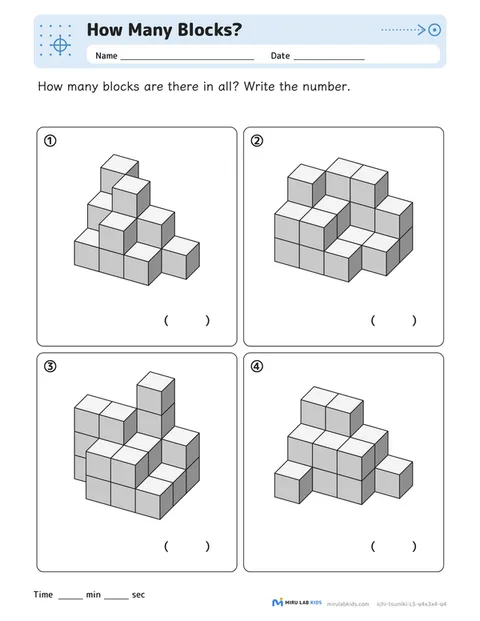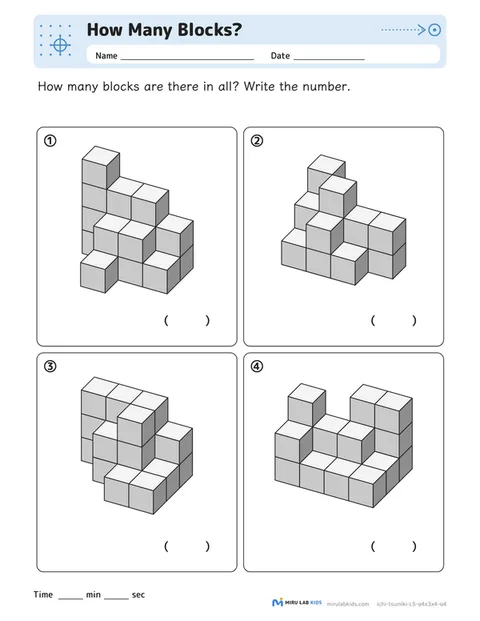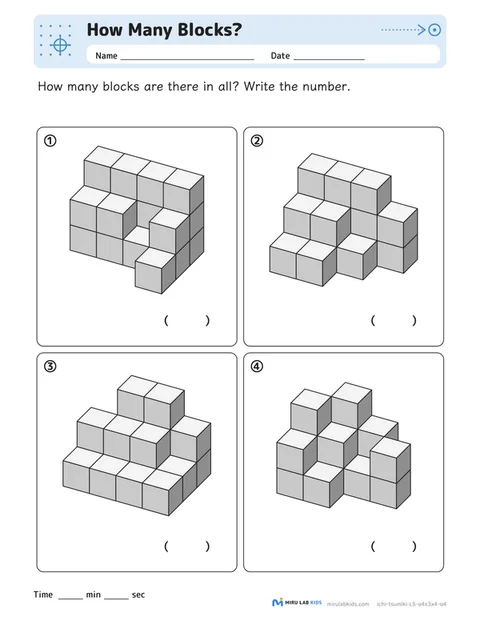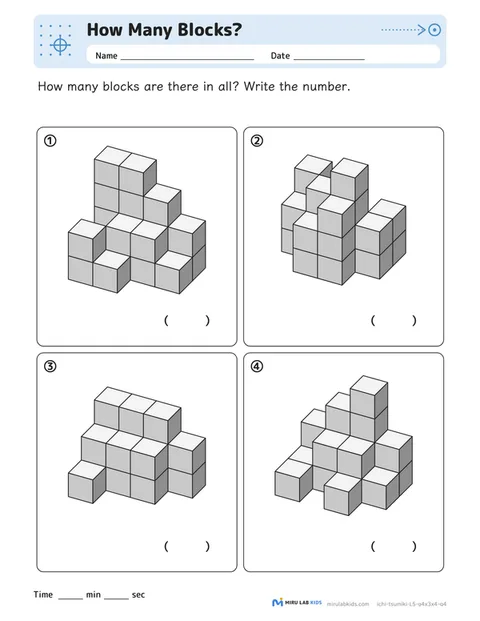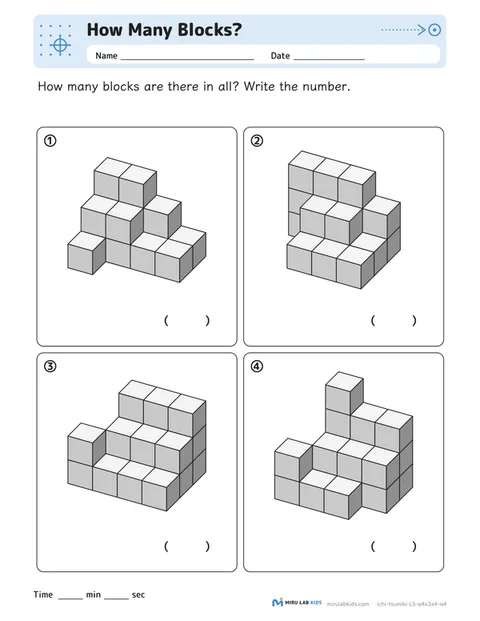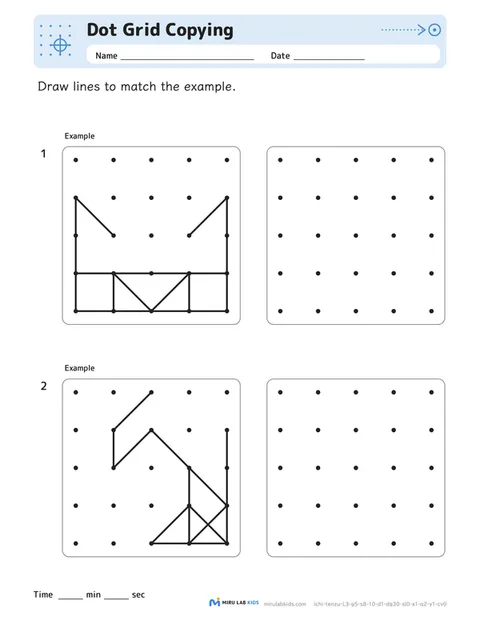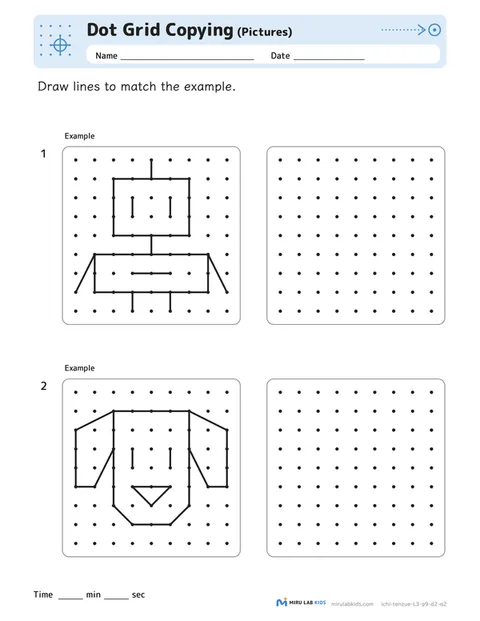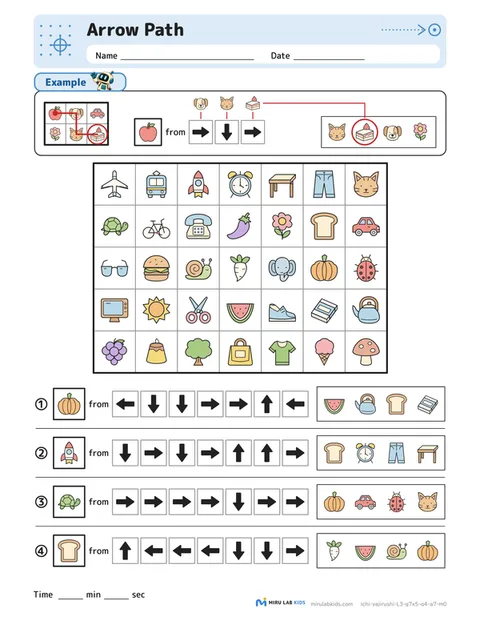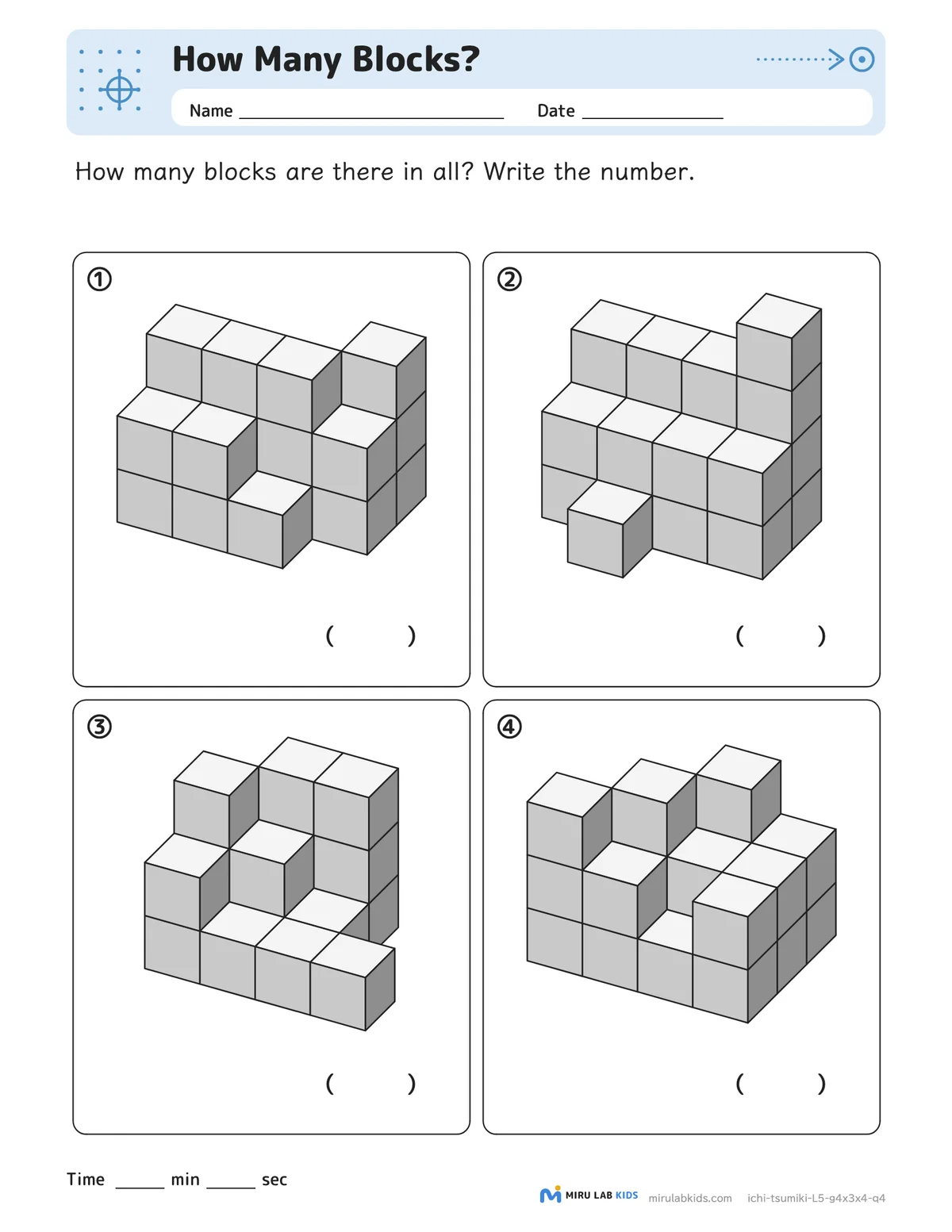
Tap a problem on the worksheet to turn the blocks around in 3D
How Many Blocks?Level 5 · No. 2
Up to 4 layers. 14 to 22 blocks, with 5 or more hidden. 4 questions per page.
Aimsspatial reasoning / Counting hidden blocks by thinking "this block must be holding up the one on top" / Counting layer by layer or row by row to avoid missing or double-counting blocks / spatial relations
PrintUS Letter
Worksheet + answers2 pagesA4 paper
Opens a PDF. Page 1 is the worksheet and page 2 is the answers. Please do not repost or sell the worksheets.
The questions print fine in black and white. The answer page colors each layer differently, so color printing is recommended for it.
Terms of Use
Aims of this activity
- Picturing a 3D shape with depth from a flat drawing (spatial reasoning)
- Counting hidden blocks by thinking "this block must be holding up the one on top"
- Counting layer by layer or row by row to avoid missing or double-counting blocks
- Understanding front and back, top and bottom (spatial relations)
Your child looks at a drawing of stacked blocks seen from above at an angle, counts how many blocks there are in all, and writes the number in the parentheses.Blocks never float, so if a block is visible on top, there are blocks underneath it too.At higher levels the stacks get taller, and more blocks are hidden behind or under the blocks in front.Instead of counting the faces they can see, your child pictures the parts they cannot see and counts blocks.The activity aims to build the ability to understand 3D shapes.
Code at the bottom right: ichi-tsumiki-L5-g4x3x4-q4
Tips
- Look at the drawing, count, and write the number in the parentheses. If it is hard, it is fine to build the same shape with real blocks.
For what to say, choosing a level and what to do if it is too hard, see How Many Blocks?: a guide for grown-ups.