 Visual Memory
Remember the Order: ShapesFree printable worksheets
Aims
- Keeping the order of what you saw in mind (visual memory and sequential memory)
- Noticing the features of a shape and telling shapes apart (visual discrimination)
- Jumping the eyes from left to right in order (saccades)
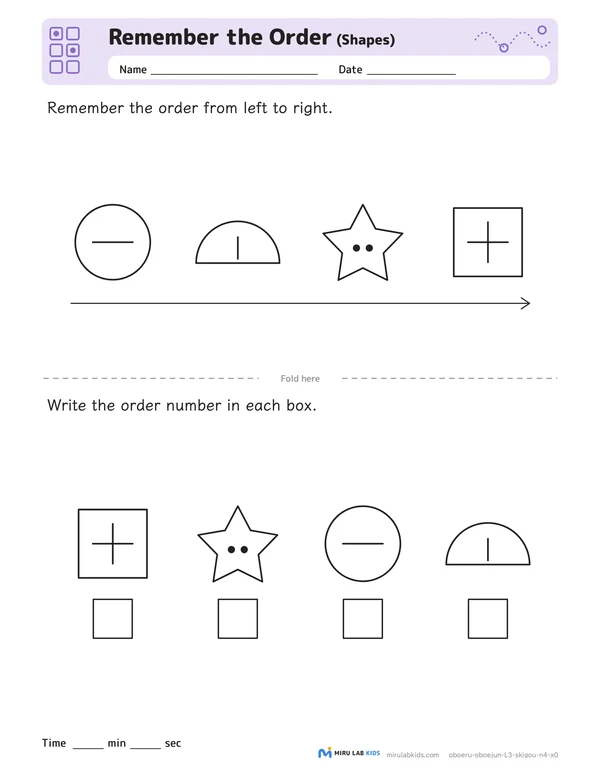
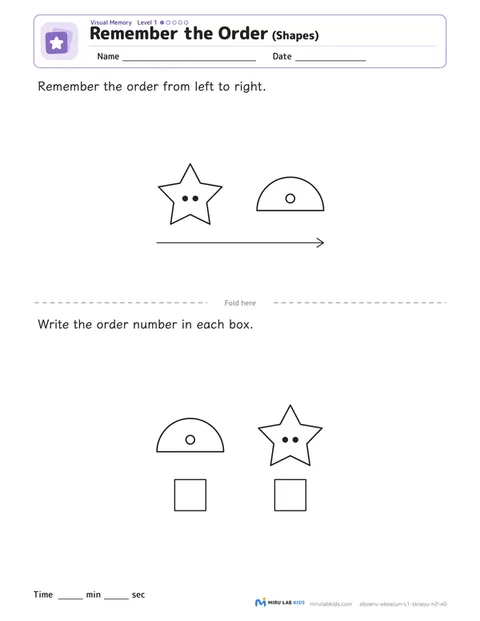
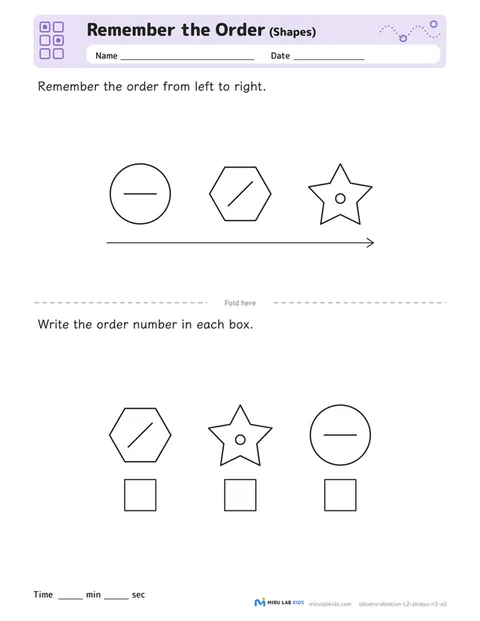
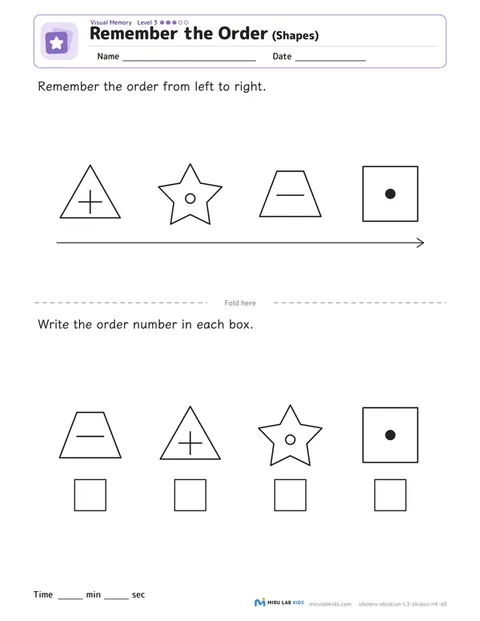
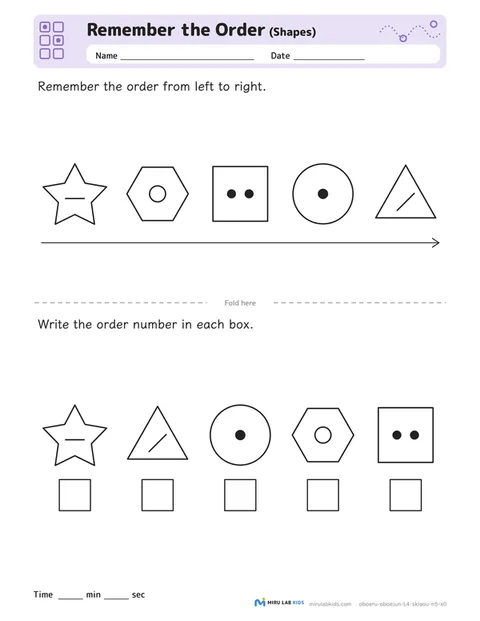
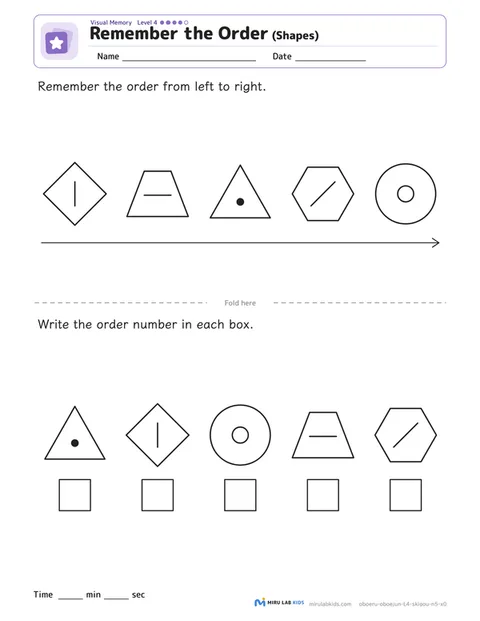
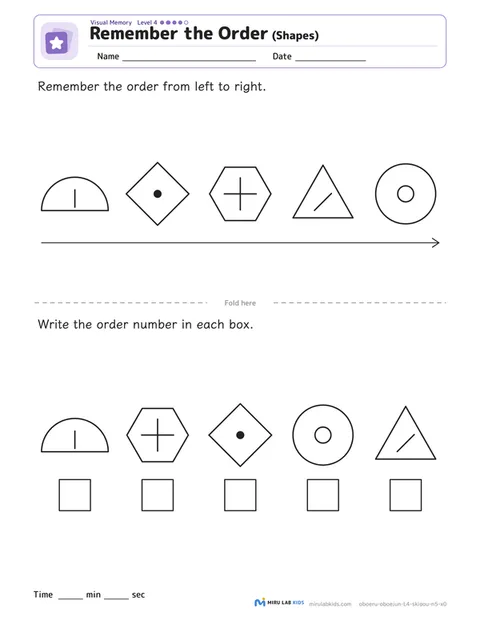
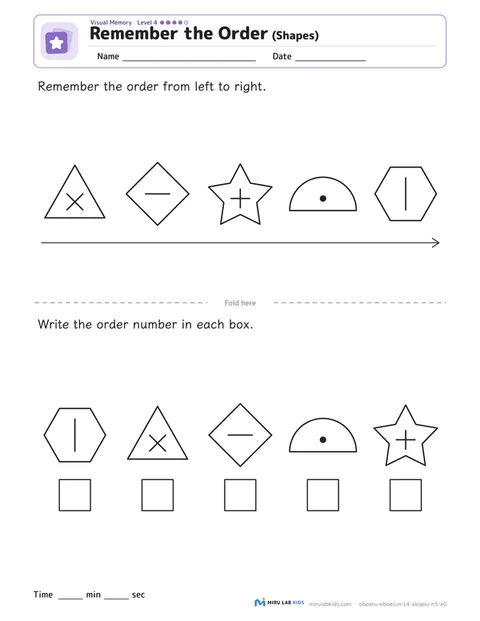
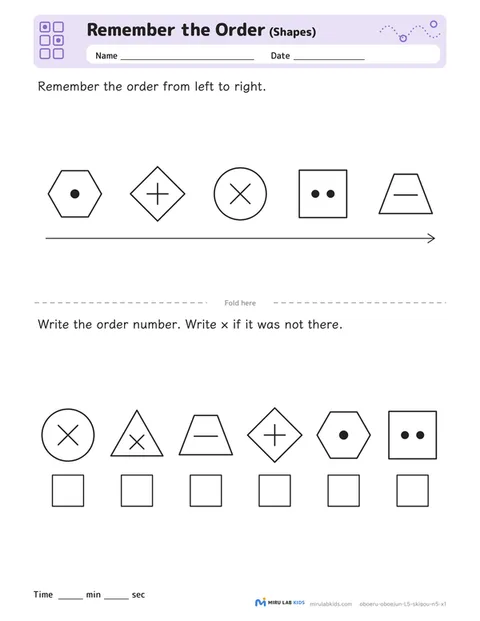
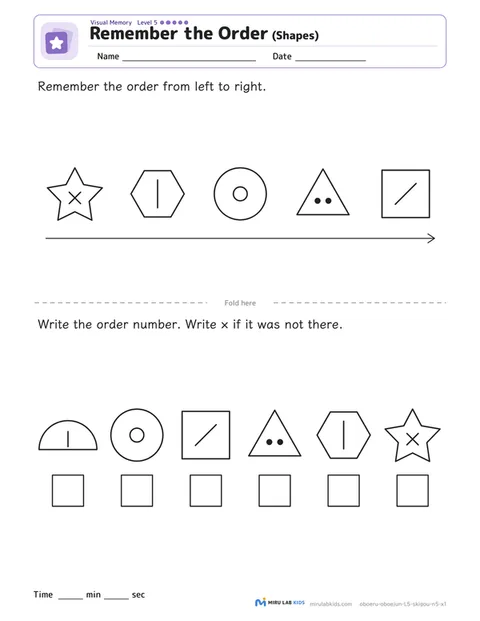
Your child remembers the order of the symbols lined up from left to right on the top half of the page, folds the page along the dotted line in the middle to hide them, and then writes in each box on the bottom half which position that symbol was in.Your child needs to remember not only which symbols were there, but also the order they were in.The activity aims to build the ability to keep the order of what you saw in mind, and to tell shapes apart.At Level 5, one look-alike symbol that was not at the top is mixed in, and your child writes × in its box.
 Level 3 example ›
Levels
| Level 1 | Remember the order of 2 symbols. | 10 worksheets |
|---|---|---|
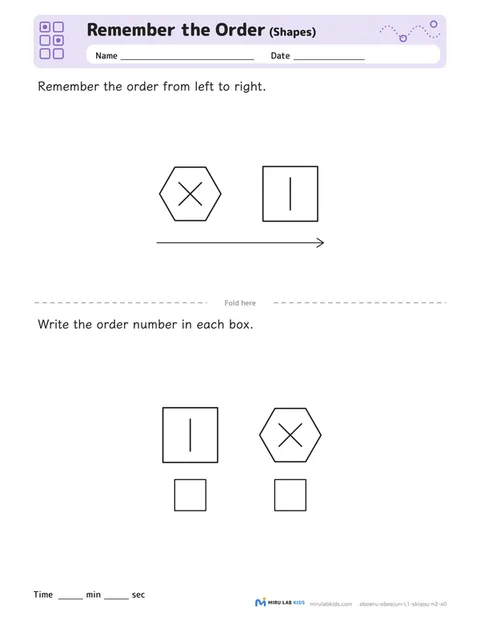
| Level 2 | Remember the order of 3 symbols. | 10 worksheets |
| Level 3 | Remember the order of 4 symbols. | 10 worksheets |
| Level 4 | Remember the order of 5 symbols. | 10 worksheets |
| Level 5 | Remember the order of 5 symbols. A look-alike that was not at the top is mixed in below, and gets an × in its box. | 10 worksheets |
Tips
- Show only the top half first, and wait until your child says "Got it!" There is no need to set a time limit.
- Then fold the page backward along the dotted line in the middle ("Fold here") to hide the top half, and write in each box on the bottom half which position that symbol was in.
- If writing numbers is hard, an adult can write them, or your child can point to the symbols in order.
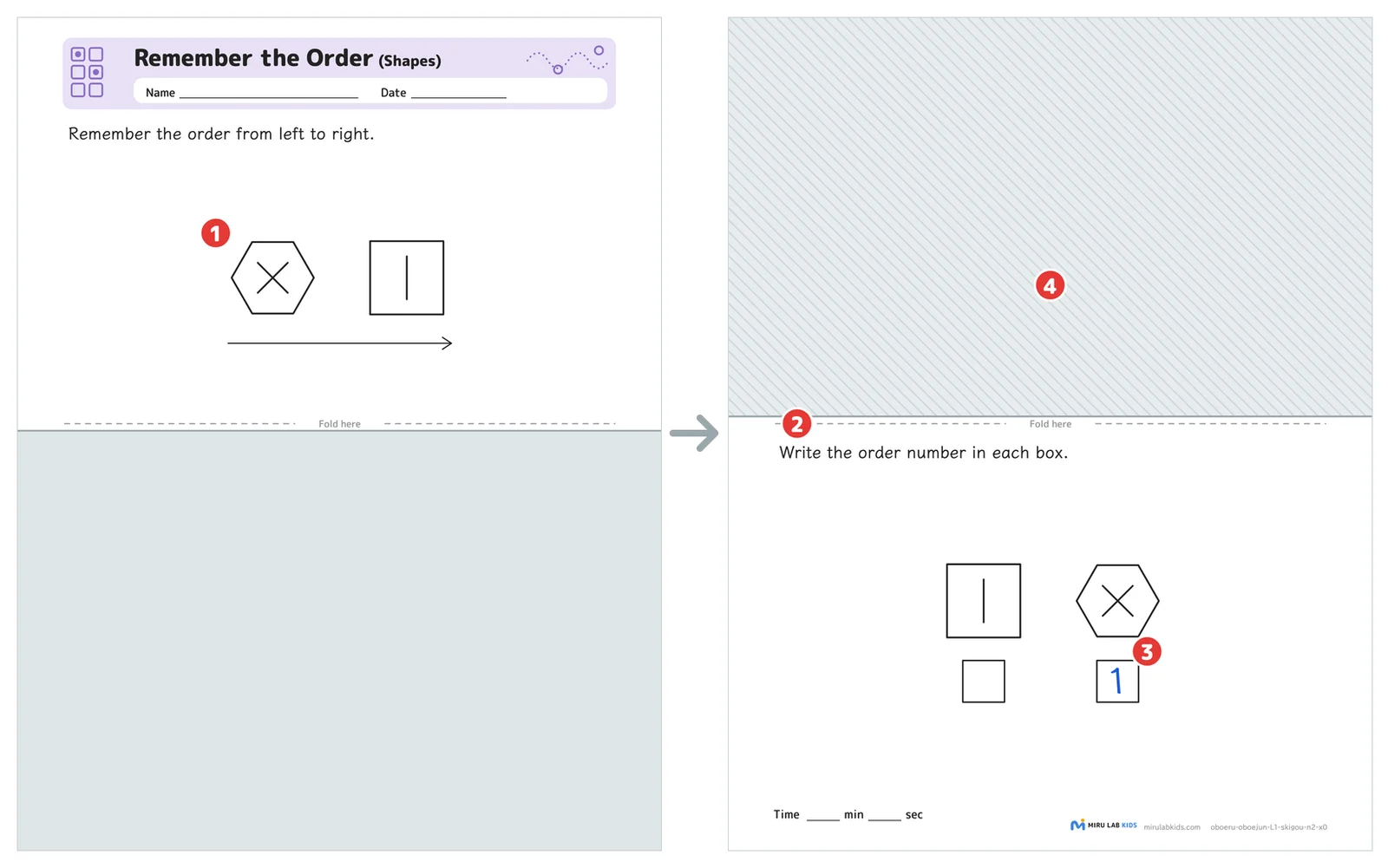
- Look from left to rightThe arrow shows the order. Your child can point while remembering.
- Fold it backward along the dotted lineMake a firm crease so the top half stays hidden before your child starts.
- The order is mixed up belowWrite 1 in the box under the one that came first.
- Unfold to checkWhen finished, unfold the page and compare with the top half. Your child can check the answers on their own.
For what to say, choosing a level and what to do if it is too hard, see Remember the Order: Shapes: a guide for grown-ups.
Worksheets
Choose a worksheet to open its printing page.
Print in bulk
Level 1Remember the order of 2 symbols.
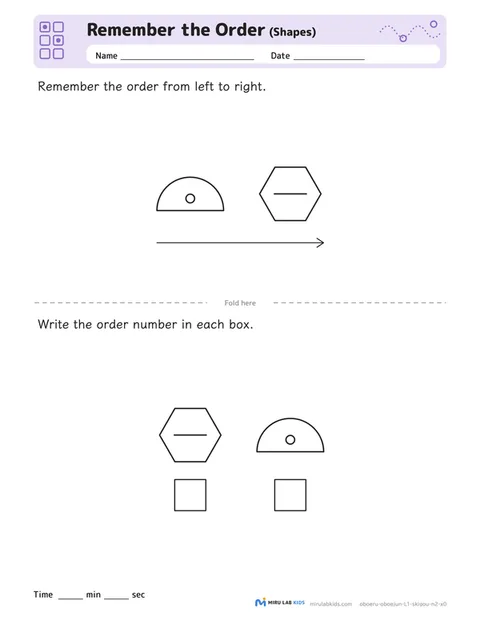
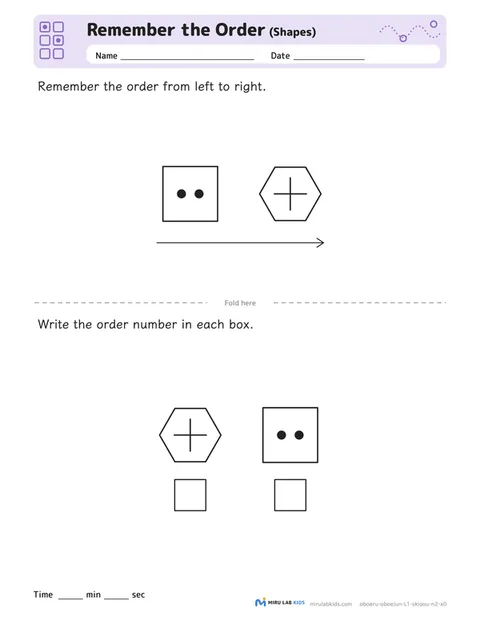
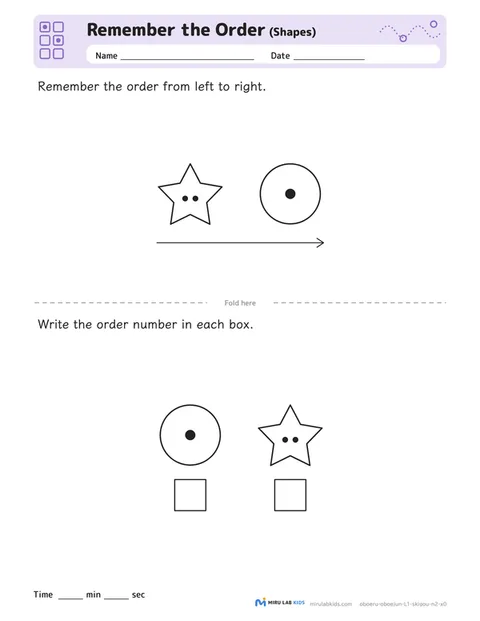
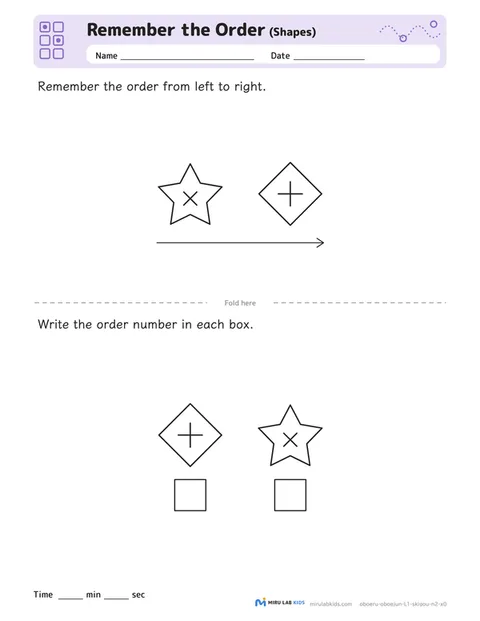
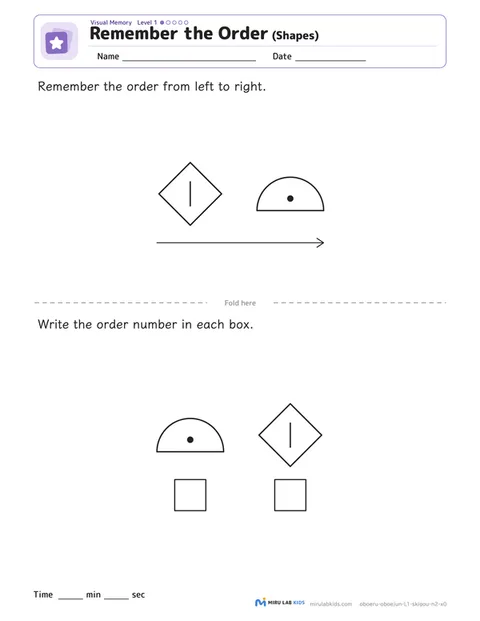
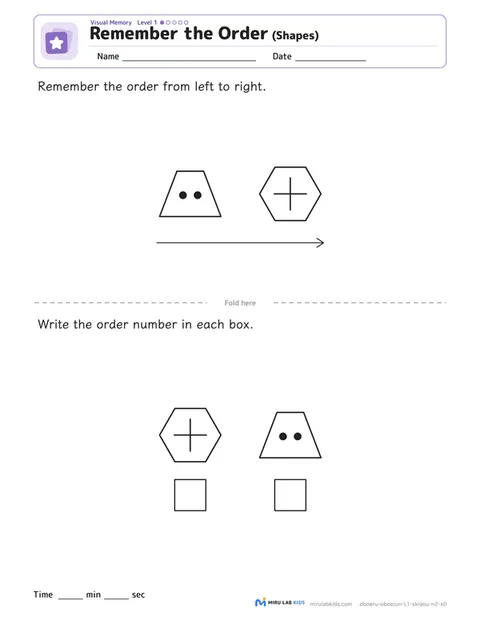
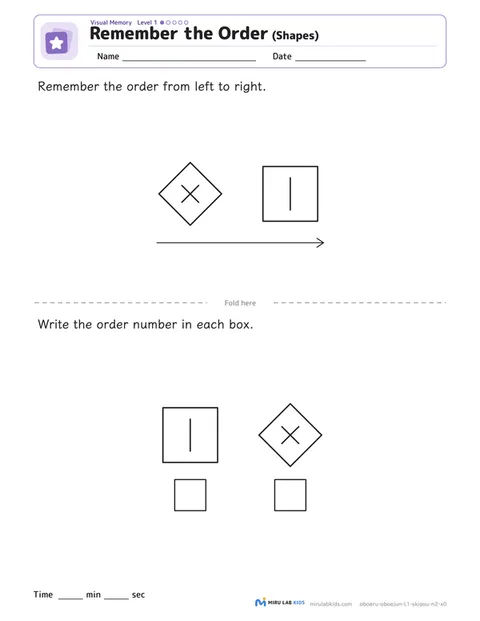
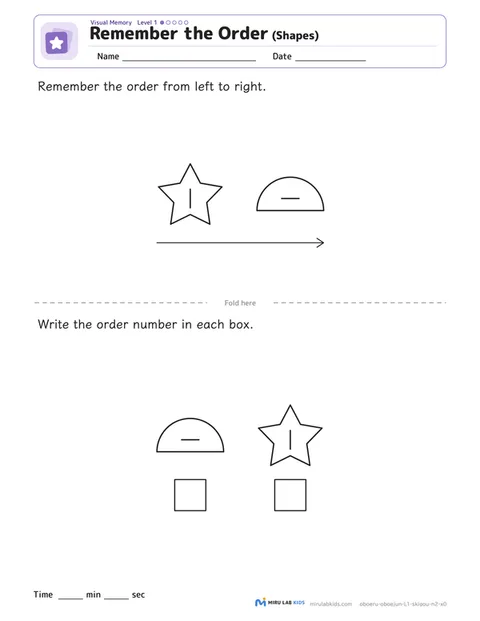
Level 2Remember the order of 3 symbols.
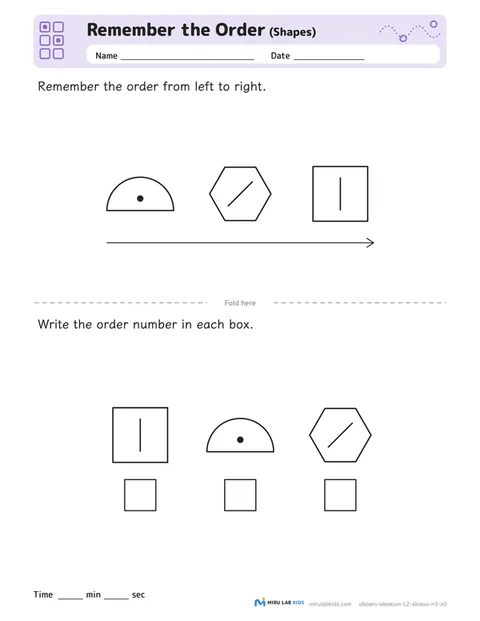
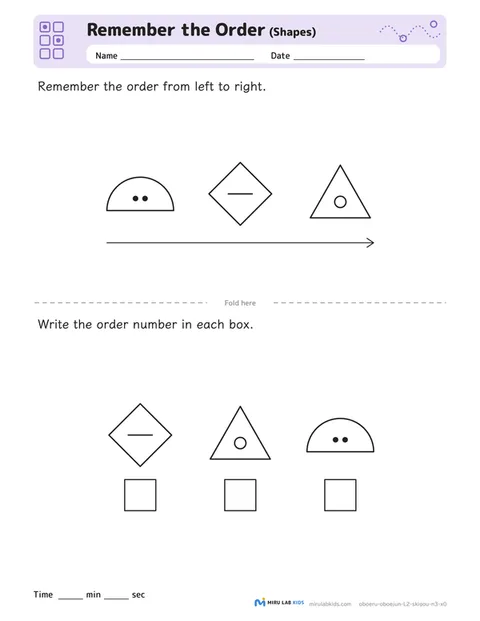
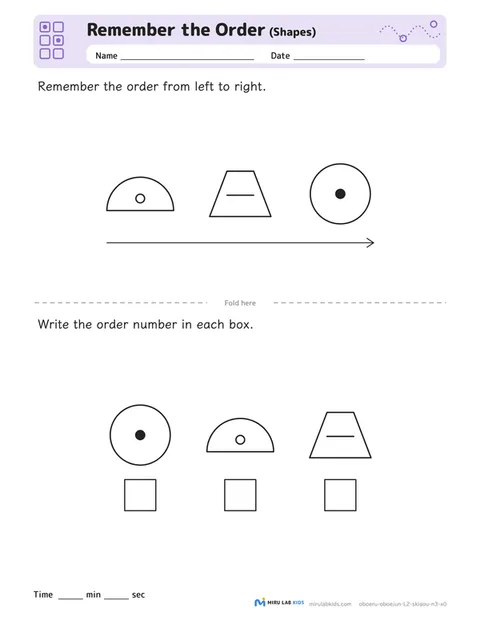
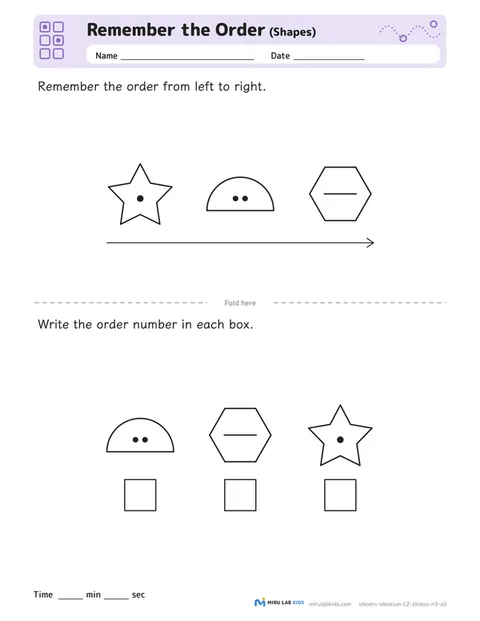
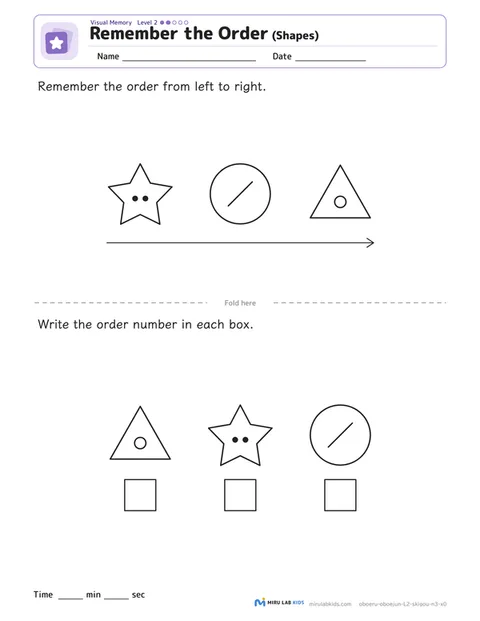
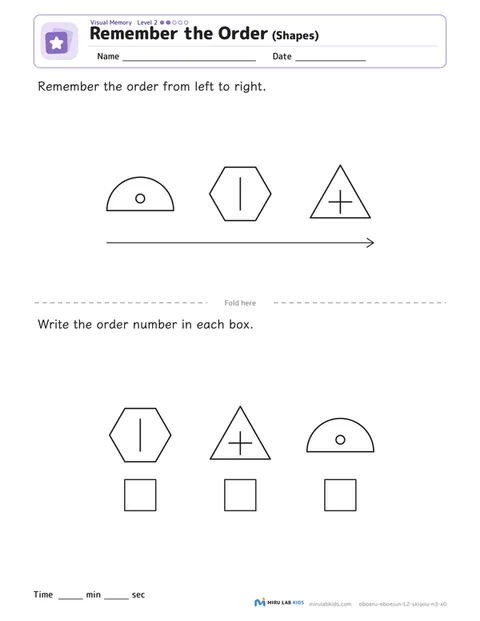
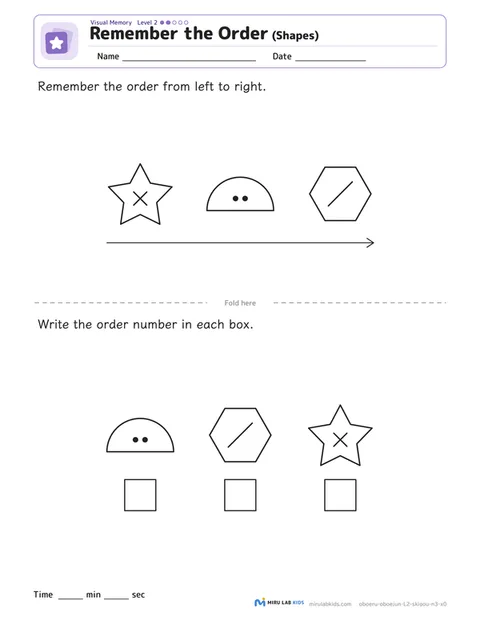
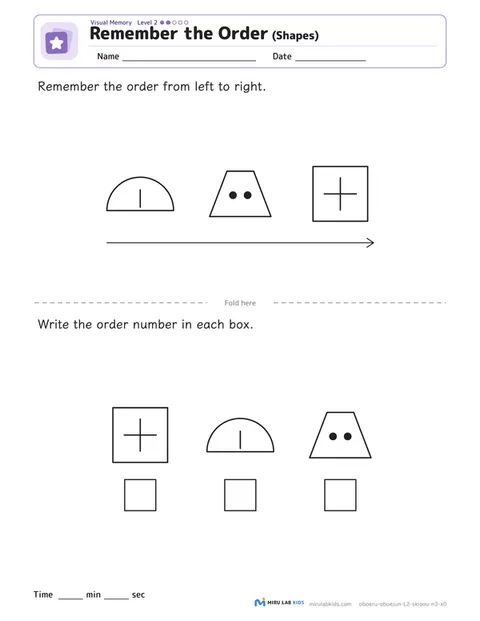
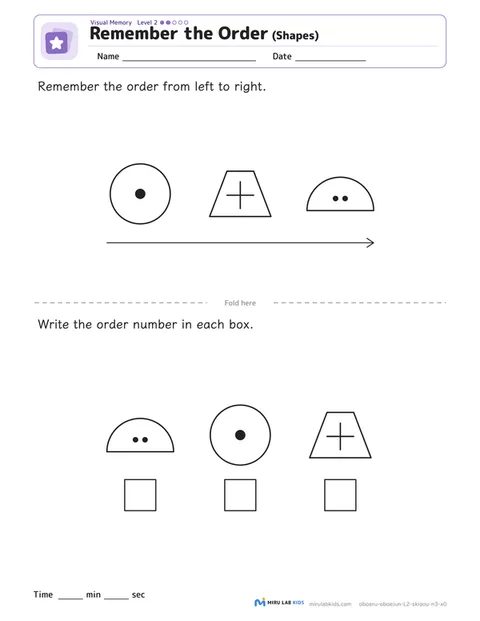
Level 3Remember the order of 4 symbols.
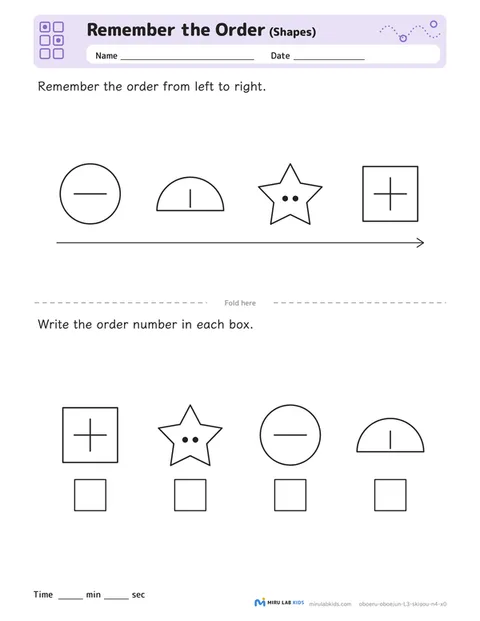
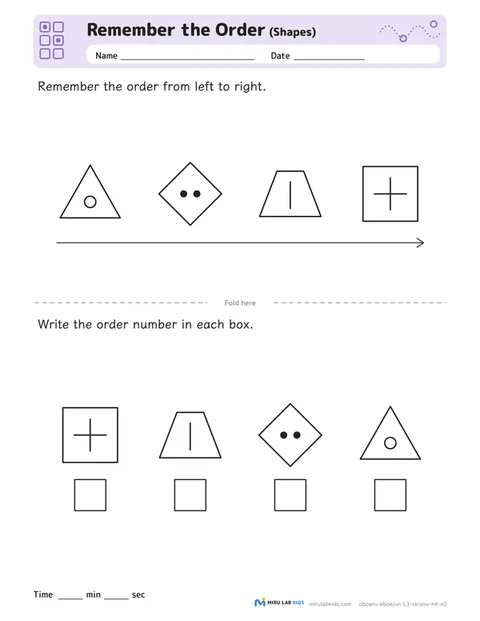
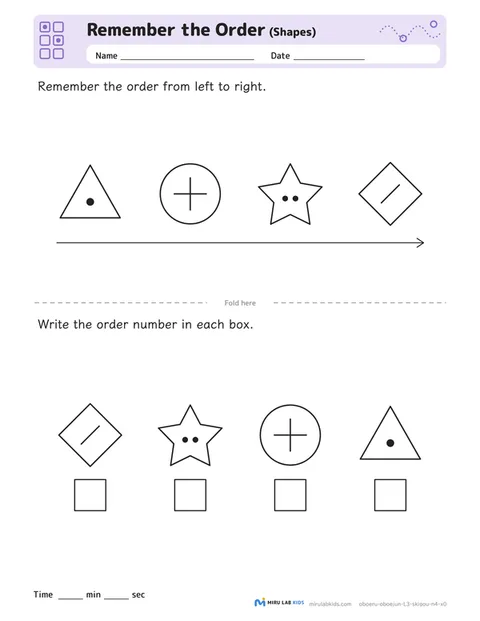
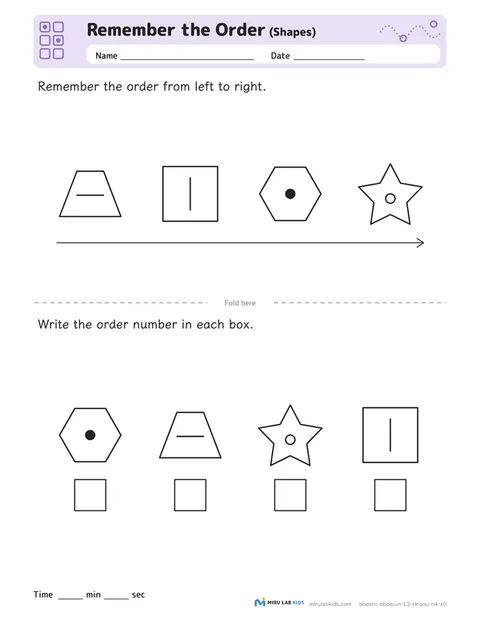
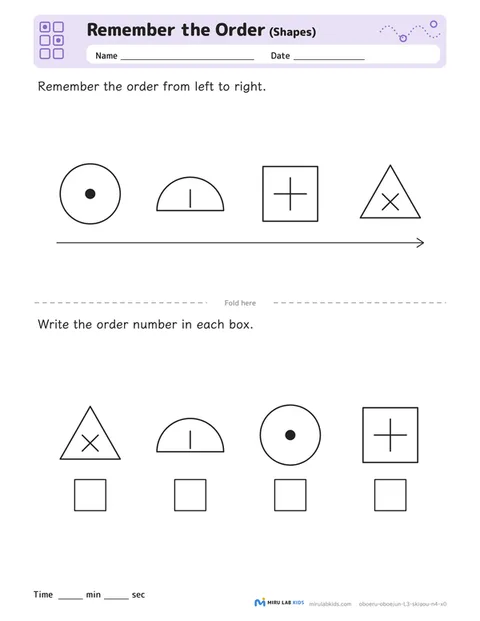
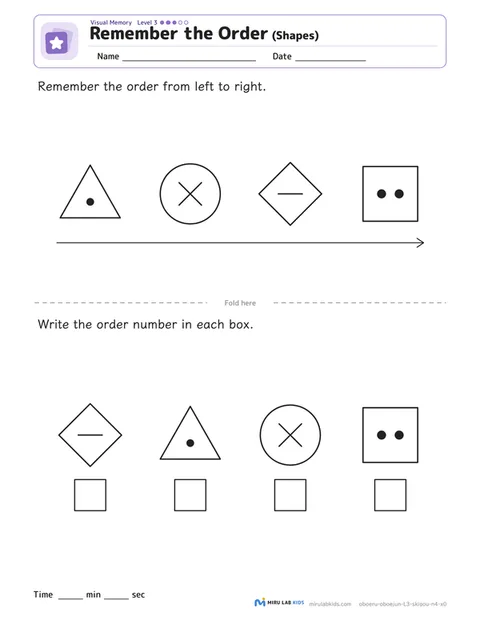
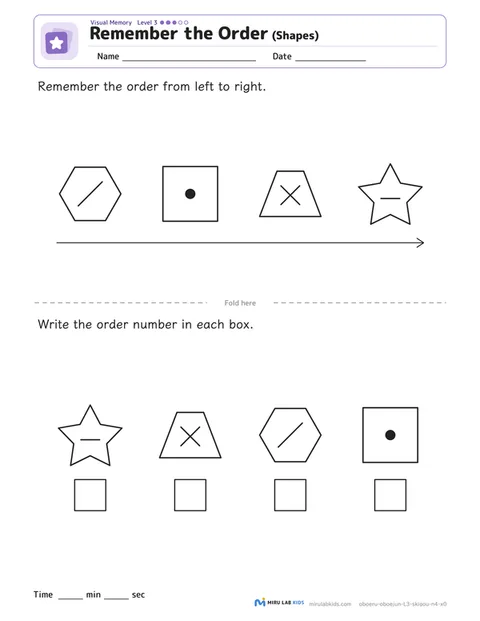
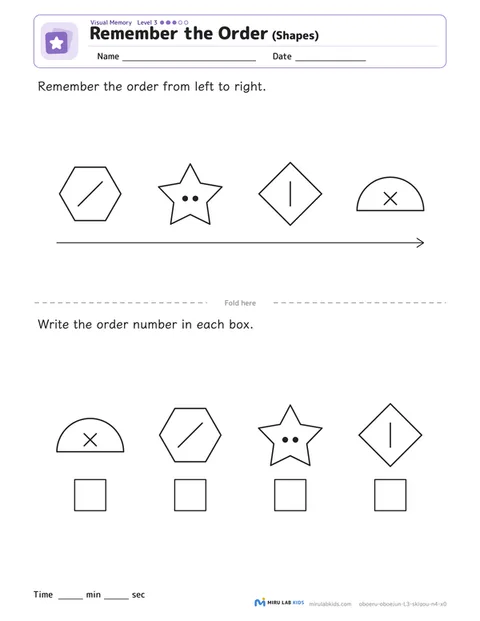
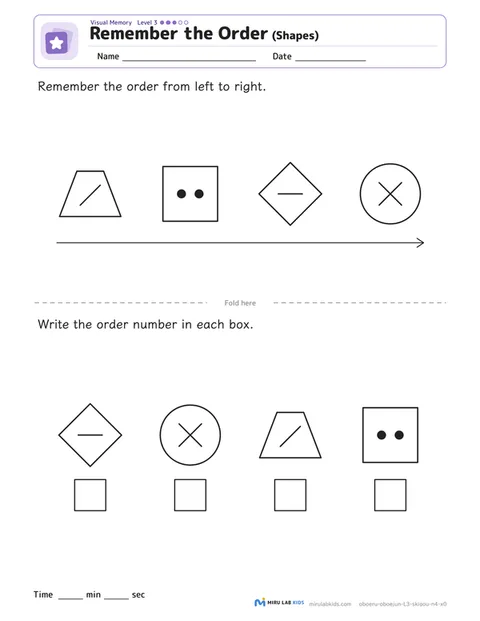
Level 4Remember the order of 5 symbols.
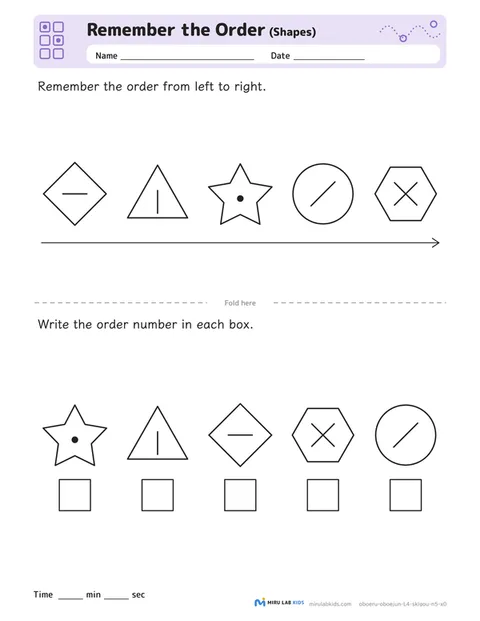
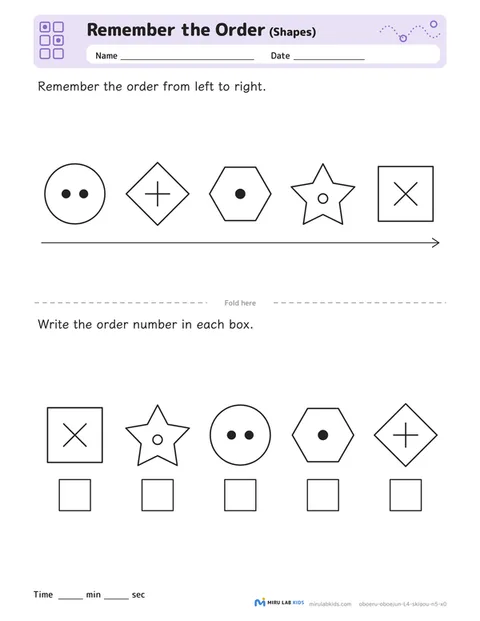
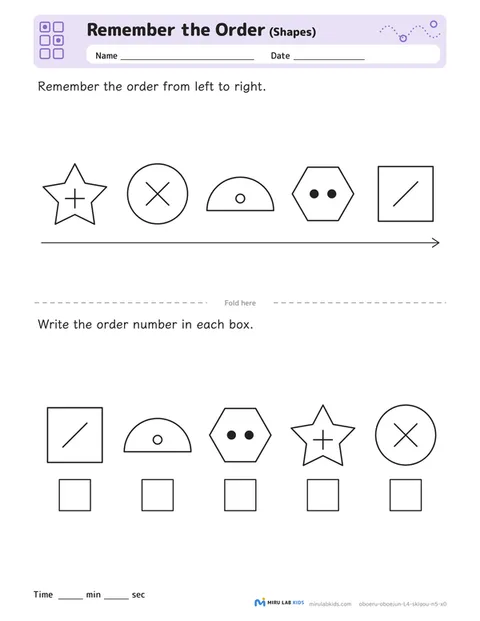
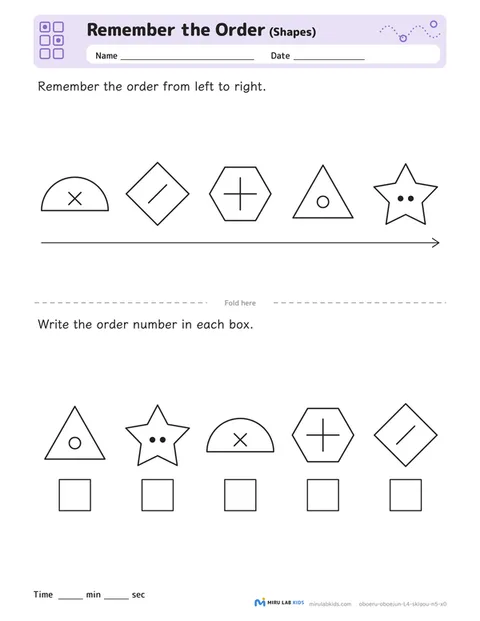
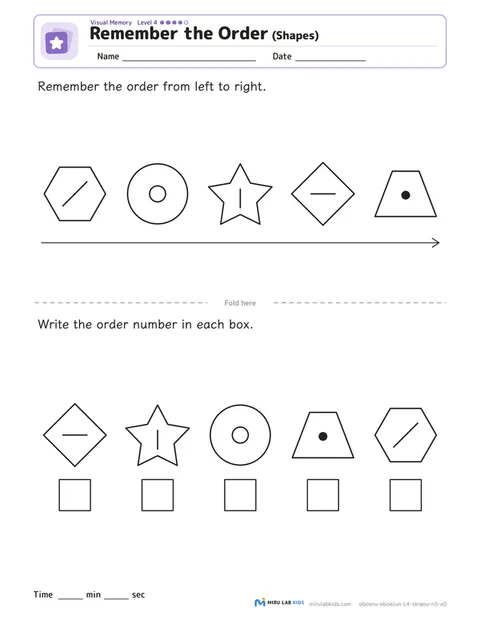
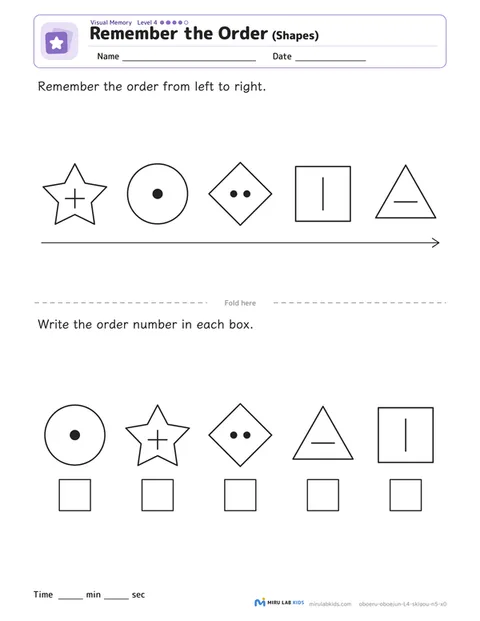
Level 5Remember the order of 5 symbols. A look-alike that was not at the top is mixed in below, and gets an × in its box.
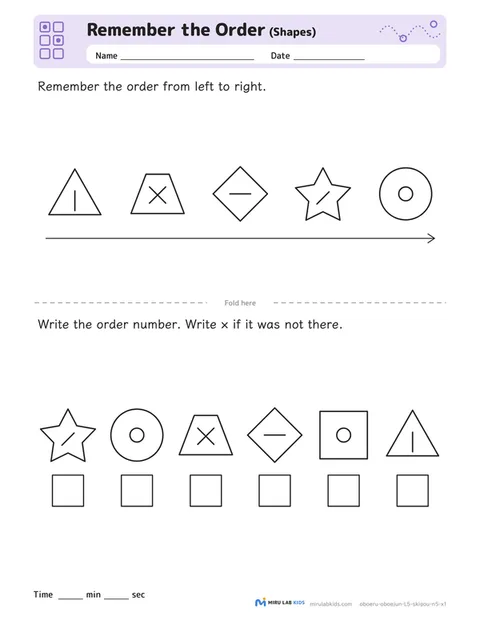
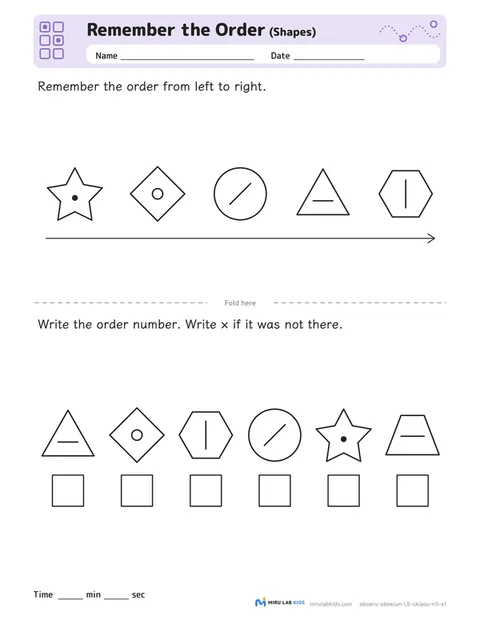
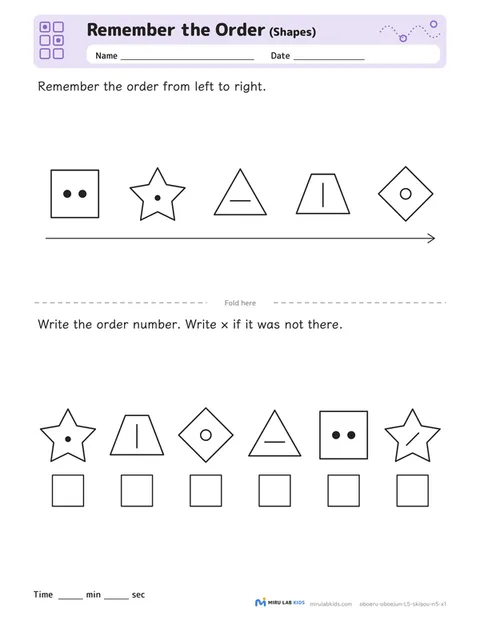
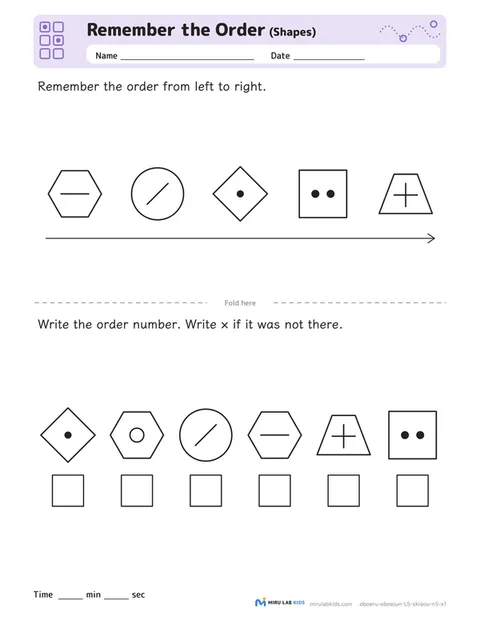
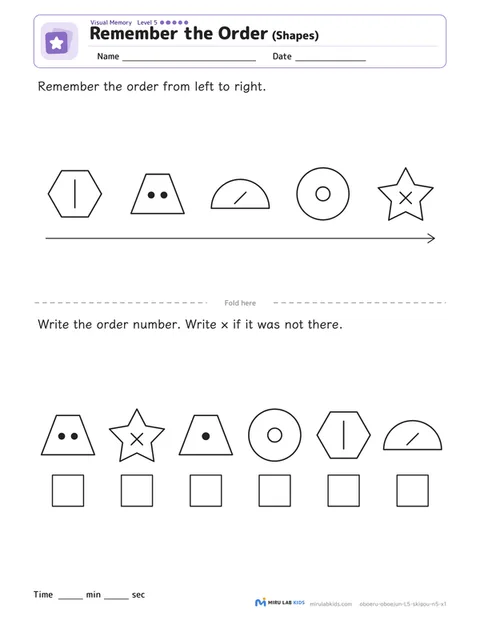
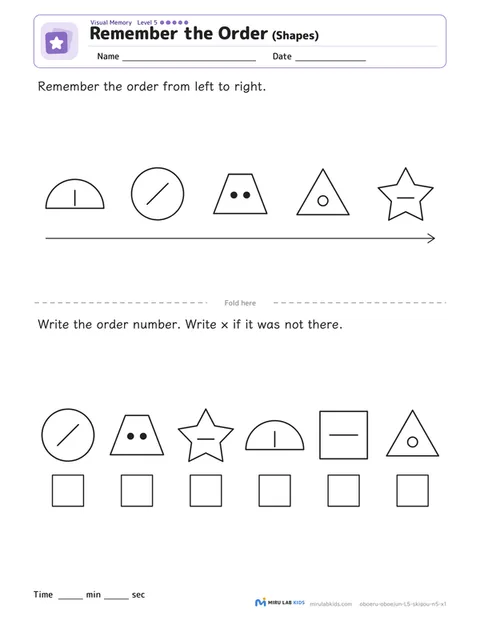
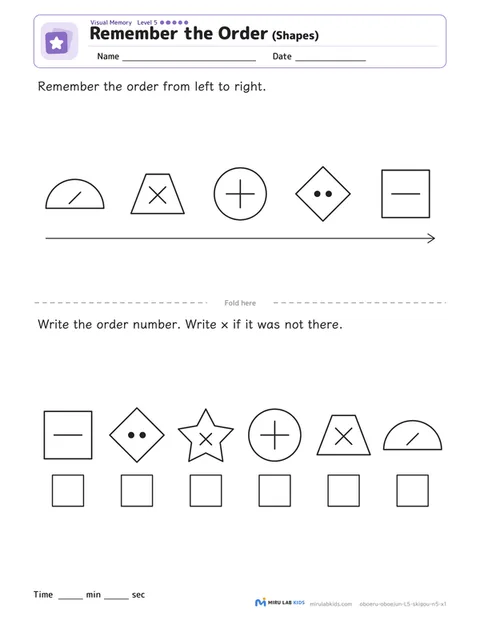
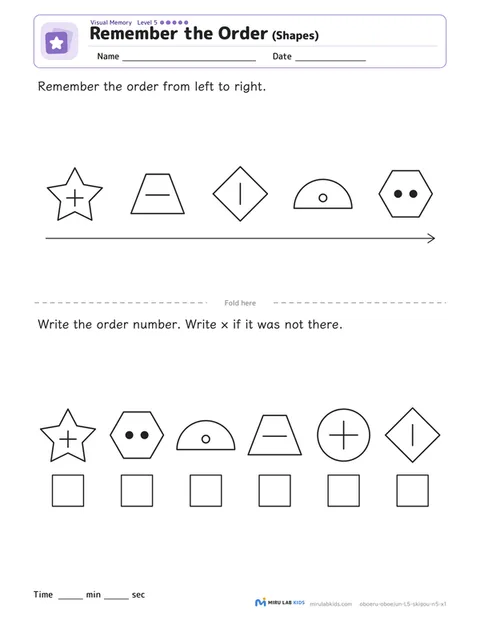
Remember the Order: Shapes: a guide for grown-ups
Who it is for
- Slow at copying from the boardIf a child can hold only a little in mind, they have to look back at the board again and again. Practice remembering by looking.
- Remembering order is hardPractice remembering not just what was there, but in what order.
- Shapes that are hard to nameThe symbols have no names, so your child practices remembering the shape itself.
- Mixing up letter shapesPractice noticing the features of a shape and telling shapes apart.
- Short sessionsOne page is quick, so it fits into spare moments.
- Therapy and classroom sessionsAll you need is one sheet of paper and a pencil.
Choosing a level
Answered correctly and happily
- Go up one level.
- Set a time limit for remembering (for example, 10 seconds).
- Wait a little after folding the page before starting to answer.
Gets the order wrong or cannot remember them all
- Go down one level.
- While remembering, point to each symbol in turn from the left.
What to watch for
| Remembering | Does your child look at the symbols in order from the left? Or just glance at the whole row? |
|---|---|
| Time to remember | You can also time how long it takes to say "Got it!" and note it in the margin, to compare when you repeat the activity. |
| Kinds of mistakes | Is the order swapped, or is a symbol itself mixed up? The kind of mistake shows where your child is stuck. |
| Look-alikes | Does your child write a number for the look-alike that was not at the top? (Level 5) |
| Own strategies | Does your child quietly say something or give the symbols names to remember them? |
| Record | Writing the number correct and the number of peeks on the Memory Log makes it easier to compare when you repeat the activity. |
If something keeps worrying you, it can help to talk with an eye doctor or another specialist rather than deciding on your own.
Things you can say
- Before startingLook at them in order from the left.The arrow at the top shows the reading direction, from left to right.
- While rememberingTell me when you've got it.Do not rush. Wait until your child says "Got it!"
- When unsureWhat was first?Give a clue to remember from the first one. Do not give the answer.
- When finishedLet's unfold it and look.Unfold the page and check together by comparing the top and bottom halves.
- Next timeYou remembered all four today!Compare with your child's own last try, such as how many they remembered or how long it took.
FAQ
Is there an answer page?
Yes. Page 2 of the PDF is the answer page. You can also unfold the page and compare the top and bottom halves.
Can I print in black and white?
Yes. The worksheet works in black and white.
Is there a version with pictures?
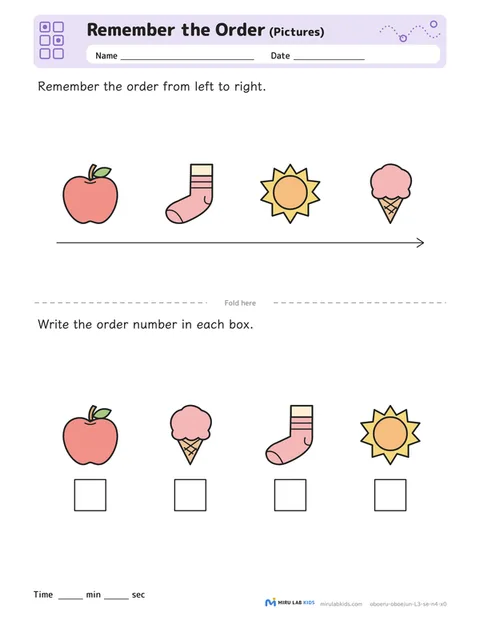
Yes. "Remember the Order: Pictures" uses familiar pictures, such as apples and cars.
How much should we do at a time?
There is no set amount. One or two sheets at a time is a good guide, and it is best to stop while your child still wants a little more. See "Every Day? How Much?" for more.
Articles
- What Is Visual Perception? More Than Good Eyesight
- Why Does My Child Put Clothes On Backwards or Inside Out? Getting Dressed Uses More Visual Skills Than You Think
- When a Child Has Trouble Catching a Ball: Breaking It Down from "Tracking" to "Reaching"
- When a Child's Tracing Slips onto Another Shape: Understanding Figure-Ground Perception
About the code at the bottom right
The code at the bottom right of each worksheet (for example, oboeru-oboejun-L1-skigou-n2-x0) shows its difficulty settings. Worksheets with the same code have the same difficulty. If you contact us about a worksheet, including this code helps us find it right away.
 Shape Recognition
 Spatial Relations
 Visual Scanning
 Visual-Motor Skills
 Visual Planning