 Visual Memory
Remember and Find: PicturesFree printable worksheets
Aims
- Keeping what you saw in mind after it is out of sight (visual memory)
- Telling the remembered picture apart from similar ones (visual discrimination)
- Using what you remember to find targets among many (visual search)
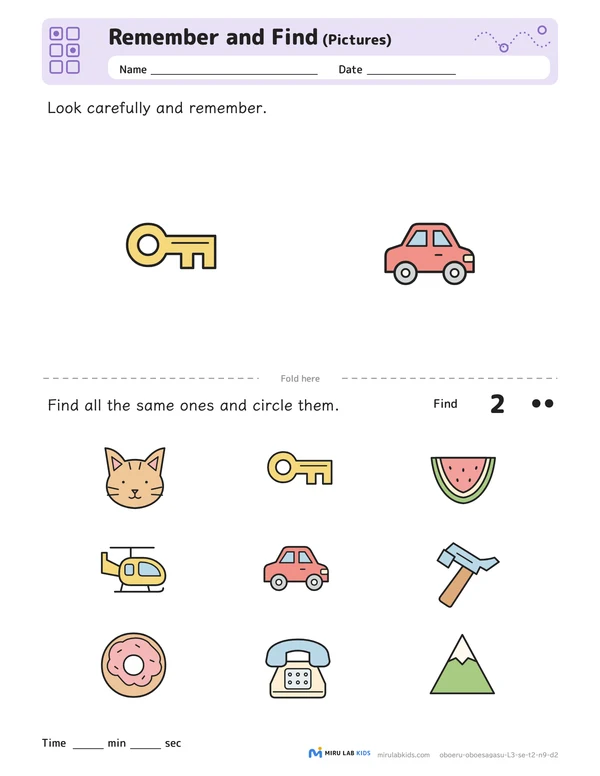
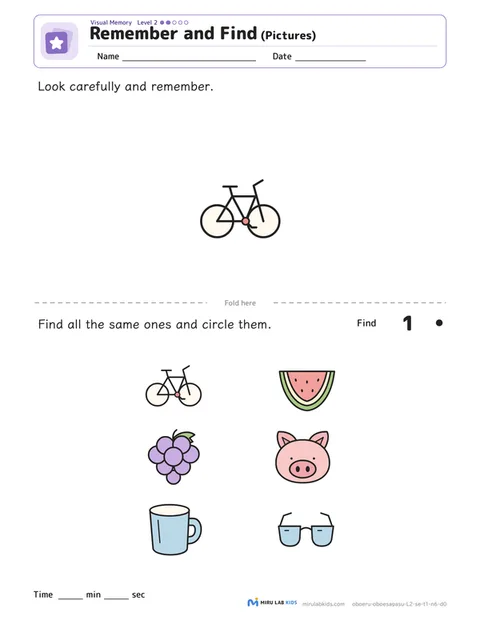
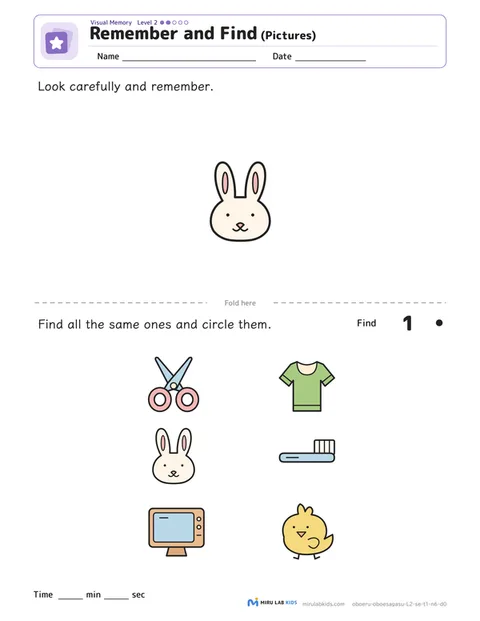
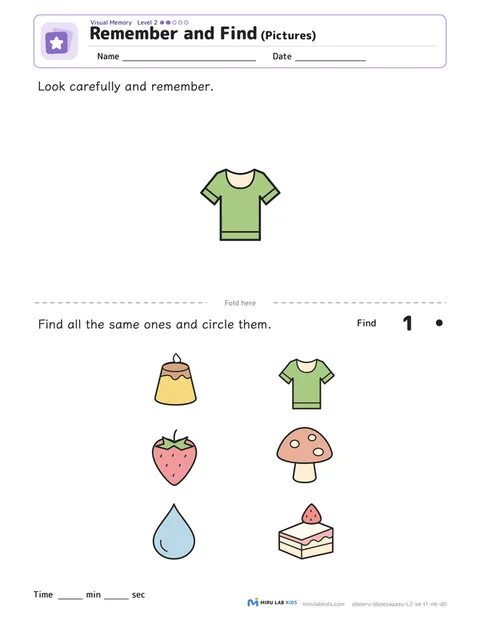
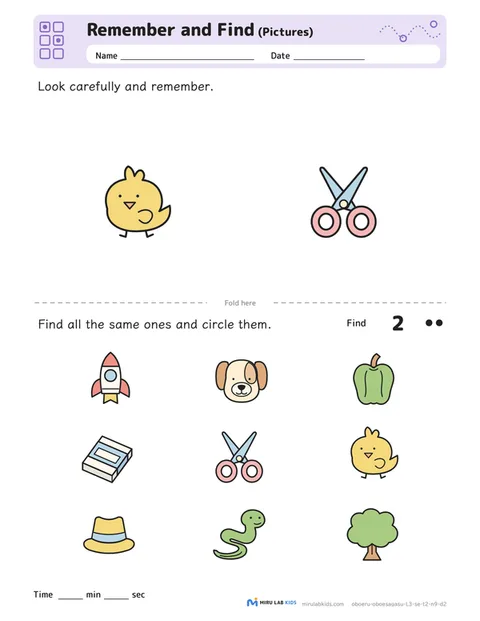
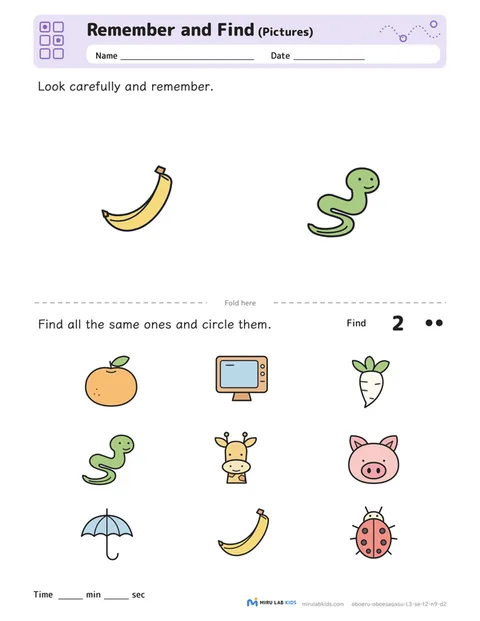
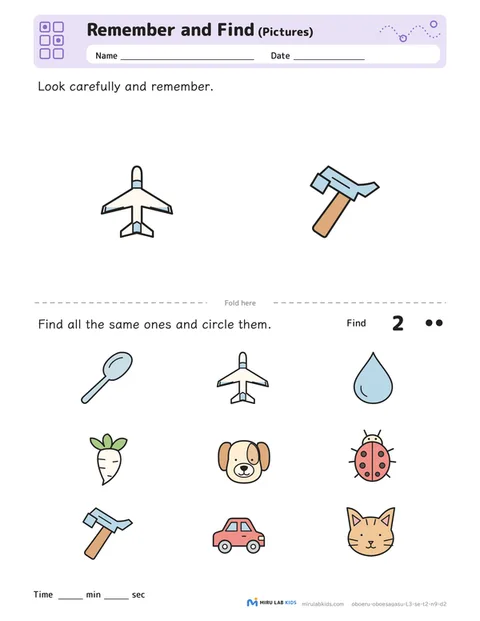
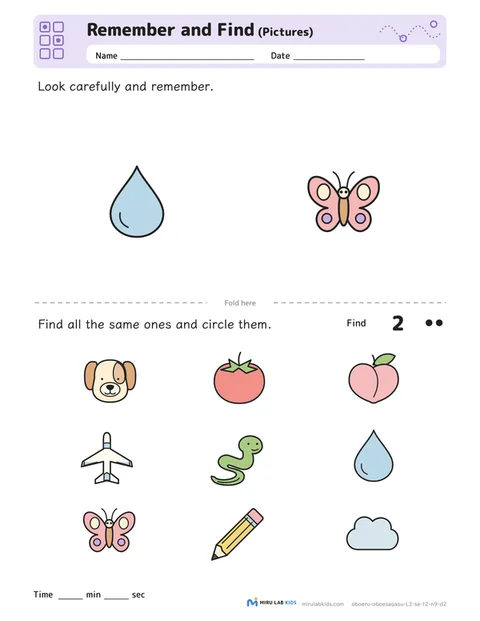
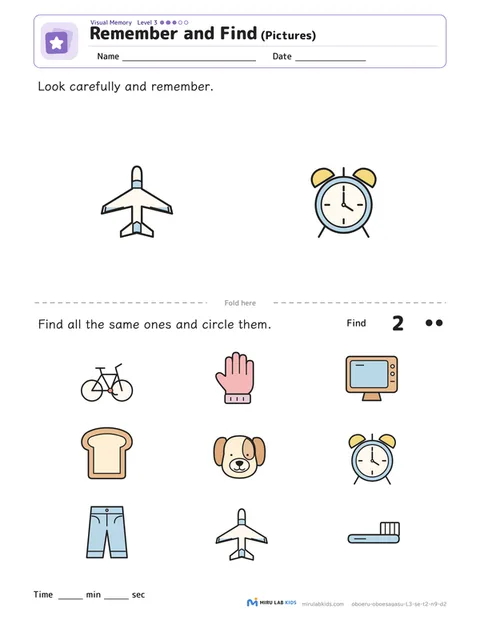
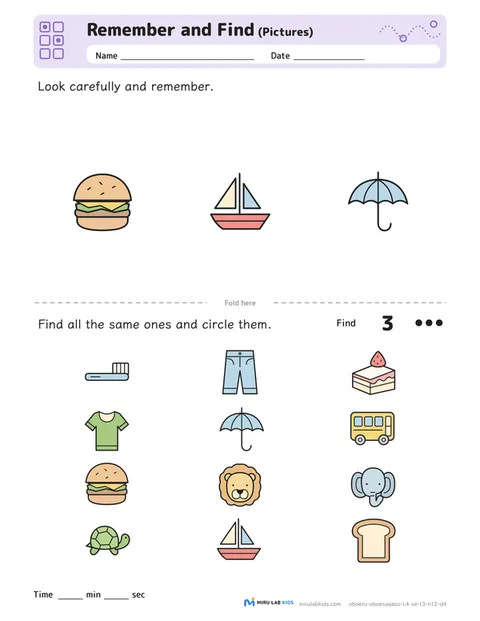
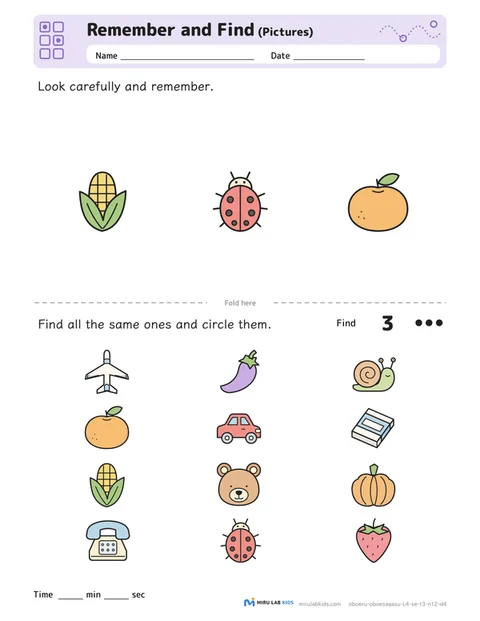
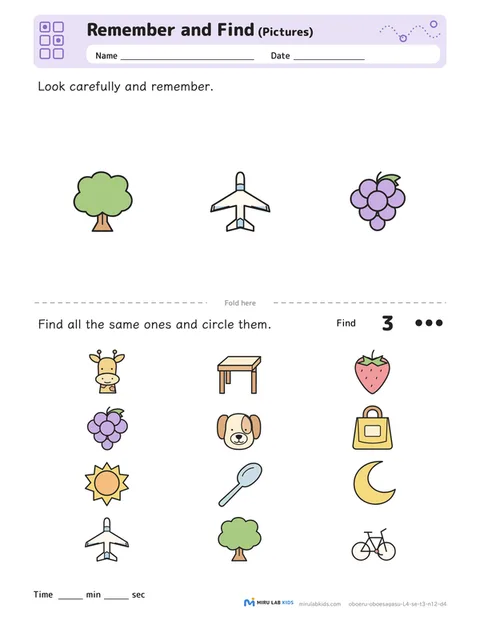
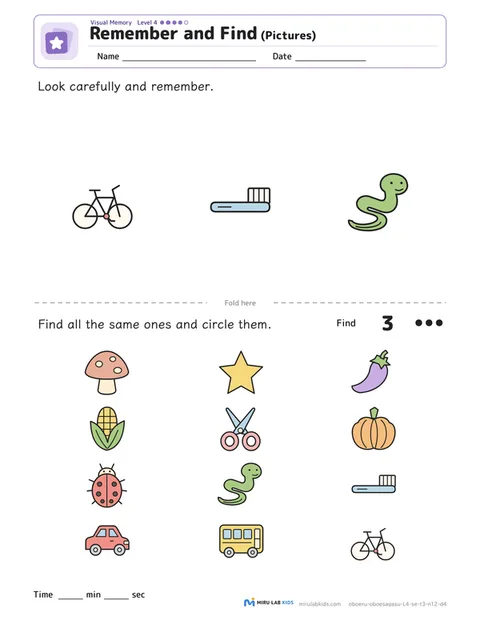
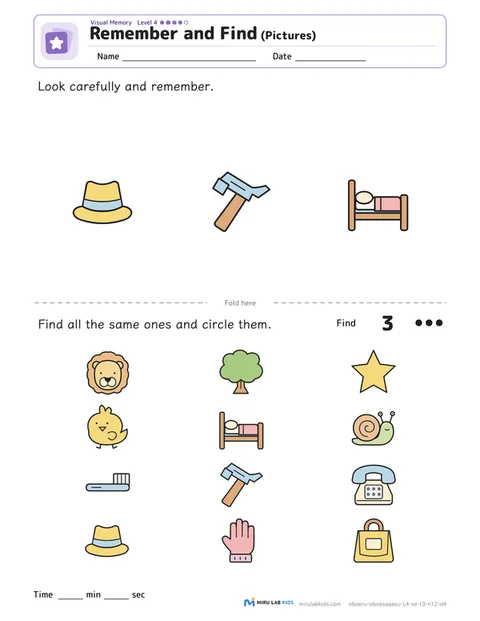
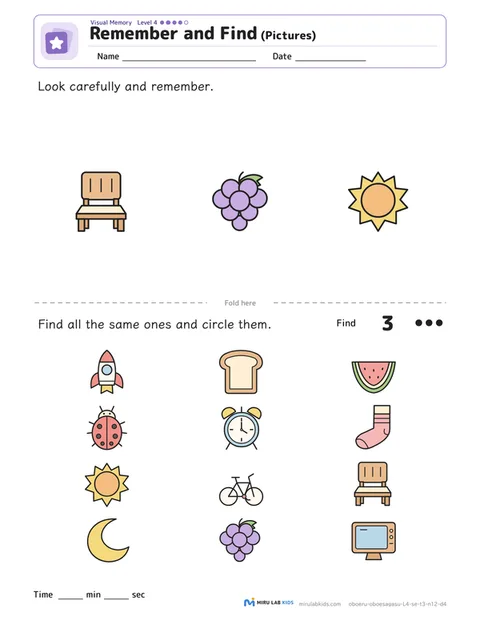
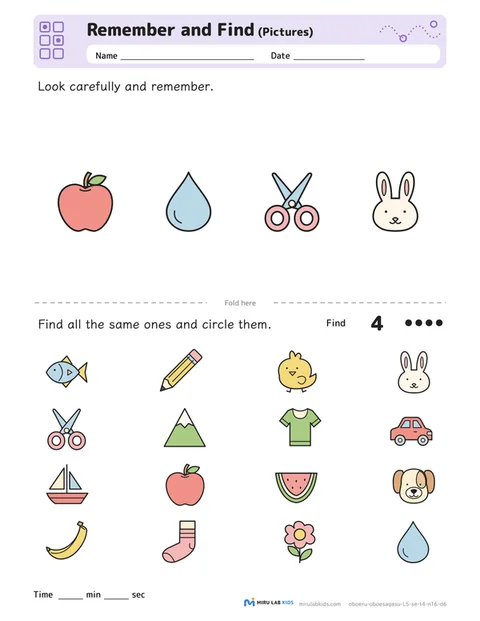
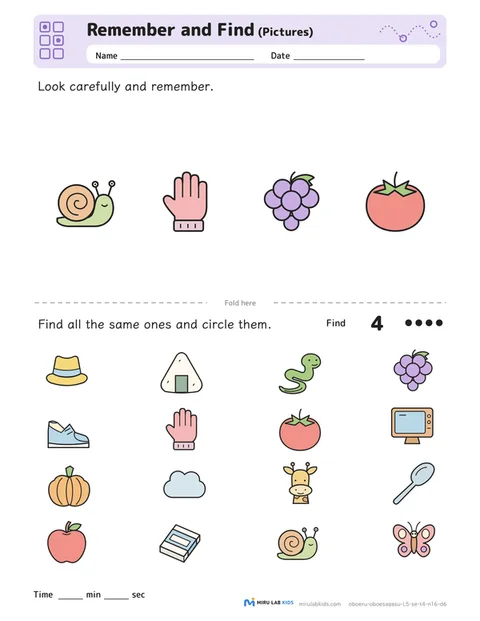
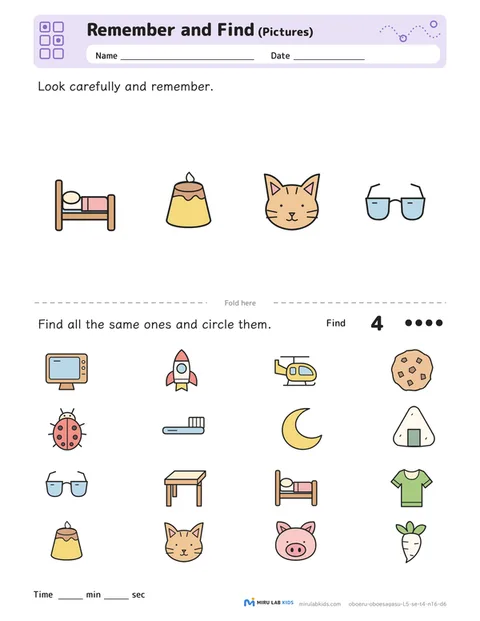
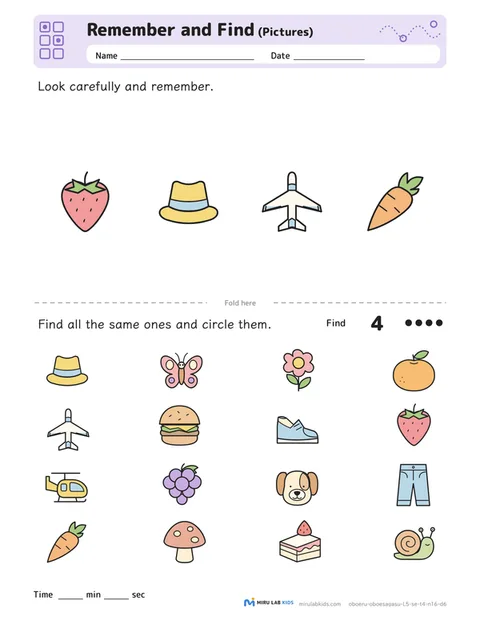
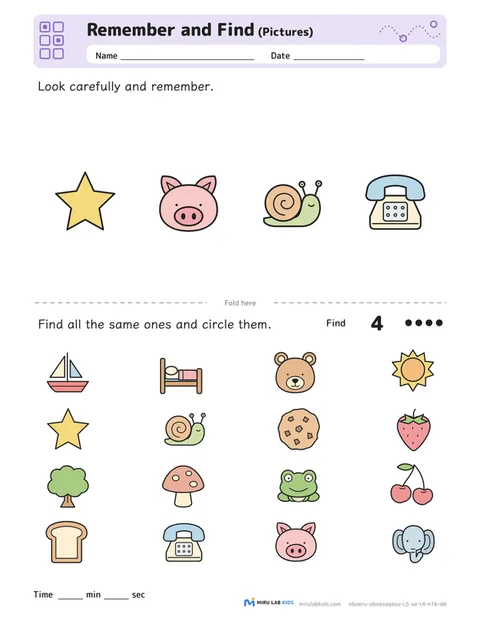
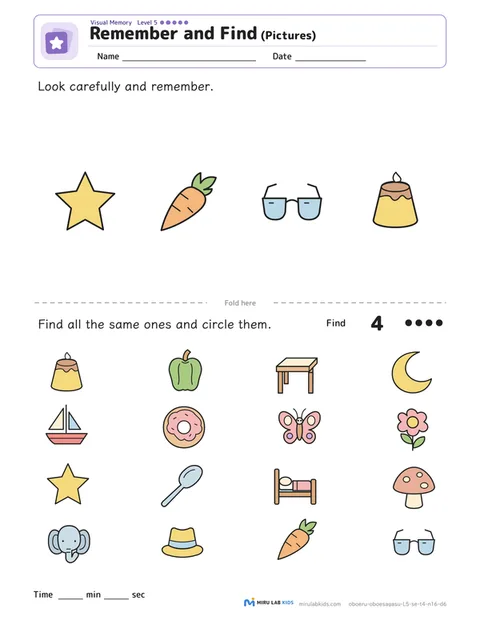
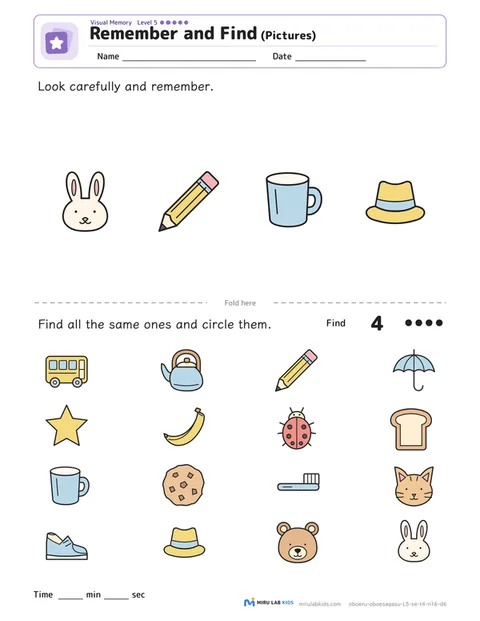
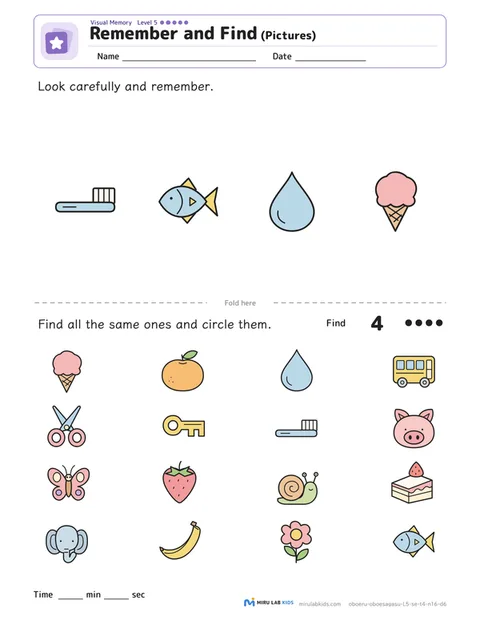
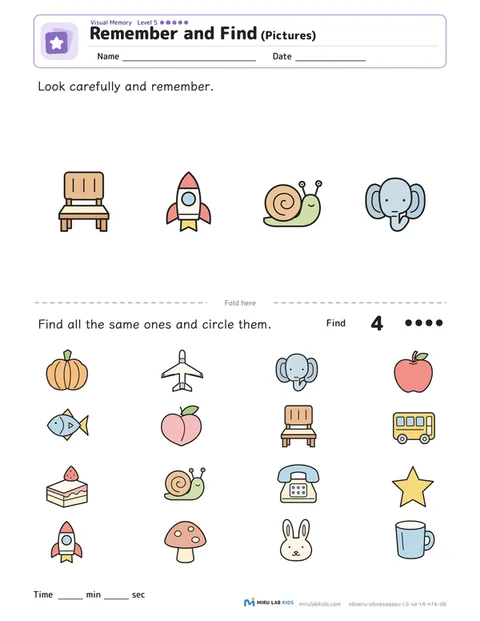
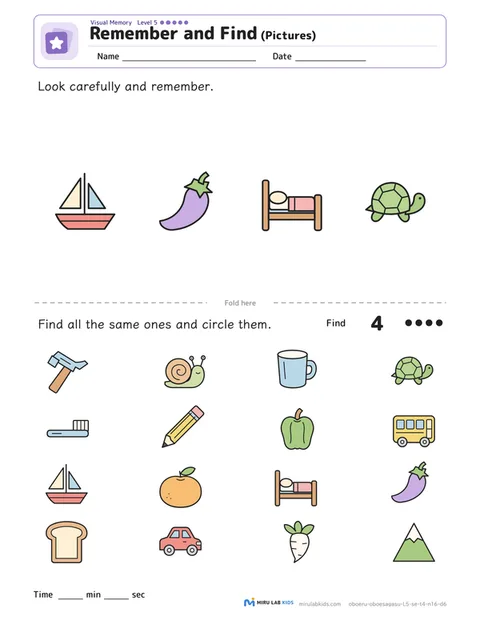
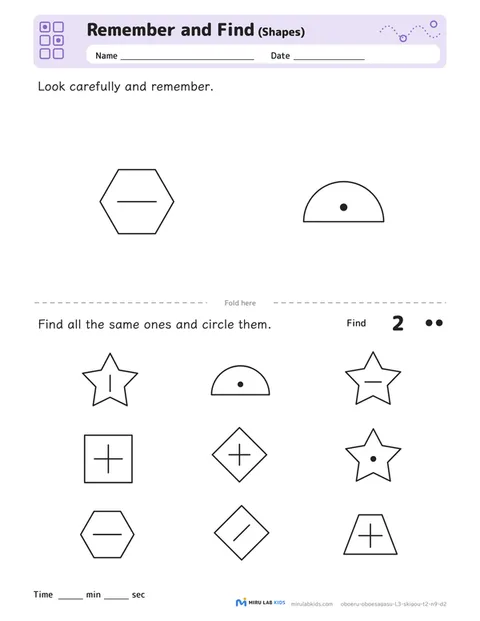
Your child remembers the pictures on the top half of the page, folds the page along the dotted line in the middle to hide them, and then finds and circles every matching picture on the bottom half.The pictures are familiar things with names, such as apples and cars.The activity aims to build the ability to keep what you saw in mind, and to use that memory to search.At higher levels, there are more pictures to remember, and other pictures from the same group (such as different fruits) are mixed in.There is also a version with symbols, "Remember and Find: Shapes."
Color printing is recommended (black and white works too).
 Level 3 example ›
Levels
| Level 1 | 1 picture to remember, 4 below. No pictures from the same group. | 10 worksheets |
|---|---|---|
| Level 2 | 1 picture to remember, 6 below. No pictures from the same group. | 10 worksheets |
| Level 3 | 2 pictures to remember, 9 below. 2 other pictures from the same group are mixed in. | 10 worksheets |
| Level 4 | 3 pictures to remember, 12 below. 4 other pictures from the same group are mixed in. | 10 worksheets |
| Level 5 | 4 pictures to remember, 16 below. 6 other pictures from the same group are mixed in. | 10 worksheets |
Tips
- Show only the top half first, and wait until your child says "Got it!" There is no need to set a time limit.
- Then fold the page backward along the dotted line in the middle ("Fold here") to hide the top half, and find and circle every matching picture on the bottom half.
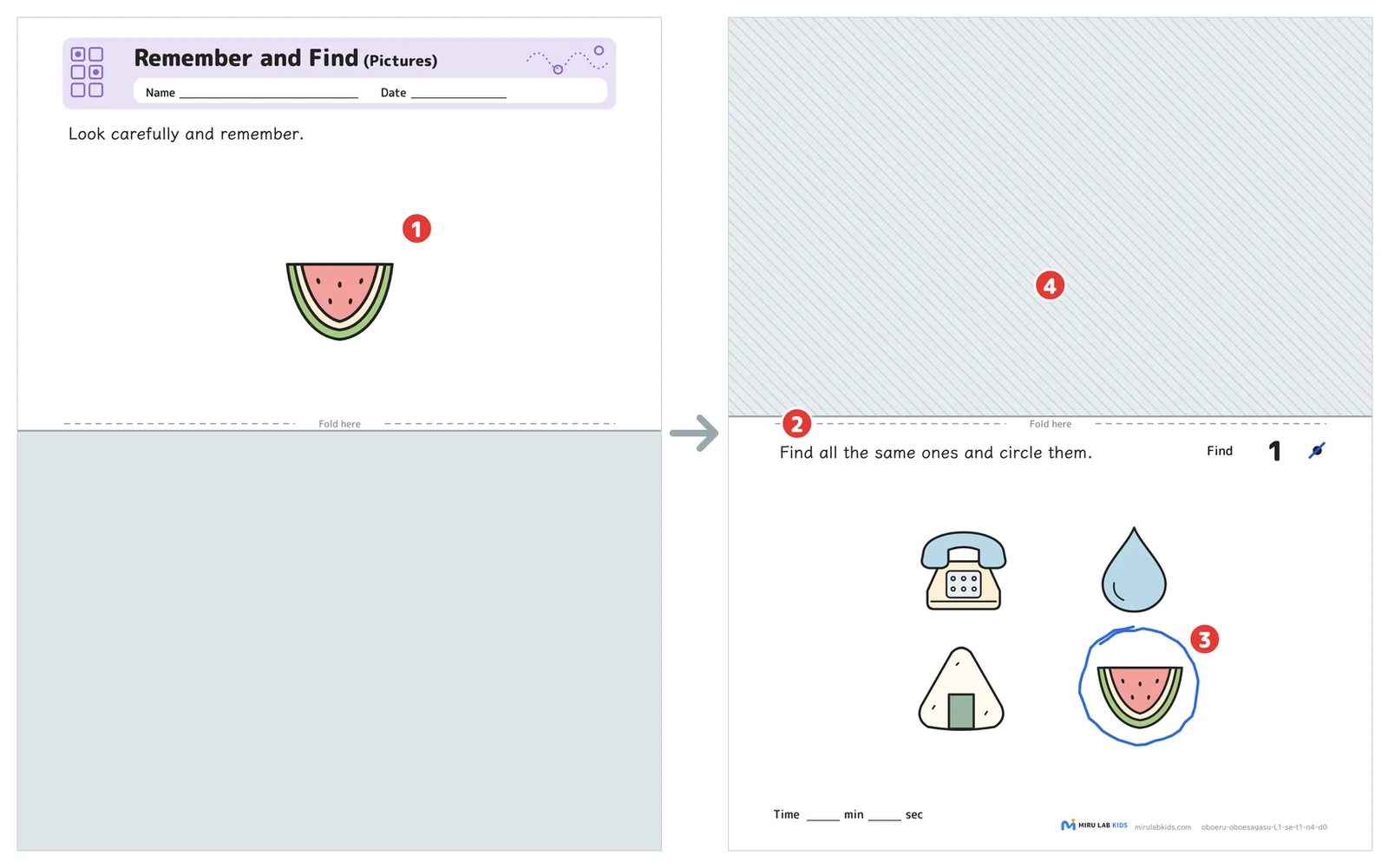
- Look at the top half onlyCovering the bottom half with a sheet of paper or a hand keeps your child from peeking ahead.
- Fold it backward along the dotted lineMake a firm crease so the top half stays hidden before your child starts.
- Circle it and cross off a dotThe "Find" number shows how many to find. Crossing off one dot each time shows how many are left.
- Unfold to checkWhen finished, unfold the page and compare with the top half. Your child can check the answers on their own.
For what to say, choosing a level and what to do if it is too hard, see Remember and Find: Pictures: a guide for grown-ups.
Worksheets
Choose a worksheet to open its printing page.
Print in bulk
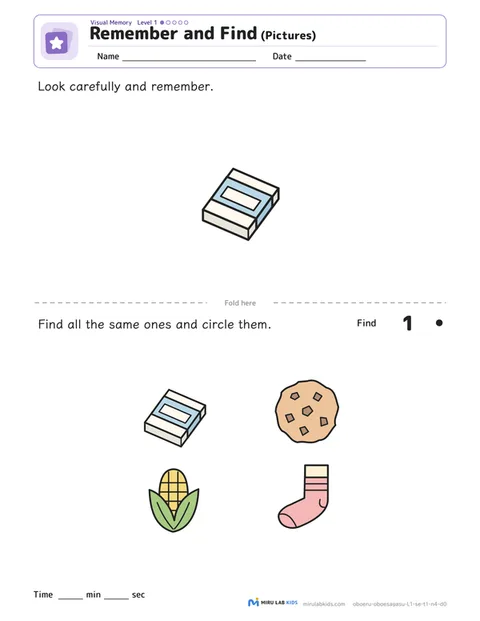
Level 11 picture to remember, 4 below. No pictures from the same group.
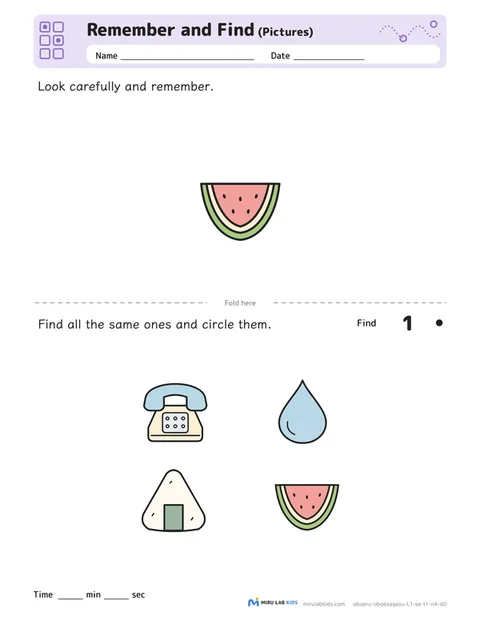
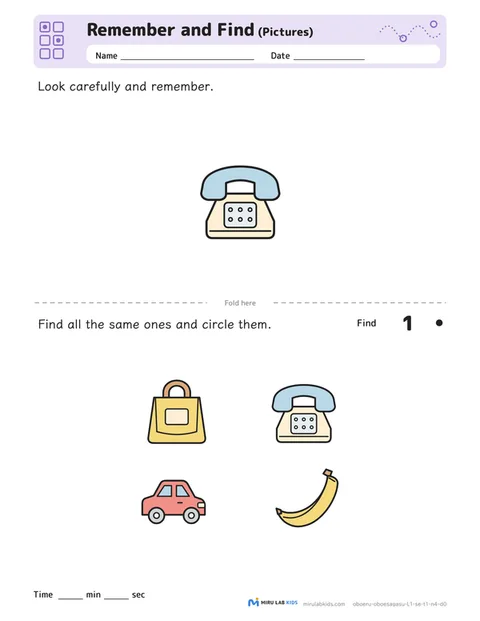
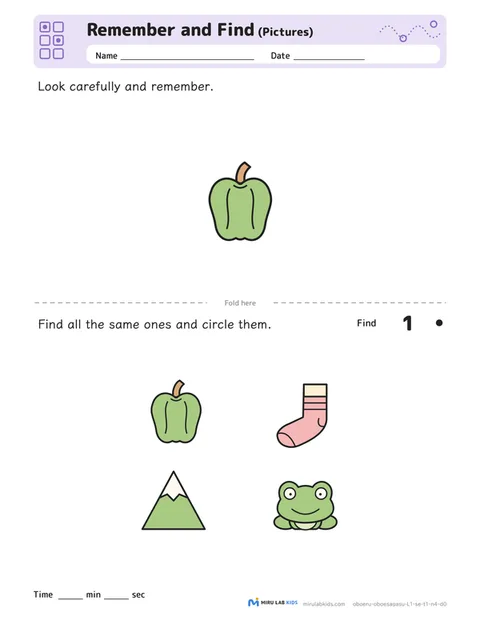
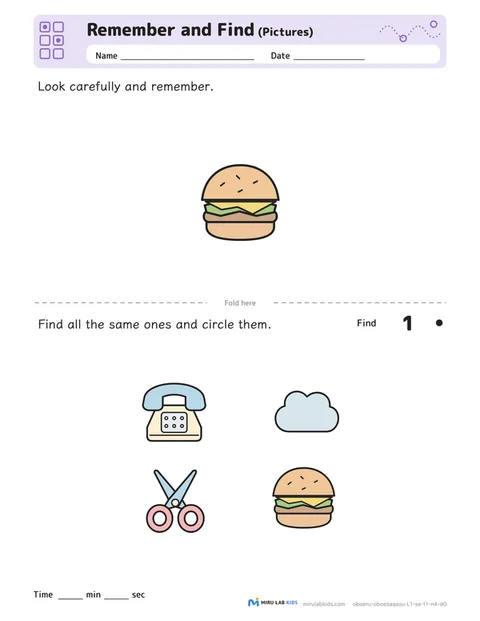
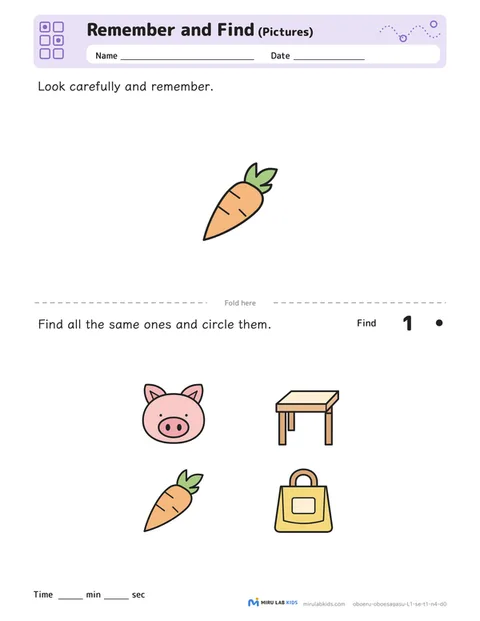
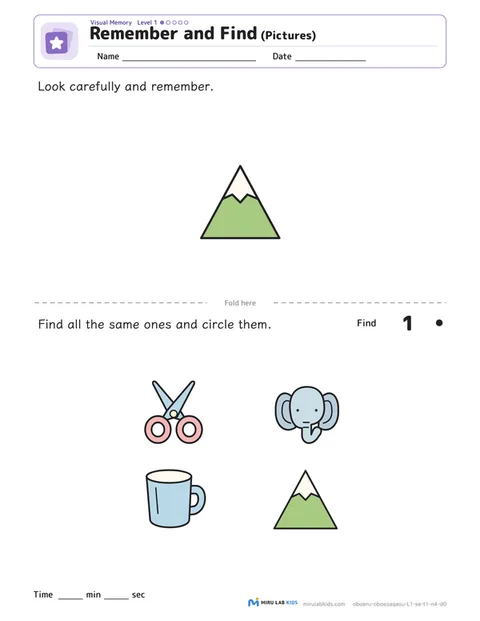
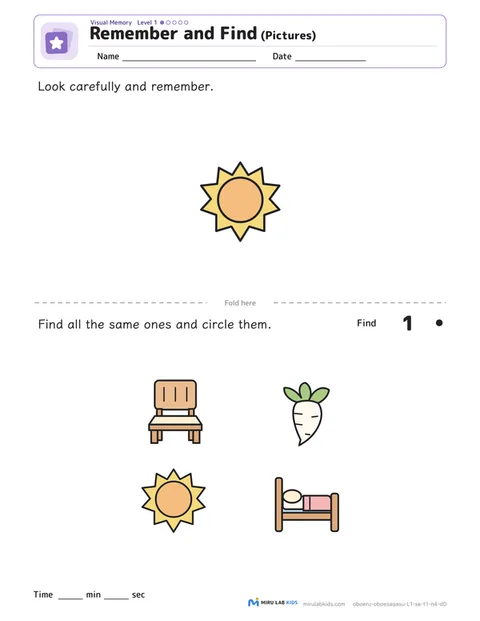
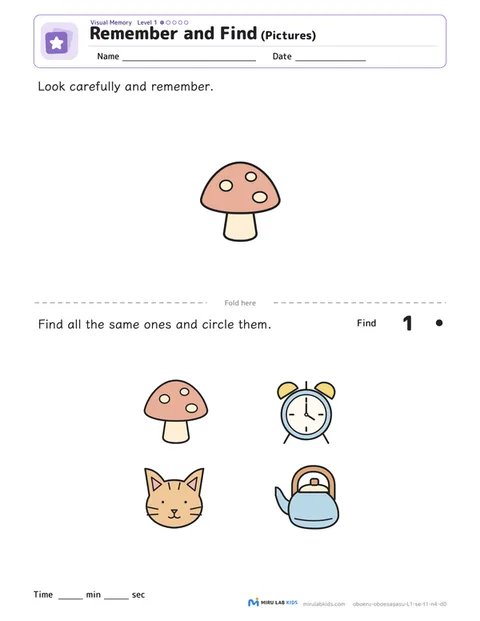
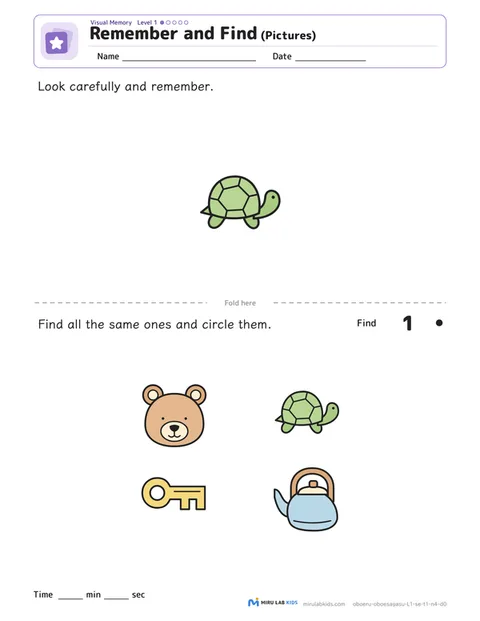
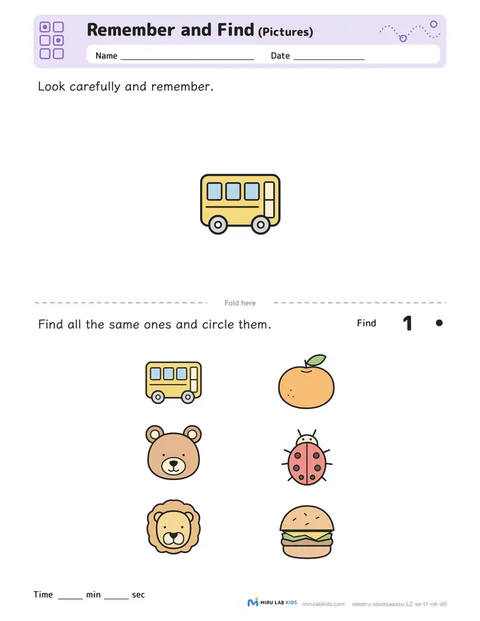
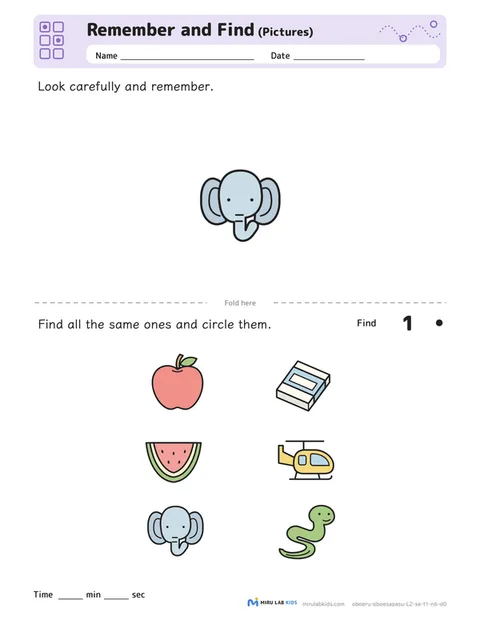
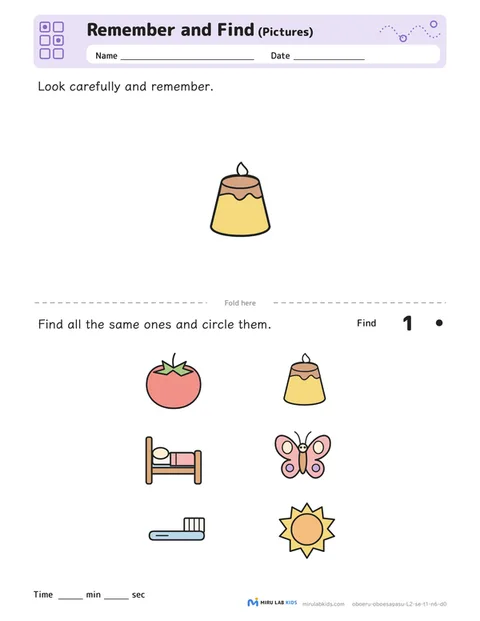
Level 21 picture to remember, 6 below. No pictures from the same group.
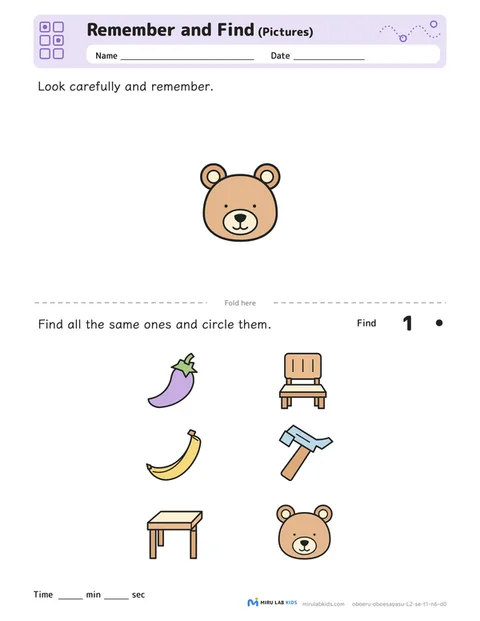
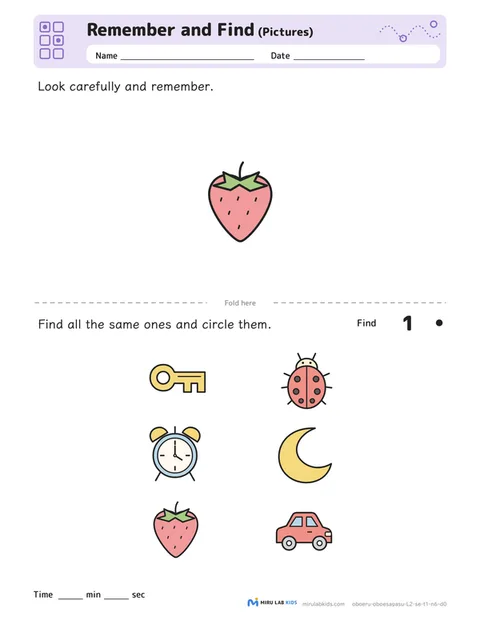
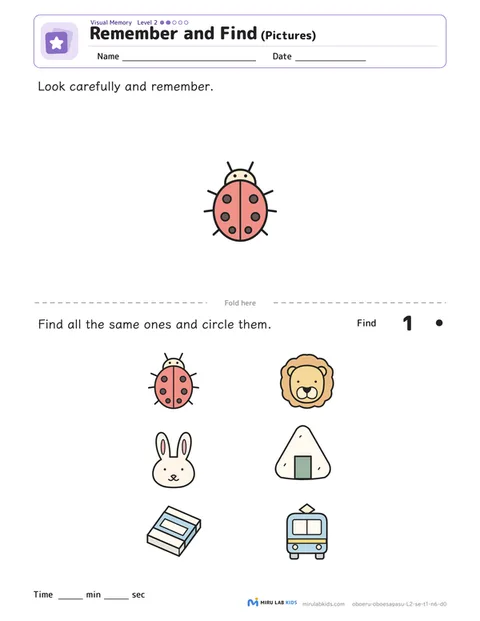
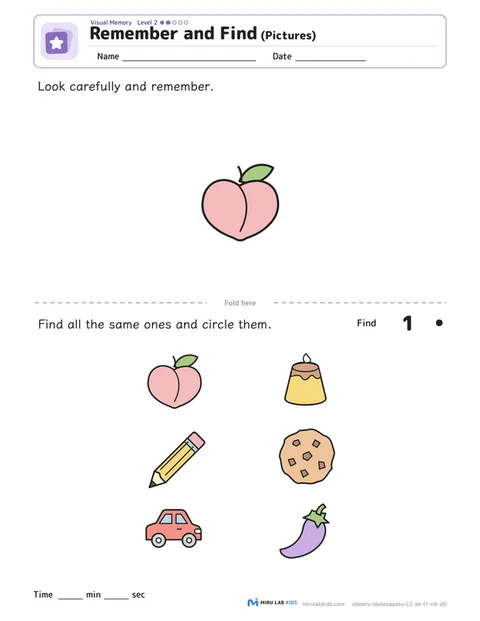
Level 32 pictures to remember, 9 below. 2 other pictures from the same group are mixed in.
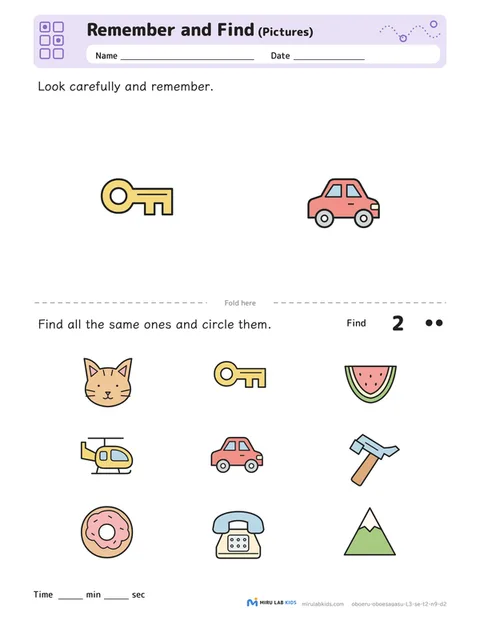
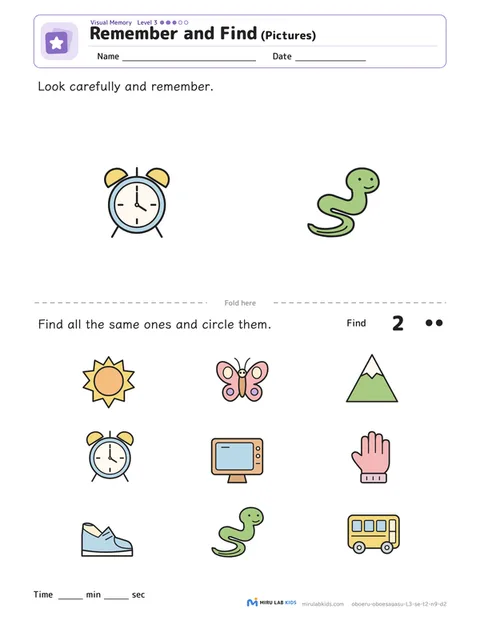
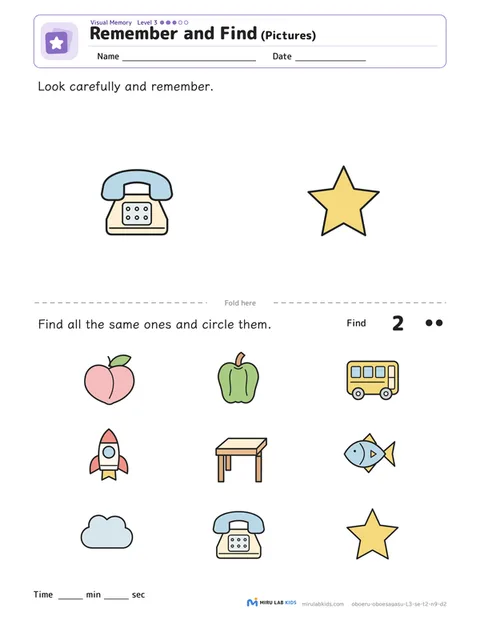
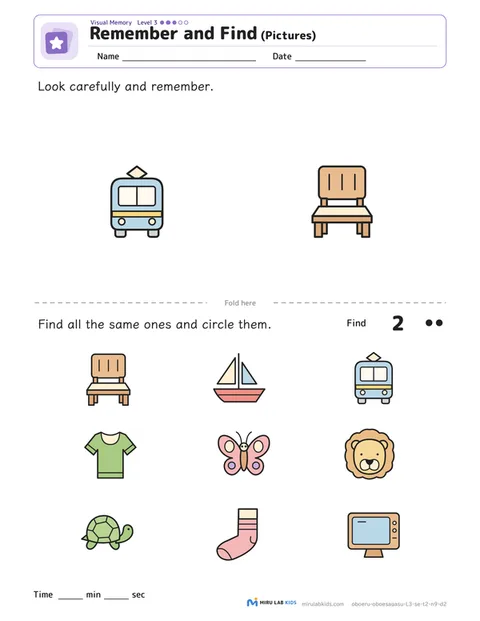
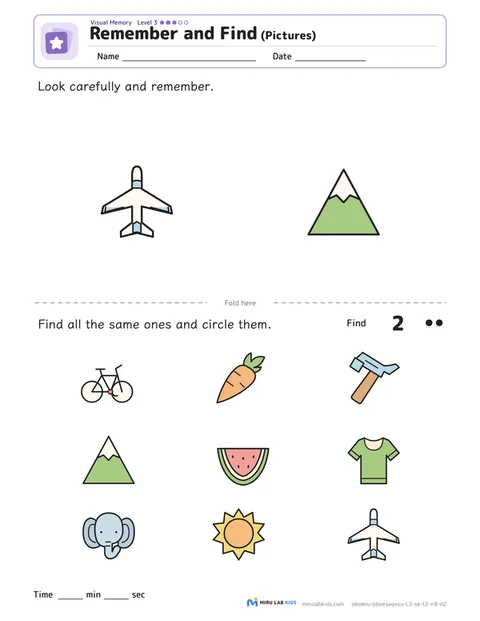
Level 43 pictures to remember, 12 below. 4 other pictures from the same group are mixed in.
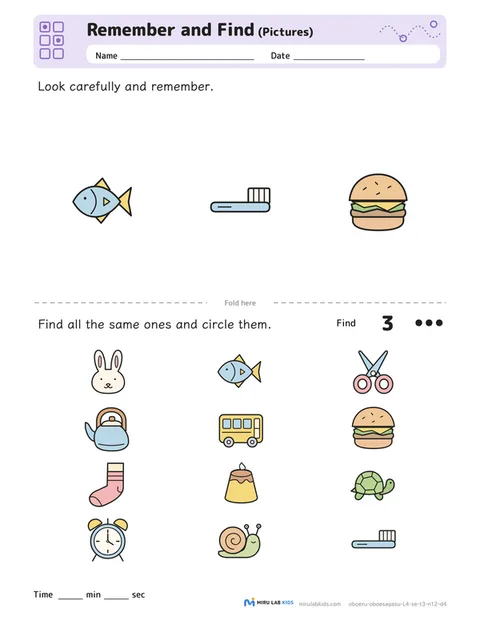
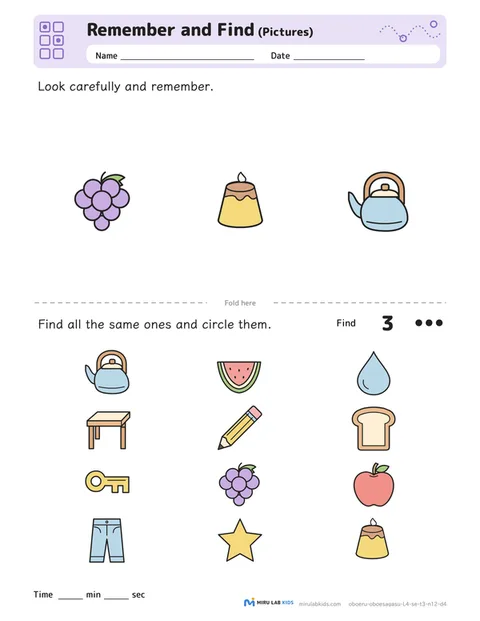
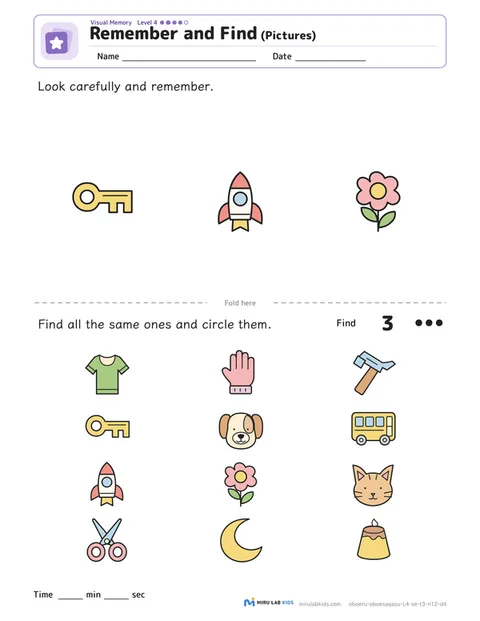
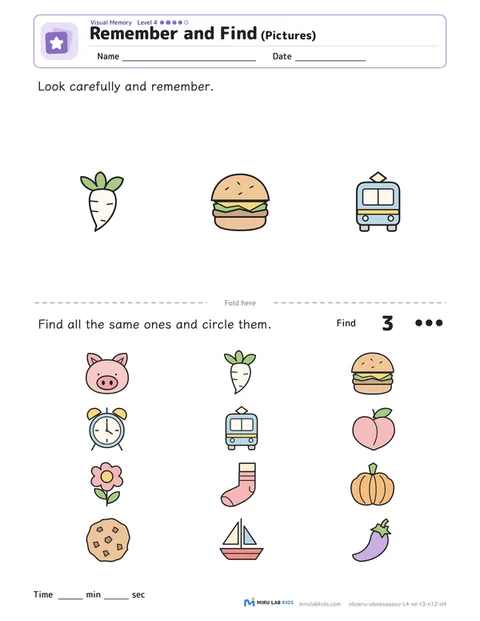
Level 54 pictures to remember, 16 below. 6 other pictures from the same group are mixed in.
Remember and Find: Pictures: a guide for grown-ups
Who it is for
- Holding things in mind is hardPractice keeping what you saw in mind after it is hidden.
- Slow at copying from the boardIf a child can hold only a little in mind, they have to look back at the board again and again. Practice remembering by looking.
- Symbols are too hardFamiliar pictures such as apples and cars are easier for some children than symbols.
- Remembers only roughlyOther pictures from the same group are mixed in, so your child practices remembering exactly which one (Levels 3 to 5).
- Short sessionsOne page is quick, so it fits into spare moments.
- Therapy and classroom sessionsAll you need is one sheet of paper and a pencil.
Choosing a level
Found them all happily
- Go up one level.
- Set a time limit for remembering (for example, 10 seconds).
- Try the symbol version, "Remember and Find: Shapes."
Circles pictures from the same group or cannot remember them all
- Go down one level.
- Say the names of the pictures together while remembering.
What to watch for
| Remembering | Does your child look at the details of the picture? Or remember it only roughly, such as "a fruit"? |
|---|---|
| Saying names | Some children say the names of the pictures out loud while remembering. To focus on remembering by looking, try doing it without saying the names. |
| Time to remember | You can also time how long it takes to say "Got it!" and note it in the margin, to compare when you repeat the activity. |
| Search | Does your child search the bottom half from the top down without missing any? Or stop after finding one? |
| Same group | Does your child circle other pictures from the same group? (Levels 3 to 5) |
| Record | Writing the number correct and the number of peeks on the Memory Log makes it easier to compare when you repeat the activity. |
If something keeps worrying you, it can help to talk with an eye doctor or another specialist rather than deciding on your own.
Things you can say
- Before startingLook closely and remember.Show only the top half and let your child know what to remember.
- While rememberingTell me when you've got it.Do not rush. Wait until your child says "Got it!"
- When stuckThree in all. One more to go.Say only how many are left. Do not point to where they are.
- When finishedLet's unfold it and look.Unfolding the page and comparing shows what was remembered and what got mixed up.
- Next timeYou didn't mix up the look-alike today!Point out something your child got wrong before and can do now.
FAQ
Is there an answer page?
Yes. Page 2 of the PDF is the answer page. You can also unfold the page and compare with the pictures at the top.
How much should we do at a time?
There is no set amount. One or two sheets at a time is a good guide, and it is best to stop while your child still wants a little more. See "Every Day? How Much?" for more.
Articles
- What Is Visual Perception? More Than Good Eyesight
- Why Does My Child Put Clothes On Backwards or Inside Out? Getting Dressed Uses More Visual Skills Than You Think
- When a Child Has Trouble Catching a Ball: Breaking It Down from "Tracking" to "Reaching"
- When a Child's Tracing Slips onto Another Shape: Understanding Figure-Ground Perception
About the code at the bottom right
The code at the bottom right of each worksheet (for example, oboeru-oboesagasu-L1-se-t1-n4-d0) shows its difficulty settings. Worksheets with the same code have the same difficulty. If you contact us about a worksheet, including this code helps us find it right away.
 Shape Recognition
 Spatial Relations
 Visual Scanning
 Visual-Motor Skills
 Visual Planning