When a Child Has Trouble Catching a Ball: Breaking It Down from "Tracking" to "Reaching"
"Their hands never come out in time.""The ball hits their body, and then their hands close."When a child has trouble playing catch, people tend to think, "Maybe they're just not athletic."But in the second or so before a ball is caught, many things are happening in the body at once.This article breaks catching into four parts, looks for clues in how a child misses, and shares a way to practice at home, at school, or in therapy.
Catching means doing four things in one second
A ball tossed gently from about 10 feet (3 meters) away reaches the hands in about one second.In that time, we do all of these things:
Up to the catch
- Track the ballfind the ball as it leaves the thrower's hand, and keep following it with the eyes
- Judge distance and speedestimate where and when the ball will arrive
- Time the handsbring the hands to that spot and close them at just the right moment
- Keep the body steadyall the while, hold the body so it doesn't wobble

The first three happen in order, and the fourth, keeping the body steady, runs from start to finish.If any one of them doesn't work well, the ball is more likely to be missed.When "Watch the ball!" doesn't change anything, the child may be struggling at a point that effort alone can't easily fix.
Looking for clues in how a child misses
Watching closely how a child misses can give clues about where they are struggling.

| How the child misses | What may be involved |
|---|---|
| Hands close after the ball has hit the body | Not tracking the ball, hands moving too late |
| Hands close before the ball arrives | Estimating the time until arrival, timing of closing the hands |
| Hands reach the wrong spot (the ball passes beside them) | Estimating distance and height, bringing the hands to where the eyes are looking |
| Keeps looking at the thrower's face, not at the ball | Finding the ball and starting to track it |
| Turns the face away, shuts the eyes | Fear of the ball, keeping the eyes on an approaching ball |
| Staggers or leans back on the catch | Keeping the body steady, getting ready before the ball arrives |
Often, several reasons overlap in a single kind of miss.
Tracking: the ball "suddenly appears right in front of me"
At the after-school day programs for children with developmental needs where I work, the child I see most often is the one whose hands come out late and don't make it in time.Watching closely, I often feel that the problem starts before the hands: the child is not tracking the ball with their eyes.
If a child loses track of the ball partway, then for that child the ball becomes "something that suddenly pops up right in front of me."Starting to move the hands only after seeing it is already too late.It is not that the hands are slow. The cue to start moving arrives late.
Research has shown the same thing.One study looked at children's eye movements while they threw a ball against a wall and caught it on the rebound (Wilson et al., 2013).Children with poorer motor coordination tracked the ball for a shorter time before the catch than well-coordinated children did.The ball was in the air for about the same time for all the children.And what made the difference in whether the ball was caught was the length of this tracking time.
The eye movement that smoothly follows a moving object is called smooth pursuit.For more, see "Smooth Pursuit and Saccades."
Judging distance and speed: where and when will it arrive?
Once the eyes are on the ball, the next step is to estimate where and when it will arrive.
One cue comes from using both eyes.We sense depth from the small difference between what the right eye and the left eye see.In a study of adults catching a ball with one hand, people caught more balls with both eyes open than with one eye, and the gap grew as the ball got faster (Mazyn et al., 2004).For people with weak stereo vision, however, using both eyes made no difference compared with one eye.
Another cue is how large the ball looks.An approaching ball looks bigger and bigger.From how fast it grows, we read "how long until it gets here."One experiment used a special ball that slowly deflated as it flew (Savelsbergh et al., 1991).Because this ball seemed to grow more slowly than a normal ball, the catchers closed their hands slightly later.
The ability to predict where a moving object is headed begins to appear in infancy.Babies reaching for a moving toy have been found to aim their hand not at where the toy is now, but at where it is about to be (von Hofsten, 1980).From there, over a long time, the range of what a child can predict widens: faster things, smaller things, things that fly in an arc.
Timing the hands
Once the place and time are known, the hands move there and close at just the right moment.Too early, and the ball hits the back of the hand or the fingertips. Too late, and it slips through.
The way a child catches changes little by little with experience.Research on how children's catching develops suggests it changes roughly in this order (Strohmeyer et al., 1991):
Catching changes little by little
- Scooping with the armswaits with arms held out, then pulls the ball in against the chest
- Trapping with arms and handsstill uses the chest, but the hands also hold the ball
- Catching with the hands onlymoves the hands to the height of the ball and catches it in the hands alone
Scooping the ball against the chest is not a failure. It is a stage on the way to catching with the hands.Stopping a big ball against the chest is also practice in timing.
Meanwhile, keeping the body steady
As a physical therapist, this fourth part is the one I watch most closely.
When a ball lands in the hands, the hands take its weight and momentum.The body does not brace itself after the ball hits.In an experiment where people caught a falling ball in one hand, the arm muscles started working shortly before the ball reached the hand (Lacquaniti & Maioli, 1989).What's more, how hard they worked changed with the weight of the ball and the height it fell from.The body predicts the force that is coming and gets ready in advance.
It is not only the arms.When the arms go forward, the body's center of mass moves forward too.The arms can go where we want them because the feet are pressing into the floor and the stomach and back are holding the body up.
When the body is wobbly, these things tend to happen:
- The head sways, making the ball harder to track
- The body sways every time the arms go out, so the hands don't settle in one place
- The force of the ball sends the child staggering backward
A child who wobbles when catching while standing may find it easier sitting on a chair, kneeling tall on the floor, or standing with their back against a wall.If changing position makes catching easier, that is a clue that body stability is involved.A ready stance, with feet shoulder-width apart and knees slightly bent, also helps keep the body steady.
"It's scary" is an important clue too
Turning the face away, shutting the eyes, pulling the body back.These are natural reactions to protect the body from something coming toward it.
But a child who turns away can no longer see the ball, which makes it even harder to catch.And when a missed ball hits the body, it gets scarier still.
When a child is afraid, switching to something that doesn't hurt and moves slowly helps more than saying "Don't be scared."A balloon, a scarf that floats down, or a soft foam ball are good choices.The experience of "I kept my eyes on it all the way" becomes the next step forward.
Catching with a box: practicing only "tracking" first
Here is the approach we use at our after-school day programs.
For a child who struggles with catching, doing all four things at once is very hard.So at first, the child does not catch with the hands. They catch with a box.
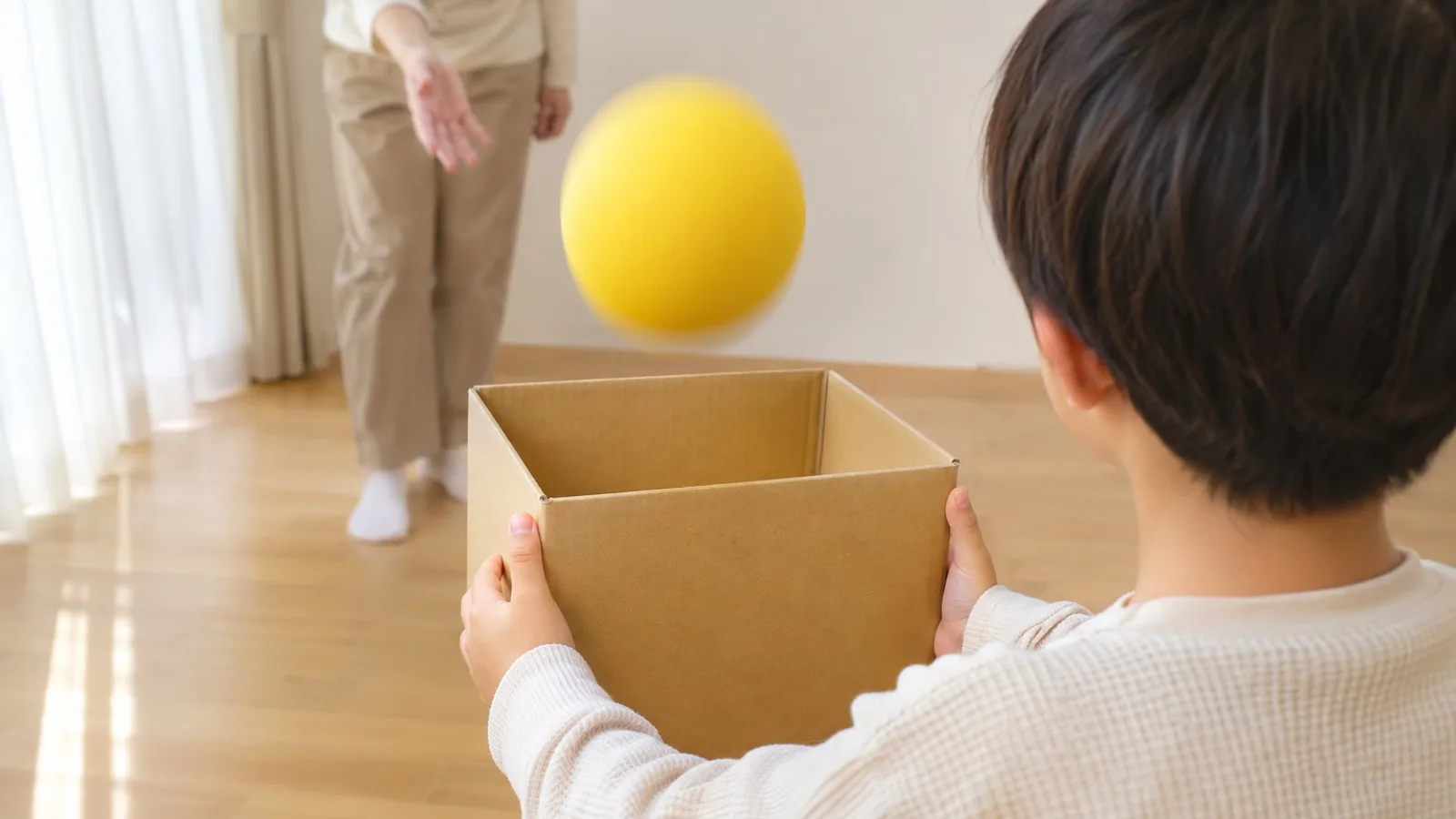
Have the child hold a box with both hands.The adult takes a large ball in an easy-to-see color and tosses it gently underhand into the box.
Catching with a box takes no timing of closing the hands.The opening of the box is much wider than the hands, so the ball goes in even if the spot is a little off.The child can put all their effort into one thing: following the ball with their eyes to the very end.
As the child gets used to it, add to what they do, a little at a time.
From box to hands, step by step
- Waiting with the boxthe adult drops the ball into the box where the child is holding it (tracking only)
- Meeting the ball with the boxthe ball comes a little off target, and the child moves the box to catch it (matching the place)
- A smaller containerswitch to a shallow box, a colander, or a hat (matching the place more exactly)
- Catching with the handscatch a large soft ball or a balloon with both hands (timing is added)
The sign that a child is ready for the next step is that their eyes stay on the ball until it lands in the box.As you toss, try watching the child's eyes rather than the ball.
Research in pediatric rehabilitation also includes practice that starts with how the eyes are used.In one study, children with developmental coordination disorder (DCD), a condition marked by difficulty coordinating movement, practiced throwing a ball against a wall and catching it (Miles et al., 2015).One group practiced using their eyes: "Before you throw, look closely at the spot on the wall you are aiming for," and "Follow the rebounding ball with your eyes until it is in your hands."Compared with a group that practiced the throwing and catching movements, this group came to track the ball longer, and their catching changed as well, such as bending the elbows to cushion the ball.
Six dials for adjusting difficulty
Whether with a box or the hands, changing these six things lets you fine-tune the difficulty.
| What to change | Easier | Harder |
|---|---|---|
| Speed | Balloon, scarf, rolled ball | Throwing a regular ball |
| Size | Big enough to hug with both arms | Small enough for one hand |
| Softness | Foam, cloth, beach ball | Hard ball |
| Color | Stands out clearly from the background, the child's favorite color | Close to the background color |
| Path | Rolled, one bounce, gentle underhand toss | Overhand throw, off to the left or right |
| Distance | Close (3 to 6 feet, or 1 to 2 meters) | Far |
On color, one study found that young children caught better with a ball in the color they liked best (Isaacs, 1980).A white ball thrown in front of a white wall is hard to see, so check what is behind the thrower too.
Change only one thing at a time.If it stops working, go back one step.
Examples of what to say during catch
- Before the tossHere's the ball. Ready? One, two, three!Showing the ball before tossing makes it easier to start tracking it
- After a catchYou watched it all the way!Put the tracking into words, rather than whether the ball was caught
- After a missSo close! Which way did the ball go?Ask a question so the child can notice for themselves
Missing is valuable experience too
When a child drops the ball, they feel it in their body: "My hands were late," or "It was a little farther forward."Feeling this gap gives them the clue for getting the timing right next time.
If the adult keeps tossing so the ball lands perfectly in the child's hands every time, the child can catch it without moving their hands at all.Keeping plenty of successes while tossing a little off target now and then gives the child more chances to adjust by themselves.Chasing and picking up a dropped ball is also a good chance to track a rolling ball with the eyes.
Of course, if misses pile up until the child says "I don't want to do this anymore," nothing is gained.A difficulty where the child succeeds about 7 or 8 times out of 10 is a good guide for keeping it going.
Worksheets that connect
Worksheets are a desk activity where the eyes work on lines and numbers that stay still.They are not a substitute for practicing with a ball in the air.But they do let a child build up, in a calm setting, the experience of "keeping the eyes on one thing all the way to the end" and "bringing the hand to where the eyes are looking."
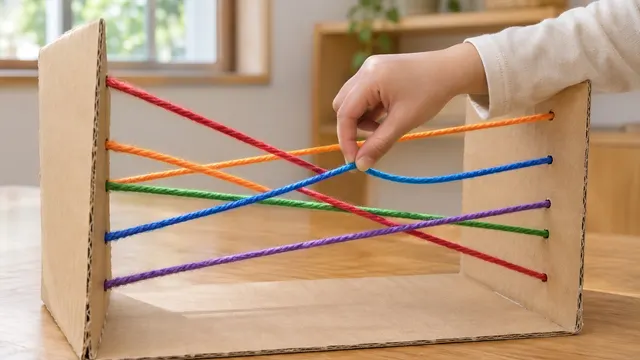
- Follow the Lines: follow one line with the eyes to the end, among tangled lines
- Mazes: follow the path with the eyes and move the pencil while looking a little ahead
- Number Hunt: search for the next number and bring the hand to where it is
- Pencil Obstacle Course: watch the course and steer the pencil without touching the walls
For how much to do in a day and how to keep going, see "Every Day? How Much?."
Things to keep in mind
The reasons for trouble catching differ from child to child.
- First, have an eye doctor check for any problem with eyesight or with how the two eyes work together
- If clumsiness in movement also stands out in other areas, such as getting dressed, eating, or handwriting, talk with your child's teacher, an occupational therapist, a physical therapist, or a pediatrician
In pediatric rehabilitation, international recommendations have been published on developmental coordination disorder (Blank et al., 2019).They recommend practice that works on the very activity the child wants to be able to do.If a child wants to get better at catching, the most direct route is catching itself, at a difficulty that fits that child.A study that compared the catching of children with DCD with that of younger children who caught the same number of balls found more grasping errors and a different way of using the body in the children with DCD (Van Waelvelde et al., 2004).When things don't go well, it is not necessarily for lack of practice.
Final thoughts
Playing catch is built from several things working together: tracking the ball, judging distance, timing the hands, and keeping the body steady.When doing all four at once is hard, try starting with a box, and with tracking alone.
Once you know where the child is struggling, you can see more ideas to try besides "Watch the ball."I hope this article gives you a slightly different angle from which to see a game of catch with your child.
Studies referred to
- Wilson MR, Miles CAL, Vine SJ, Vickers JN. Quiet eye distinguishes children of high and low motor coordination abilities. Medicine & Science in Sports & Exercise. 2013;45(6):1144-1151.
- Land MF, McLeod P. From eye movements to actions: how batsmen hit the ball. Nature Neuroscience. 2000;3(12):1340-1345.
- Mazyn LIN, Lenoir M, Montagne G, Savelsbergh GJP. The contribution of stereo vision to one-handed catching. Experimental Brain Research. 2004;157(3):383-390.
- Savelsbergh GJP, Whiting HTA, Bootsma RJ. Grasping tau. Journal of Experimental Psychology: Human Perception and Performance. 1991;17(2):315-322.
- von Hofsten C. Predictive reaching for moving objects by human infants. Journal of Experimental Child Psychology. 1980;30(3):369-382.
- Strohmeyer HS, Williams K, Schaub-George D. Developmental sequences for catching a small ball: a prelongitudinal screening. Research Quarterly for Exercise and Sport. 1991;62(3):257-266.
- Lacquaniti F, Maioli C. The role of preparation in tuning anticipatory and reflex responses during catching. The Journal of Neuroscience. 1989;9(1):134-148.
- Miles CAL, Wood G, Vine SJ, Vickers JN, Wilson MR. Quiet eye training facilitates visuomotor coordination in children with developmental coordination disorder. Research in Developmental Disabilities. 2015;40:31-41.
- Isaacs LD. Effects of ball size, ball color, and preferred color on catching by young children. Perceptual and Motor Skills. 1980;51(2):583-586.
- Van Waelvelde H, De Weerdt W, De Cock P, Smits-Engelsman BCM, Peersman W. Ball catching performance in children with developmental coordination disorder. Adapted Physical Activity Quarterly. 2004;21(4):348-363.
- Blank R, Barnett AL, Cairney J, et al. International clinical practice recommendations on the definition, diagnosis, assessment, intervention, and psychosocial aspects of developmental coordination disorder. Developmental Medicine & Child Neurology. 2019;61(3):242-285.