Can Read Letters but Can't Write Them? Four Ways to See Where Writing Gets Stuck
"My child can read all the letters, but when it's time to write them, they just don't come."At the after-school day program for children with developmental needs where I work, this is something I often hear from parents.If a child can read a letter, surely they can write it. Thinking that way, it can seem puzzling.But for the brain, reading and writing are quite different jobs.This article breaks writing into several steps, shows a way to see where a child is getting stuck, and shares ideas you can try at home.
Reading and writing use different skills
Even adults have words they can read but can't write without help."Necessary": one c or two? "Rhythm"? "Embarrass"?You read these words instantly, yet when you try to write them from memory, many of us hesitate.
When a child struggles to write letters, something similar may be happening.
When reading, the letter is right in front of you.You don't need to remember every detail of its shape. If you can spot what makes it different from other letters, like "this part is round" or "this part sticks up," you can tell which letter it is.With n and h, for example, you can tell them apart just by whether there's a tall line.
When writing, the letter isn't in front of you.You have to recall the whole shape, down to the details, and then move your hand in the right order and direction to put it on paper.

In other words, being able to read a letter means "I know this shape."Being able to write it means "I can recall this shape without looking, and produce it with my hand."Even for the same letter, writing uses more skills.
Comparing four ways of writing shows where a child is stuck
"Can't write" doesn't mean every child is stuck in the same place.Comparing these four ways of writing can give you clues.

| Way of writing | Main skill used | If the child gets stuck here, it may be |
|---|---|---|
| 1. Copy from an example | Seeing a shape and producing it with the hand | Seeing shapes, moving the hand as intended |
| 2. Look at the example, then cover it and write | Holding a shape in memory | Keeping a shape in mind after seeing it |
| 3. Write a letter you hear | Recalling a shape from its name or sound | Linking sounds and letters, recalling the shape |
| 4. Can write, but slowly or with tiring | Keeping the hand and body working | Finger movement, posture, pencil grip |
For 1. Copy from an example, put the example right next to the writing paper.If the example is far away, the child has to hold the shape in mind while moving the eyes.Then the memory skill from 2 gets mixed in, making it hard to tell which one they're stuck on.How hard it is when the example is far away is covered in "Slow at Copying from the Board?"
If the child can do 1 but stops at 2, they can see the shape, and may be stuck at holding it in memory.If they can do 2 but stop at 3, they can remember the shape, but calling it up from the sound may be what's hard.If they can do 1 through 3 but it takes a very long time or tires them out quickly, look at 4: the hand and body.If letters go off the lines, or the child writes with the wrist or arm, "When Handwriting Won't Stay on the Lines" may also help.
Try it at home
Trying all four with the same letters makes the differences easier to see.
- Choose about five letters your child can read well (for example, a, b, g, k, s)
- 1: Put the example right next to the paper and have your child copy it
- 2: Show each letter for a few seconds, cover it with paper, and have your child write it
- 3: Without showing an example, just say it: "Write the letter b"
- 4: Throughout, watch how long it takes, and whether the child shakes out their hand or their posture slumps
Writing down the results like this makes it easier to compare later (example below).
| Letter | 1. Copy | 2. Covered | 3. From sound | Notes |
|---|---|---|---|---|
| a | ○ | ○ | ○ | |
| s | ○ | ○ | △ | Wrote it backward |
| b | ○ | △ | × | Mixed it up with d |
| g | ○ | △ | × | Tail curled the wrong way |
| k | ○ | ○ | △ |
A rough mark is enough: ○ = wrote it right away, △ = hesitated or the shape was a little off, × = couldn't recall it.In this example, the child could do all of 1, began to hesitate at 2, and often stopped at 3.They can see the shapes, so helping with "holding in memory" and "recalling from the sound" seems like a good place to start.
This isn't for deciding what the child "can" or "can't" do.Please use it as one clue for thinking about where to start helping.Rather than deciding from one try, look again a few times on different days, and you'll also see how much it varies with the day's condition.
Mirror writing comes from how the brain naturally works
Children sometimes write letters backward, like b for d, or a reversed s.This is called mirror writing, and it's common among children who are just starting to learn letters.
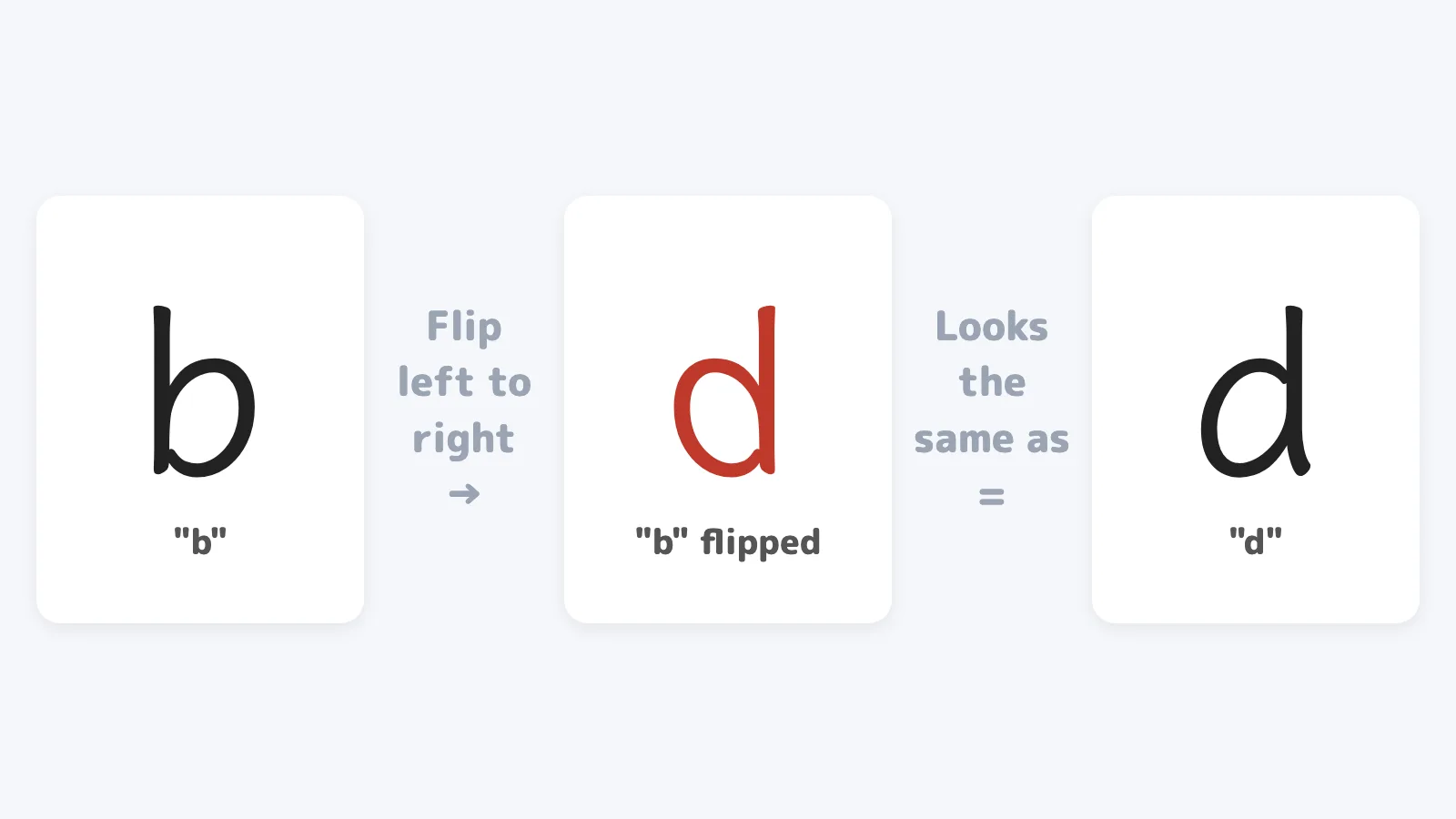
In fact, our brains have a built-in tendency to see left-right mirror images as "the same thing."A cat facing right and a cat facing left are the same cat.This is very handy for recognizing the things around us.
But with letters, a different left-right direction makes a different letter.A study of the part of the brain that works when we read found that adult brains responded to mirrored pictures as "the same," but did not respond to mirrored letters as "the same" (Dehaene et al., 2010).It is thought that while learning to read and write, the brain changes so that this tendency stops working for letters only.
Mirror writing can be seen as a stage along that path.Left and right directions settle bit by bit, through the experience of writing and comparing again and again.
Letter shapes are remembered by the hand, too
Have you ever traced a word in the air or on a table with your finger while trying to remember how to write it?In Japan, this is so common it has a name: kusho, or "air writing." People often do it when trying to recall complex kanji characters.In a Japanese experiment where participants had to work out a character by combining kanji parts, almost all of the 105 participants were seen air writing (Sasaki & Watanabe, 1983).Air writing with a surface to write on, such as a desk, helped them answer correctly.Later research also reported that moving the finger helps recall the shapes of characters (Itaguchi et al., 2015).
Letter shapes are remembered not only through the eyes, but also through the movement of the hand.
In one study, young children practiced learning letters either by writing them by hand or by typing them on a keyboard (Longcamp et al., 2005).Among the older children in the study, those who learned by handwriting were better at recognizing the letters afterward.Producing the shape with the hand is thought to help the way the shape itself is remembered.
So there are ways to learn letters using not just the eyes, but also touch and movement:
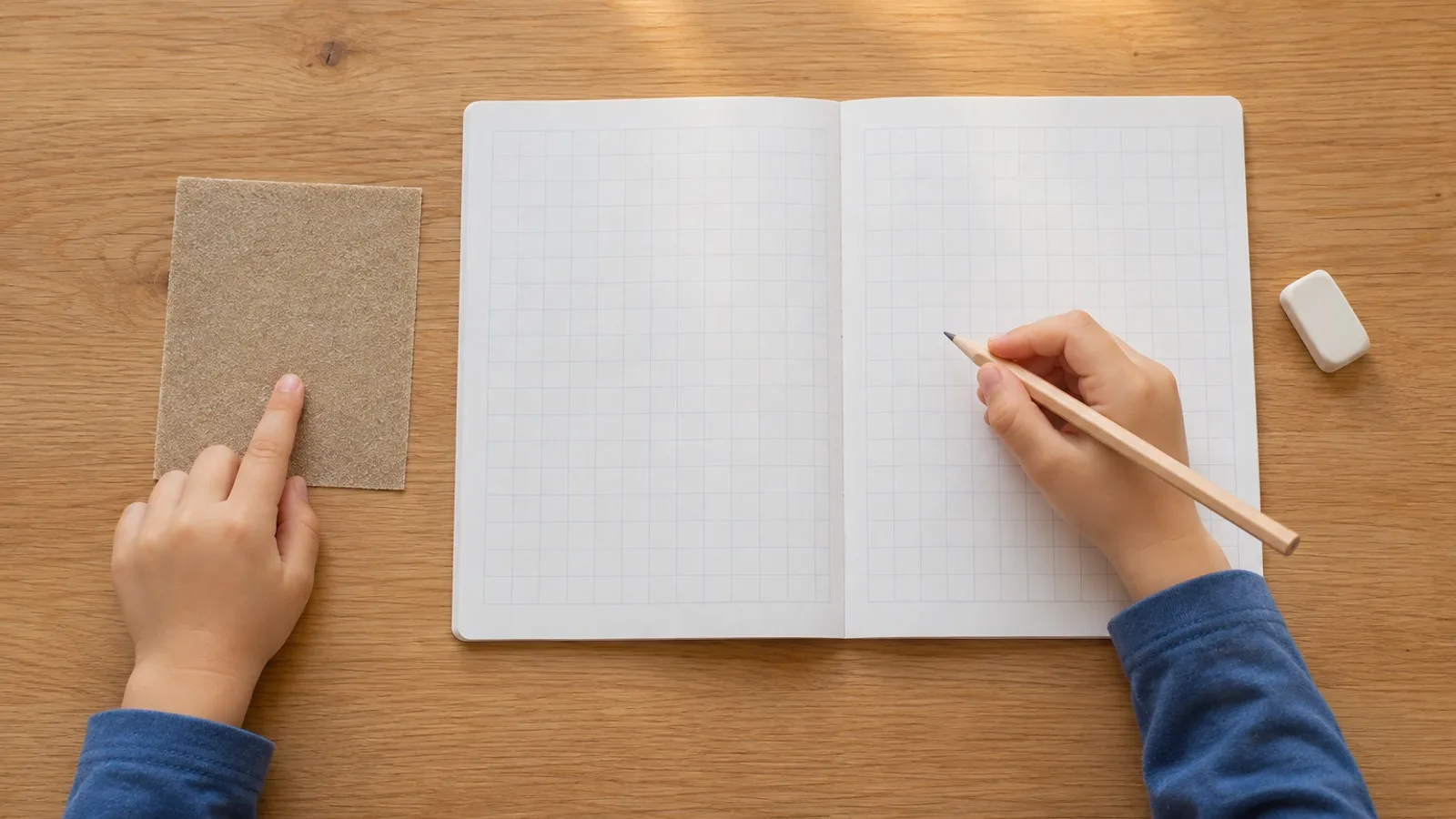
- Write on paper laid over sandpaper: the pencil tip meets just the right amount of resistance, and the gritty feel travels back through the pencil to the fingers and hand. This makes it easier to feel how the hand is moving.
- Draw letters on each other's palm or back with a finger and guess: the child pictures the shape from touch alone. Taking turns writing and guessing makes it a game.
- Trace letter shapes with a finger: with eyes closed, follow raised letters or thick, bold letters with a finger.
A study of about 130 first graders in Japan found that laying sandpaper under the paper improved scores on a task of drawing lines as intended (Shinjo et al., 2019).The difference was clearest for children who had found drawing lines hard to begin with.This study looked at whether children could draw lines neatly, not at whether they learned letter shapes.It's an easy idea to try first when the child seems stuck on the hand-and-body side (4), such as shaky lines or pressing too lightly or too hard.
Another study found that kindergarten children who practiced checking letter shapes by tracing them with their fingers, not just by looking, improved more in linking letters and sounds (Bara et al., 2004).
Related worksheets
These MIRU LAB KIDS worksheets work on skills close to those used in writing letters.
- Dot Grid Copying and Dot Grid Copying: Pictures: copy the same shape as the example by connecting dots. Close to "seeing a shape and producing it with the hand" in 1
- Symmetry Coloring: work out the mirror-image shape and color it. Practice for noticing left-right direction
- Find the Same Shape: tell apart the same shape among similar ones
- Remember the Order: Shapes and Remember and Find: Shapes: remember shapes you saw and recall them. Close to "holding a shape in memory" in 2
The worksheets are not letter-writing practice in themselves.Use them as a playful way to work on each of the skills that writing uses.Keeping a record on the tracking sheets makes changes easier to see.
Final thoughts
Between "can read" and "can write," there are several steps.Writing uses more skills than reading. It is hard work.
Comparing the four ways of writing shows how far your child can go, and where they stop.I hope this article helps you move forward one step at a time, starting from what your child can already do.
Studies referred to
- Dehaene S, Nakamura K, Jobert A, Kuroki C, Ogawa S, Cohen L. Why do children make mirror errors in reading? Neural correlates of mirror invariance in the visual word form area. NeuroImage. 2010;49(2):1837-1848.
- Sasaki M, Watanabe A. [The emergence and function of "kusho" (air writing) behavior: on the kinesthetic component of representation] (in Japanese). The Japanese Journal of Educational Psychology. 1983;31(4):273-282.
- Itaguchi Y, Yamada C, Fukuzawa K. Writing in the air: contributions of finger movement to cognitive processing. PLOS ONE. 2015;10(6):e0128419.
- Longcamp M, Zerbato-Poudou MT, Velay JL. The influence of writing practice on letter recognition in preschool children: a comparison between handwriting and typing. Acta Psychologica. 2005;119(1):67-79.
- Shinjo M, Kato T, Matsushima K. [Effects of sensory feedback on handwriting movements in school-age children] (in Japanese). LD Research. 2019;28(2):241-248.
- Bara F, Gentaz E, Colé P, Sprenger-Charolles L. The visuo-haptic and haptic exploration of letters increases the kindergarten-children's understanding of the alphabetic principle. Cognitive Development. 2004;19(3):433-449.