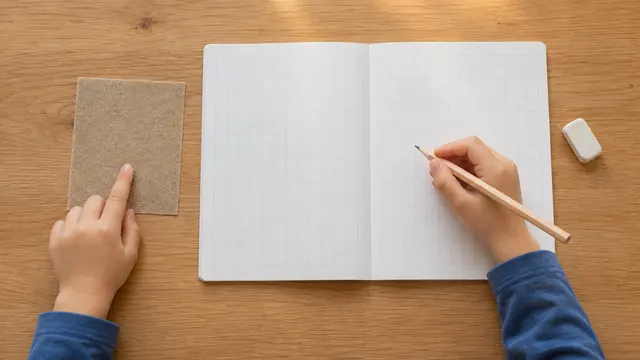
A Child Who Often Misses Things: Before Saying "Look Carefully," Look at How They Miss
Skipping one question on a worksheet.Leaving out one letter when copying.Saying "It's not here" when the thing they are looking for is right in front of them.When misses keep happening, it's natural to want to say "Look carefully."
But there are different kinds of misses.Where and how a child misses things changes how you can help.In this article, using "cancellation tasks" (searching through many items and marking the ones you are told to find) as a guide, I'll explain what the way a child misses things can tell you, how to work with distractions around them, and how to help a child find their own way to miss less.
Searching uses several skills together
When a child searches a page for a certain digit, their mind is using several skills in order.
Until one digit is found
- Rememberkeep the shape of the target digit in mind
- Look in ordermove the eyes left to right, from the top row to the bottom row
- Comparecheck whether each digit is the same as the target
- Keep goingkeep searching, without drifting off, until the last one
- Checkcompare the number found with the number to find
How easy it is to search also depends a lot on what else is on the page.For example, a single red digit among black digits jumps right out.But when looking for 3s among lots of 8s, you can't find them without comparing one by one.Studies with adults have shown that when a target can be told apart by one feature, such as color, adding more items hardly changes the search time, while when a combination of features is needed, the more items there are, the longer it takes.
Searching among similar things is hard work in itself.Even when there are misses, it is often not that the child "isn't looking," but that misses happen in the middle of hard work.
What the way a child misses things can tell you
When a worksheet is finished, look not only at how many were found, but also at where and how things were missed.Here are six common ways of missing things.

| Way of missing | What may be happening | Strategies to try |
|---|---|---|
| 1. One side left over | The area they look at leans toward the middle or one side of the page | Before starting, touch the four corners of the page to confirm the search area |
| 2. A whole row skipped | Moving from the end of one row to the start of the next is hard | Place a ruler or a piece of paper under the row and move it down one row at a time |
| 3. Circling similar digits | Comparing small differences in shape is hard | Put the shape of the target into words ("an 8 has two loops") |
| 4. More misses later on | Attention drifts as they keep searching | Fold the page in half to split it into a first and second half |
| 5. Jumping all over | There is no set order for searching | Decide where to start and which way to go: "from the top left" |
| 6. Fast, but many misses | Finishing quickly has become the goal | Before saying "done," count how many they found |
For 1, check whether misses always happen in the same place, such as the right edge or the bottom of the page.For 4, comparing the number of misses in the first and second halves makes it easier to see.Rather than deciding from one worksheet, looking over several in a row shows that child's own pattern of missing things.
Searching in order develops little by little
Searching that "jumps all over," as in 5, is more common in younger children.
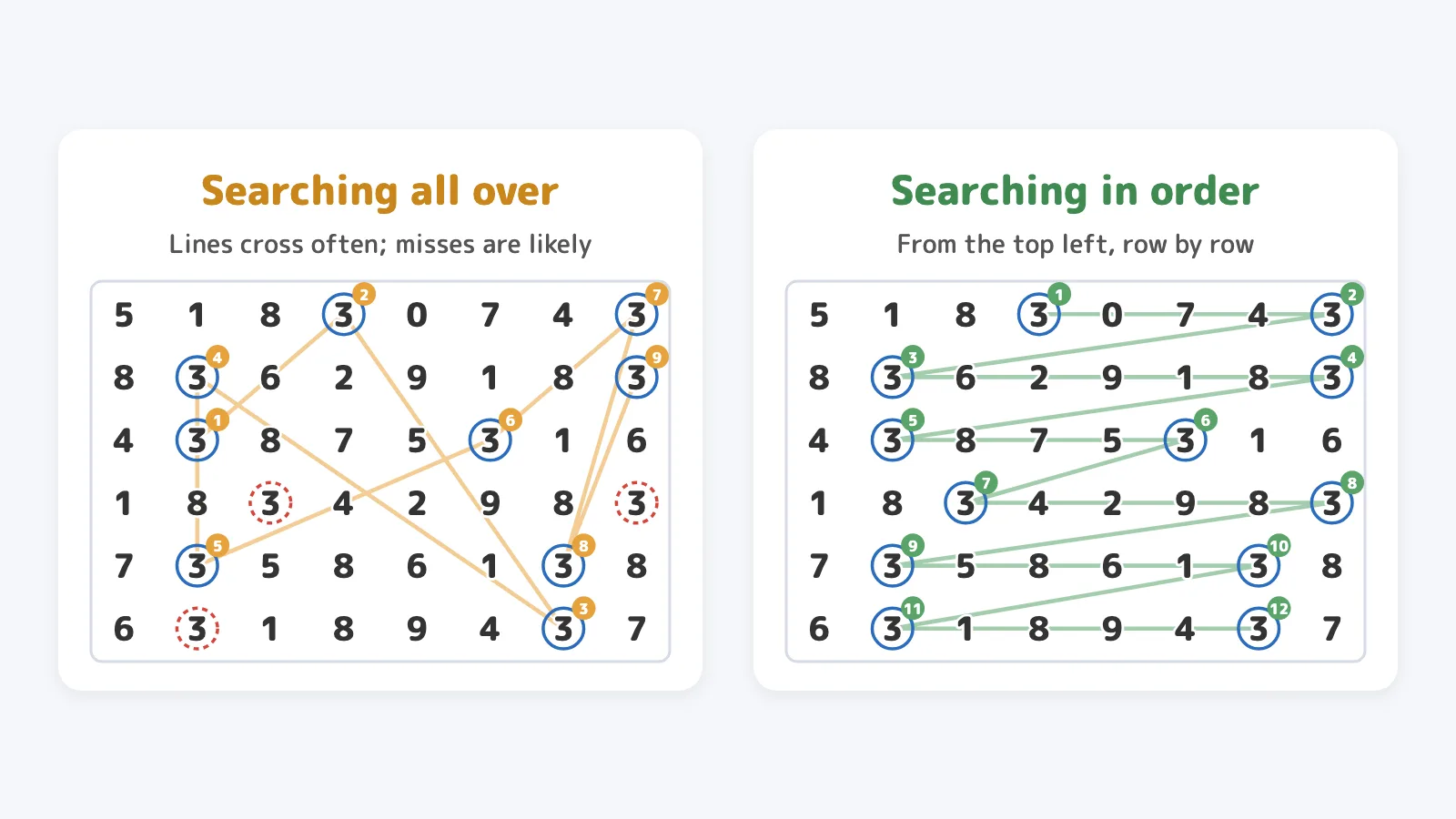
In one study, children did a cancellation task, searching for and marking pictures of apples, and the order of their marks was recorded.As children grew, their searching gradually became more organized, moving from jumping all over to searching in order along rows or columns.And children who searched in a more organized way tended to miss fewer targets among similar-looking pictures.
In other words, one key to missing less is the order of searching.Watching from behind as a child marks the page shows you clearly how they search.Another idea is to have them write a small number next to each mark.
Cancellation tasks are used in pediatric therapy too
In pediatric therapy and psychology, cancellation tasks are also used in tests that look at attention and how a child searches.The WISC, a widely used intelligence test for children, includes a cancellation subtest, in which the child marks certain pictures among many.
In a study that developed a test of children's attention (the TEA-Ch), results from children aged 6 to 16 showed that attention can be well explained by dividing it into these three kinds:
- Selective attention: directing attention to the target among many things
- Sustained attention: keeping attention on the same thing
- Attentional control (switching): switching attention when the task changes
In terms of the ways of missing things above, 3, "circling similar digits," is linked to telling shapes apart and selective attention, and 4, "more misses later on," is linked to sustained attention.Even for the same "misses," thinking about which kind of attention may be involved makes it easier to choose how to help.
Children with noticeable inattention (such as ADHD) and distractions around them
In children with ADHD (attention-deficit/hyperactivity disorder), misses are often noticeable.A study that followed boys with ADHD for four years found that, as they grew, hyperactivity and impulsive behavior became less noticeable, while inattention tended to remain.Of course, missing things often does not by itself mean a child has ADHD.A diagnosis is made by a doctor, based on the child's life as a whole.
Some children with noticeable inattention are easily distracted not only within the worksheet, but also by sounds and movement around them while they work.At the after-school day programs where I work, I meet children who look up every time a car passes the window or the child next to them starts talking.
When that happens, try to notice which kinds of stimuli the child reacts to most.
| Stimuli they react to | Ways to adjust the environment |
|---|---|
| Things they see (people moving, posters on the wall, things on the desk) | Sit facing a wall, sit with their back to the window, keep only the worksheet and pencil on the desk |
| Sounds they hear (voices, TV, noises) | Choose a quiet room or time, try earmuffs |
Which stimuli bother a child differs from child to child.Earmuffs suit some children, while others are more bothered by the feeling of having their ears covered.Trying a few things and finding the way to reduce distractions that suits that child is a good approach.
Finding a way to miss less that suits the child
Building the power of attention itself is not easy.That is why it is worth focusing on helping the child find out for themselves "What helps me miss less?"
Strategies to use while searching
In cancellation tasks, there are many ways to think while searching, not just search.
- Say the target digit quietly out loud while searching
- Make a small mark at the left end of each finished row
- Trace the place you are looking at with a finger or a ruler
- Cross off one of the dots next to the example each time you find one
- When finished, count how many you found and compare with the number to find
Which strategy suits a child differs from child to child.Rather than an adult choosing one, try a few and ask, "Which one was easier?"
Finding and fixing it themselves
When something is missed, if an adult points first and says "Here," it becomes correct on the spot.But what stays with the child is the experience of "being told."If you only tell them the area, such as "There's one more in this row," and let them search again, what stays is the experience of finding and fixing it themselves.
In pediatric therapy (occupational therapy), there is also an approach (CO-OP) in which children find a way that suits them by repeating "set a goal → plan how to do it → do it → check whether it worked."A review of studies with children with ADHD also reports that approaches in which children record and check their own work improved time on task and accuracy.
When they finish, try a short look back together.
Examples of words for looking back
- When finished"Where was it easy to miss things?"It's fine if they don't have an answer. Ask while looking at the page together
- Before the next one"How will you search next time?"Try the strategy the child chose on the next worksheet
- When it went well"Which way worked best?"Put the strategy that worked into words
Someday, choosing for themselves
A tendency to miss things, and to be pulled away by certain stimuli, can continue into adulthood.What we are aiming for is not zero misses, but for the child to know their own tendencies and be able to choose their own strategies.
"Sounds bother me, so I'll put on earmuffs.""I tend to miss things in the second half, so I'll look it over once more at the end."As there are more things a child can decide and control for themselves like this, it helps outside of worksheets too.At first, an adult can think it through with the child, then gradually give the child more chances to choose.
When timing, record the number of misses too
Recording how long it took makes changes visible and can be encouraging.But if you record only the time, finishing fast can become the goal, and misses may increase, as in 6.When timing, it's a good idea to also write down the number of misses and the strategy used (example below).
| Date | Level | Time | Misses | Strategy used / notes |
|---|---|---|---|---|
| 11/3 | 3 | 2:10 | 3 | Two at the right edge. More in the second half |
| 11/5 | 3 | 2:40 | 1 | Marked finished rows. Took a bit longer |
| 11/9 | 3 | 2:20 | 0 | Chose the row-marking strategy on their own |
| 11/12 | 3 | 1:55 | 1 | Also tried a ruler. "Marking is better" |
In this example, on the days they used row marks the time went up a little, but the misses went down.Not only a shorter time, but fewer misses and choosing a strategy on their own are important changes too.
For recording time, you can use the "Time Log" on the tracking sheets.The sheet has no column for misses, so write the number of misses small next to the date, or keep a notebook like the table above, to make it easier to look back on.
Things to do beyond worksheets
Searching skills are used a lot away from paper too.
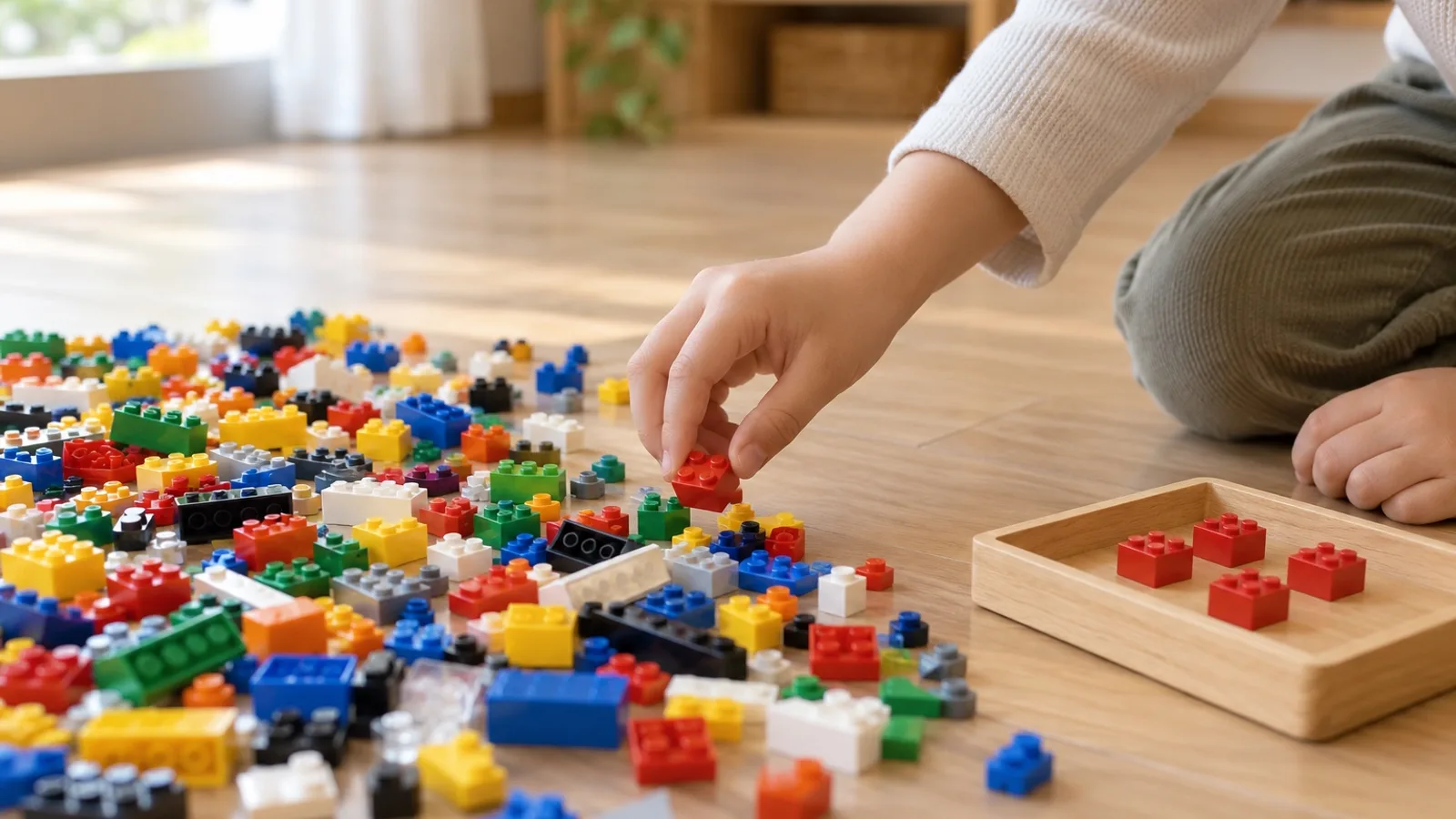
- Collect all of one kind of piece from a pile of blocks or toys: when finished, count them to check that none were missed
- Find books with a certain color of spine on a bookshelf: search shelf by shelf from the top, tracing with a finger
- Find the items on a list while shopping: mark the list when each one is found. This is also practice in checking for themselves
Choosing a worksheet
MIRU LAB KIDS has worksheets you can use as cancellation tasks.
| Worksheet | What to find | Features |
|---|---|---|
| Circle the Numbers | A certain digit | Digits lined up in rows and columns. Also works on telling similar digits apart, like 3 and 8 |
| Number Hunt | Numbers in order: 1, 2, 3… | Numbers scattered all over the page, so the child scans the whole page to search |
If 2 (skipping rows) is a concern, start with levels 1 and 2 of Circle the Numbers, which have a band for each row.If 5 (jumping all over) is a concern, it's a good idea to practice searching in order with Circle the Numbers first, then scan the whole page with Number Hunt.
Eye movements are covered in "Smooth Pursuit and Saccades," and how much to do in a day in "Every Day? How Much?."
Final thoughts: focus on favorite things is a seed of strength
A child who often misses things may become so absorbed in something they love that they don't even notice when you call them.A study with adults also reported that people with ADHD were more likely than people without ADHD to report "hyperfocus," deep concentration on things that interest them.
There are times when attention is hard to direct, and times when it locks right on.Alongside strategies to miss less, valuing the things a child can get absorbed in may one day lead to a real strength.
Before saying "Look carefully," look at how the child is missing things.Then, together with your child, look for what helps them miss less.I hope a single worksheet can be the start of that.
Studies referred to
- Treisman AM, Gelade G. A feature-integration theory of attention. Cognitive Psychology. 1980;12(1):97-136.
- Woods AJ, Göksun T, Chatterjee A, Zelonis S, Mehta A, Smith SE. The development of organized visual search. Acta Psychologica. 2013;143(2):191-199.
- Manly T, Anderson V, Nimmo-Smith I, Turner A, Watson P, Robertson IH. The differential assessment of children's attention: the Test of Everyday Attention for Children (TEA-Ch), normative sample and ADHD performance. Journal of Child Psychology and Psychiatry. 2001;42(8):1065-1081.
- Biederman J, Mick E, Faraone SV. Age-dependent decline of symptoms of attention deficit hyperactivity disorder: impact of remission definition and symptom type. American Journal of Psychiatry. 2000;157(5):816-818.
- Polatajko HJ, Mandich AD, Missiuna C, Miller LT, Macnab JJ, Malloy-Miller T, Kinsella EA. Cognitive orientation to daily occupational performance (CO-OP): part III—the protocol in brief. Physical & Occupational Therapy in Pediatrics. 2001;20(2-3):107-123.
- Reid R, Trout AL, Schartz M. Self-regulation interventions for children with attention deficit/hyperactivity disorder. Exceptional Children. 2005;71(4):361-377.
- Hupfeld KE, Abagis TR, Shah P. Living "in the zone": hyperfocus in adult ADHD. ADHD Attention Deficit and Hyperactivity Disorders. 2019;11(2):191-208.
Materials referred to
- Wechsler D. Wechsler Intelligence Scale for Children—Fourth Edition (WISC-IV). San Antonio, TX: Psychological Corporation; 2003.