Smooth Pursuit and Saccades: Two Eye Movements, Home Activities, and Choosing Worksheets
Our eyes keep moving almost nonstop while we are awake.Yet we hardly ever notice these movements.This article introduces two especially important ones: following something with the eyes, and jumping the eyes quickly to a new spot.Their technical names are smooth pursuit and saccades.We will look at where each one is used in daily life, activities you can try at home, and how to choose worksheets.
There are several kinds of eye movements
The eyes move in several different ways.For example, they turn inward together when we look at something close (convergence), and they stay fixed on what we are looking at even when the head or body moves (the vestibulo-ocular reflex).These two are covered in "Visual Perception Shows Up in Unexpected Places."
This article focuses on the following two:
Two eye movements
- Smooth pursuitfollowing a moving object smoothly with the eyes
- Saccadesjumping the eyes quickly to where you want to look
Both are important ways of using the eyes that support visual perception.For an overview of visual perception, see "What Is Visual Perception?"
Smooth pursuit: following with the eyes
Smooth pursuit is the eye movement that follows a moving object smoothly.In therapy and education, it is often called "visual tracking."
It is used in moments like these:
- Following a ball through the air with the eyes, then catching it
- Watching a friend running during a game of tag
- Watching the tip of a pointer as the teacher moves it along the board
- Watching the tip of your own pencil as you draw a line
This movement works smoothly when there is a moving object to follow.If the object moves too fast, smooth movement can't keep up, and the eyes start catching up with quick jumps here and there.
Saccades: jumping the eyes to a new spot
Saccades are the eye movements that jump the gaze quickly to where you want to look.The word "saccade" comes from French and means a sudden jerk. The eyes move to the next spot as if hopping.
They are used in moments like these:
- Copying from the board, looking back and forth between the board and the notebook
- Reading, moving the eyes from the end of one line to the start of the next
- Searching for one thing among many
- Turning to look when someone calls your name
In fact, when we read, the eyes do not glide smoothly across the letters.They stop briefly, jump ahead, stop again, and jump again.Reading is supported by a chain of saccades (Rayner, 1998).
Comparing the two
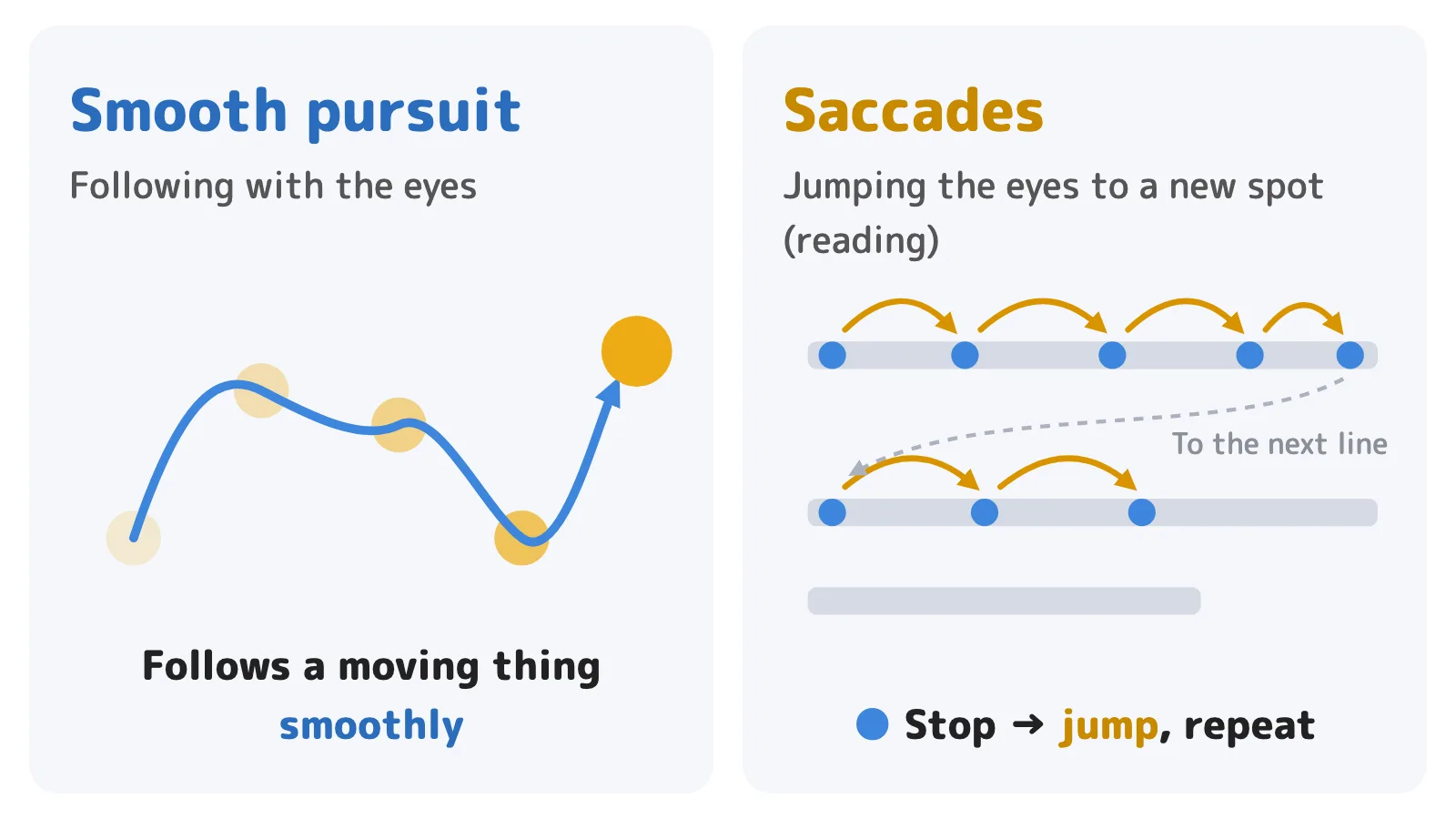
| Smooth pursuit (following) | Saccades (jumping) | |
|---|---|---|
| How the eyes move | Smoothly, along with a moving object | Quickly, hopping to the next spot |
| Everyday moments | Playing ball, watching things move, watching the pencil tip while drawing a line | Reading, copying, searching, comparing |
| What you might see when it's hard | Can't follow a ball and often misses it. Eyes drift off when following something moving | Skips lines or words while reading. Slow at copying. Can't find things |
However, the signs in the "when it's hard" row can have many causes besides eye movements.Please use this table as just one clue when watching your child.
Eye movements develop little by little
The basic ability to move the eyes starts developing early.On the other hand, studies report that the ability to decide "I'll look there" and move the eyes on purpose, or to hold the eyes still when you'd like to look away, develops slowly over a long time (Luna et al., 2008).
So even if your child's eye movements still look a bit clumsy, there is no need to worry.Think of it as a skill that grows at the child's own pace, and look for fun chances to use the eyes more.
Activities to try at home
The eyes move a lot during everyday play.But if you want to use an activity as eye-movement practice, look for ones that have these three things:
Here are some activities that keep these three points in mind.
Activities for following (smooth pursuit)
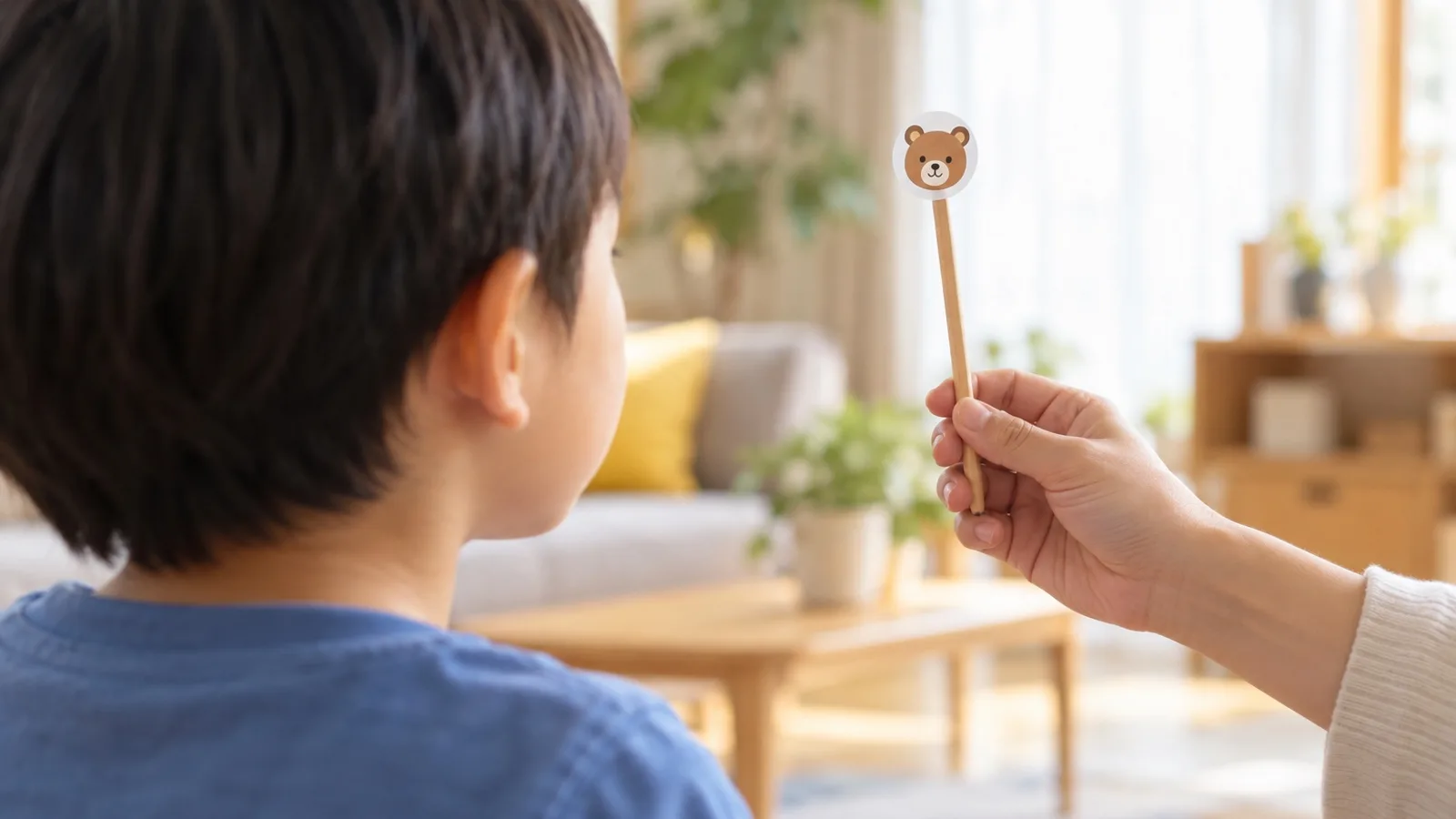
- Chase a favorite thing on a pen: Stick a sticker or small picture of the child's favorite character or animal on the end of a pen or a straw. Hold it about 12 to 16 inches (30 to 40 cm) from the child's face and move it slowly side to side, up and down, diagonally, and in circles. Compared with a bare pen tip, it makes the child want to look, so it is easier to keep following. Saying things like "It's running away, don't lose it!" or stopping now and then for the child to tap it with a finger keeps it feeling like a game.
- Follow a swinging pendulum: Hang a small ball or soft toy from a string and swing it side to side at eye level. The size of the swing changes the speed, so start small and slow and gradually make it bigger. Swinging it forward and back, or in a circle, changes how the eyes move.
- Chase the light: Darken the room a little. The adult shines a flashlight on the wall and moves the spot slowly, and the child follows it with the eyes. Once that is easy, give the child a flashlight too, and have them keep their light on top of yours as it moves. This practices following with the eyes and moving the hand while looking, at the same time.
Activities for jumping (saccades)
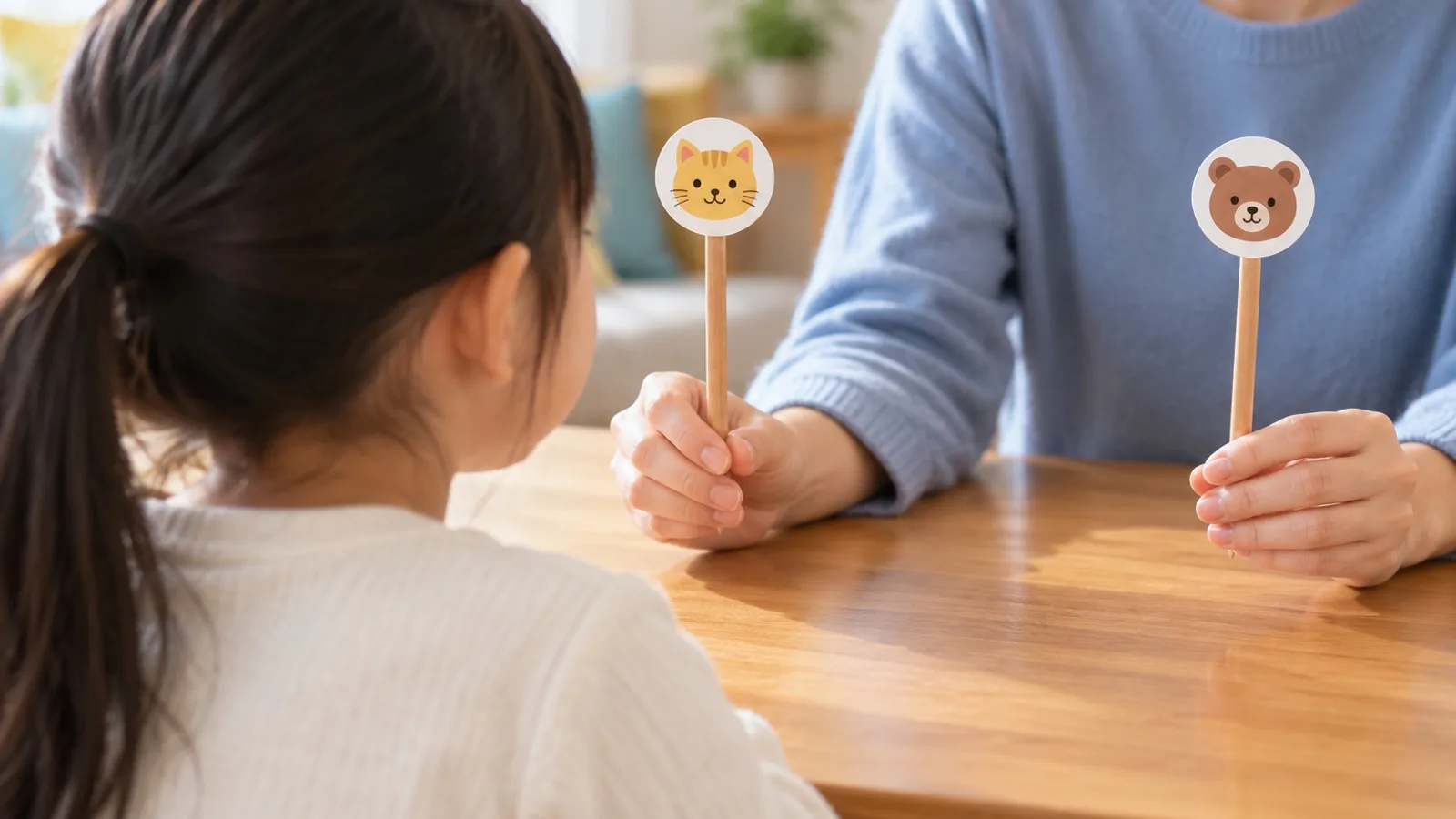
- Compare favorite things on two pens: Put a different character sticker on each of two pens and hold them about shoulder-width apart. The child looks quickly at whichever one the adult names. Once that is easy, change it a little at a time: look left and right in time with clapping, hold the pens farther apart, or hold them up and down or diagonally.
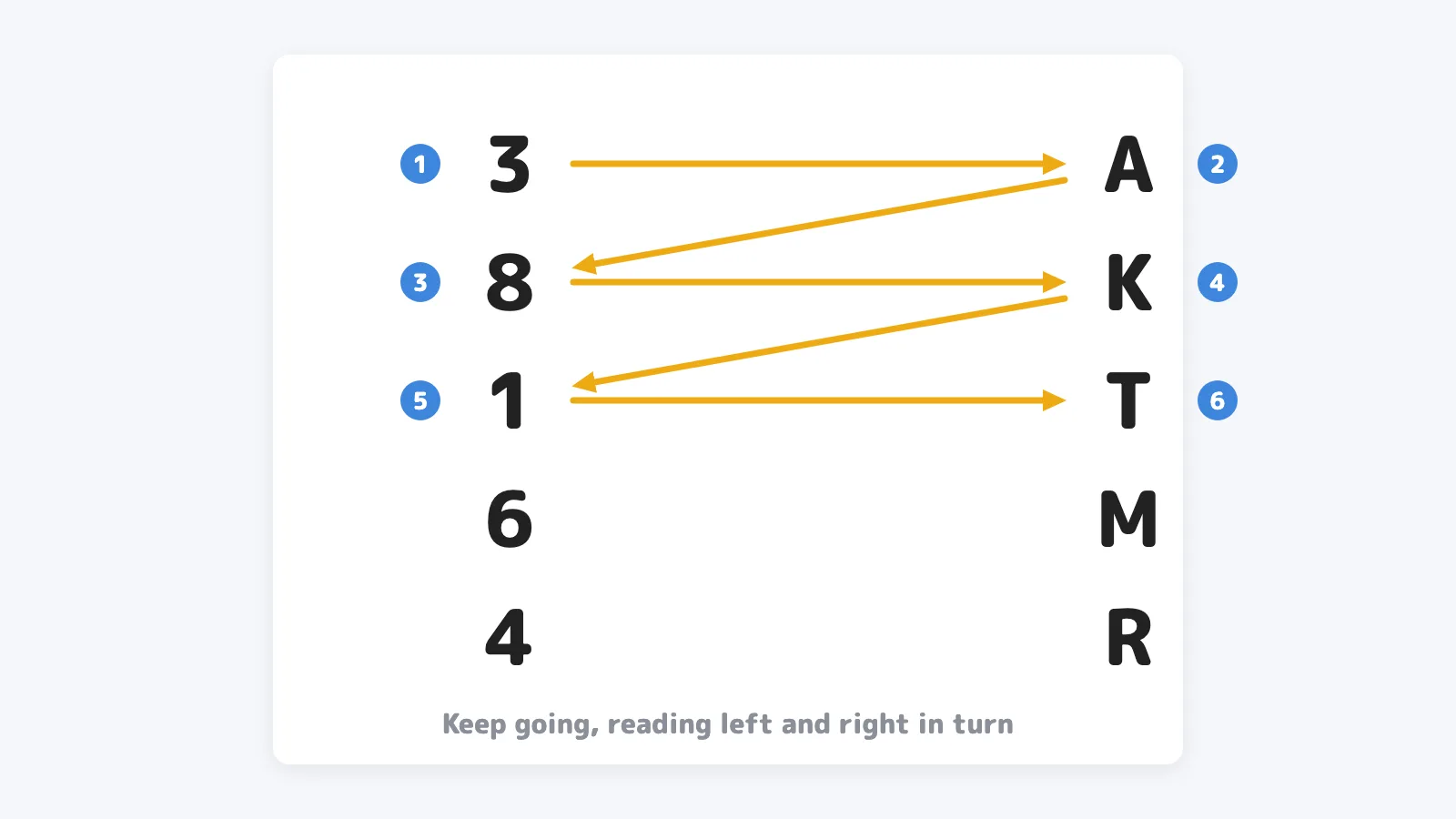
- Read two columns, back and forth: Write a column of numbers or letters down the left edge of a sheet of paper and another down the right edge, and tape it to the wall. Sitting a little way back, the child reads aloud, going back and forth: "first on the left, first on the right, second on the left, second on the right..." When that is easy, add a third or fourth column, or use bigger paper to spread the columns farther apart. For children who can't read yet, use animal pictures or colored stickers instead, and have them say the name or the color.
- Look and tap the open hand: The adult makes two fists and holds them out to the left and right in front of the child. When one hand suddenly opens, the child looks at it and taps it right away. To make it harder, open hands in different places (up, down, diagonal), or open them faster.
Tips for practice
- Watch the child's eyes: During practice, the adult watches the child's eyes, not the target. The places where the eyes lose the target or catch and stop are the hard spots for that child. Repeat those parts slowly, with small movements.
- Keep it short: One or two minutes per activity is plenty. Combine a few activities and keep it playful.
- It's okay if the head moves at first: Once the child is used to it, try saying, "Keep your face still and look with just your eyes."
- Start slow: Begin with slow, small movements. As the child gets better, make them a little faster and bigger.
- Stop if it seems uncomfortable: If the child's eyes seem tired, or they have a headache or feel unwell, take a break right away.
Choosing worksheets
Different MIRU LAB KIDS worksheets use different eye movements more.Choose worksheets to match the eye movement you want to work on.
Worksheets that use following (smooth pursuit)
- Follow the Lines: follow one line all the way through a tangle of lines with the eyes
- Mazes and Number Mazes: follow the path with the eyes, look ahead, and draw a line
- Overlapping Shapes: trace the outline of one shape among overlapping lines with the eyes and a finger
Worksheets that use jumping (saccades)
- Number Hunt and Number and Letter Hunt: find scattered numbers or letters in order, one after another
- Circle the Numbers: search along the rows, moving the eyes left to right and top to bottom
- Dot-to-Dot: find the next number, then jump the eyes to it
- Dot Grid Copying, Dot Grid Copying: Pictures, and Symmetry Coloring: look back and forth between the example and your own grid to compare
- Remember the Order: Shapes and Remember the Order: Pictures: move the eyes from left to right along a row of items
Every worksheet also uses other skills, such as telling shapes apart and using the eyes and hands together.No worksheet uses only one eye movement, so please treat this as a rough guide.
If you're not sure, try pairing one following worksheet with one jumping worksheet.For how much to do in a day and how to keep going, see "Every Day? How Much?"
Things to keep in mind
Anyone can start eye-movement activities easily.But practice does not always bring a visible change.
Also, signs like "skipping lines when reading" or "missing the ball" can have many causes besides eye movements: eyesight, how the two eyes work together, attention, how the child uses their body, and more.If you keep noticing concerns about your child's vision, first have an eye doctor check their eyesight and eye health.Then talk to the people around your child, such as their teacher, an occupational therapist, or a physical therapist.
Final thoughts
Following with the eyes, and jumping the eyes to a new spot.Both support us in so many everyday moments: reading, writing, and playing.
Eye movements are easy to overlook, but knowing about them gives you a new clue when watching your child.I hope you can make time to use the eyes together in a fun way, through play and worksheets.
Studies referred to
- Rayner K. Eye movements in reading and information processing: 20 years of research. Psychological Bulletin. 1998;124(3):372-422.
- Luna B, Velanova K, Geier CF. Development of eye-movement control. Brain and Cognition. 2008;68(3):293-308.