Pencil Obstacle CourseFree printable worksheets
Aims
- Watching the path ahead and moving the pencil to match (eye-hand coordination)
- Adjusting pencil speed and pressure so it does not touch the walls (pencil control)
- Using the fingers and wrist to turn the pencil at curves and corners
- Staying slow and careful all the way to the end (sustained attention)
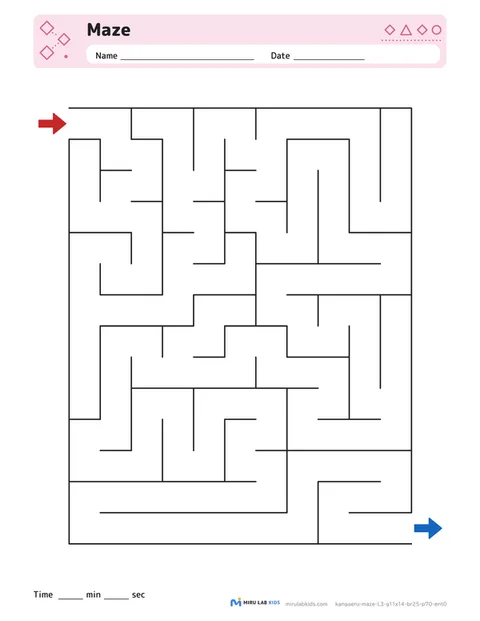
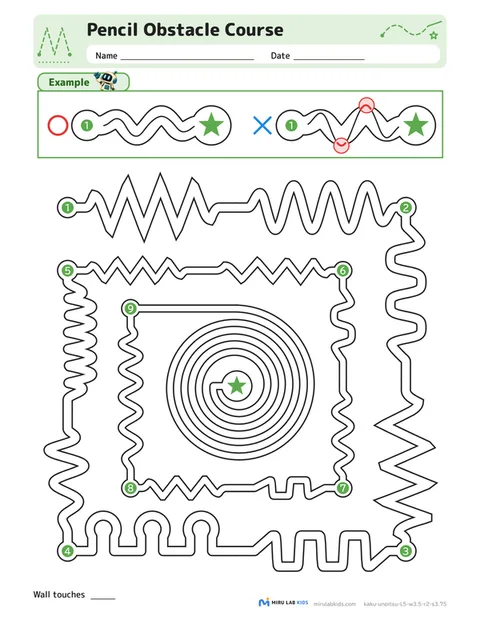
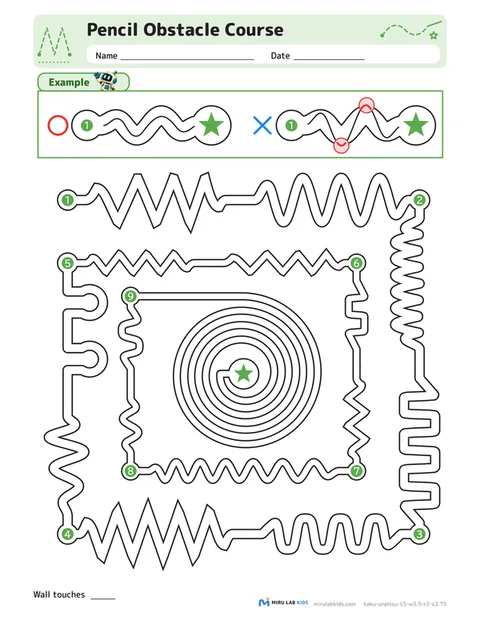
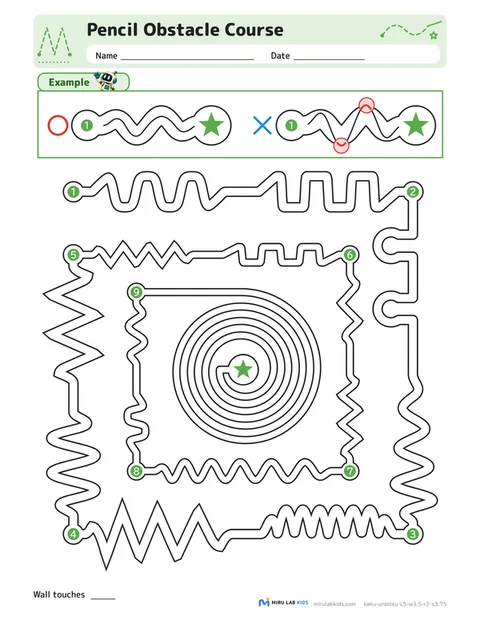
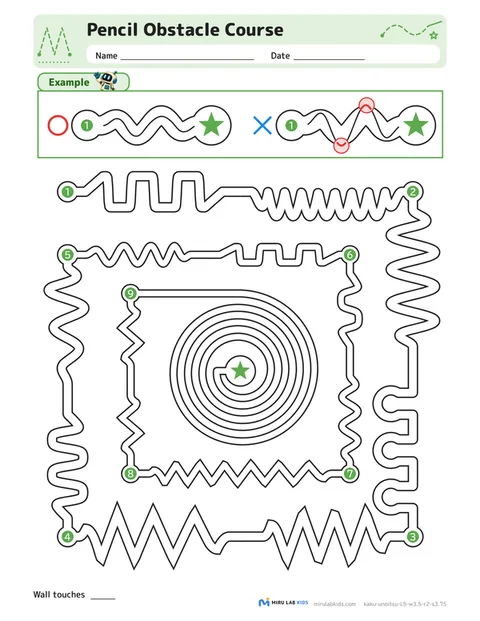
Your child moves a pencil along a path between two lines, from "1" to the star, without touching the walls (the lines of the path).The course runs clockwise from the top left toward the middle, through obstacles of different shapes: waves, zigzags, square waves, arches, mushrooms, and more.Count the places where the pencil touched a wall and write the number at the bottom of the page.Speed is not compared; what matters is how carefully your child went.It is known that the narrower and longer a path is, the longer it takes to get through without going outside it.The levels are set from the path width and length so that each level is roughly 2 to 3 times harder than the one before.Tests used in children's therapy (occupational therapy) also include drawing a line between two lines without going outside them, as one way of looking at eye-hand coordination.The activity aims to build the ability to move the hand the way the eyes see.
Black and white printing works. The path width sets the difficulty, so print at actual size (100%) without scaling. There is no answer page.
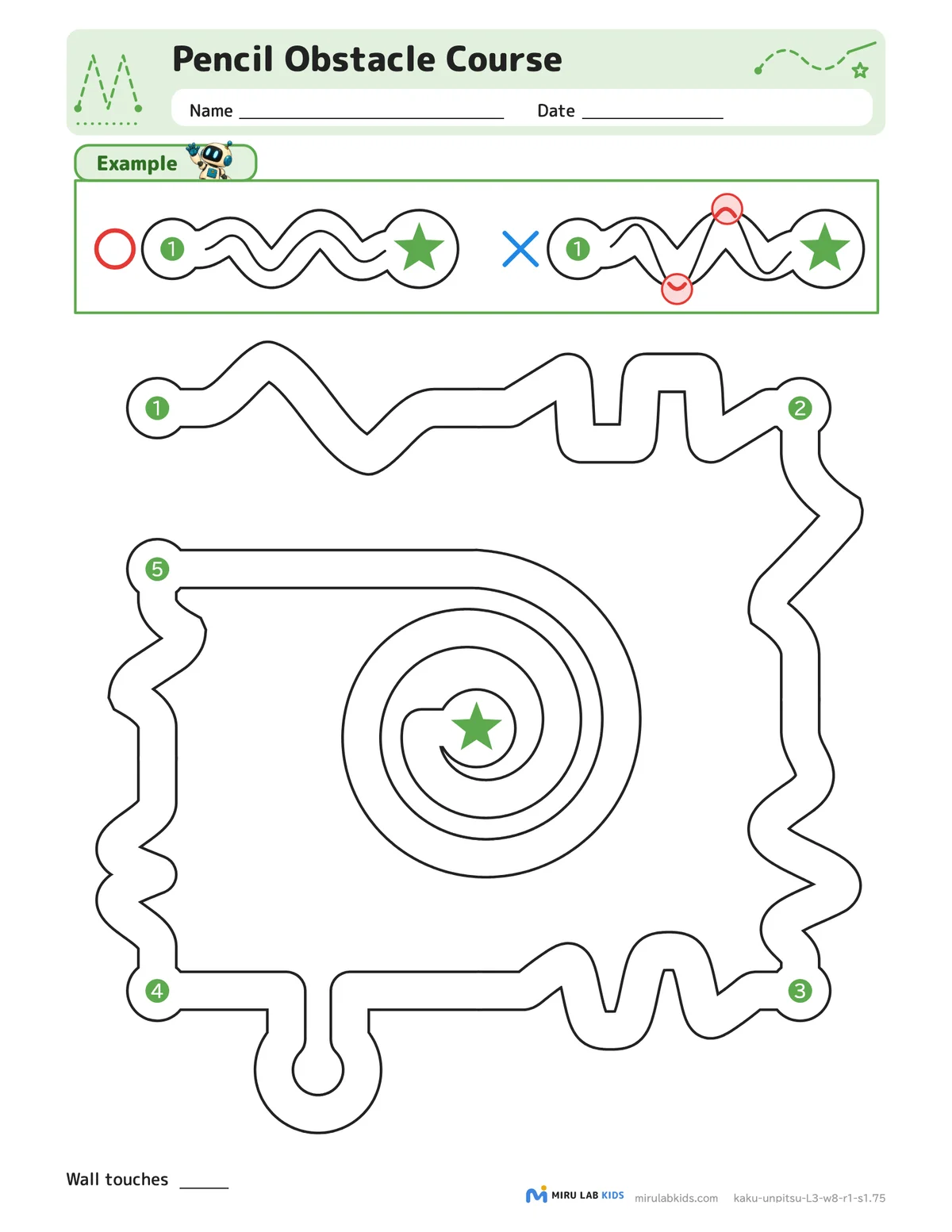 Level 3 example ›
Levels
| Level 1 | The path is 16 mm wide. 4 obstacles (waves, an arch, waves that grow bigger, zigzags) and no spiral. A good first sheet for pencil control. | 5 worksheets |
|---|---|---|
| Level 2 | The path is 11 mm wide. 7 obstacles, including rounded squares. A short spiral in the middle (0.75 turns). | 5 worksheets |
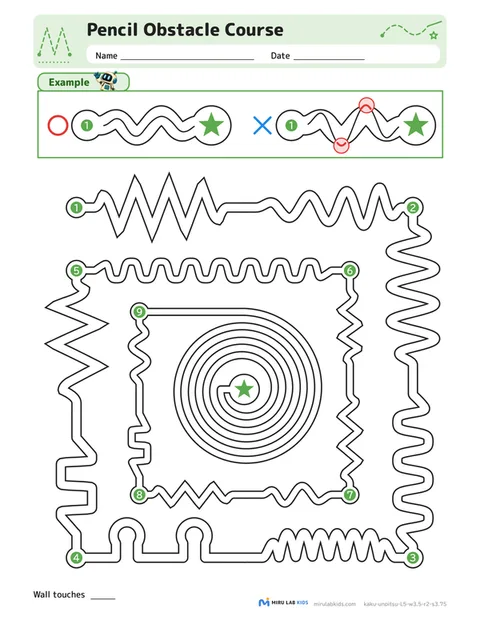
| Level 3 | The path is 8 mm wide. Sharp zigzags, square waves, and mushrooms. The spiral makes 1.75 turns. | 5 worksheets |
| Level 4 | The path is 5 mm wide. The course goes around twice, and the inner lap has small, tight waves. The spiral makes 2.75 turns. | 5 worksheets |
| Level 5 | The path is 3.5 mm wide, and 2.5 mm on the inner lap. Two laps and a spiral of 3.75 turns. The narrowest and longest course. | 5 worksheets |
Tips
- Before starting, sharpen the pencil to a moderate point. A blunt pencil makes a thick line that touches the walls more easily.
- Look at the "Example" at the top together and check that the line should stay in the middle of the path without touching the walls. Going slowly and carefully matters more than speed.
- The numbered dots (2, 3, 4...) are rest stops. Your child can lift the pencil and rest the hand there.
- When finished, count together the places where the pencil line touched a wall, and write the number next to "Wall touches" at the bottom. One continuous touch counts as one.
For what to say, choosing a level and what to do if it is too hard, see Pencil Obstacle Course: a guide for grown-ups.
Worksheets
Choose a worksheet to open its printing page.
Level 1The path is 16 mm wide. 4 obstacles (waves, an arch, waves that grow bigger, zigzags) and no spiral. A good first sheet for pencil control.
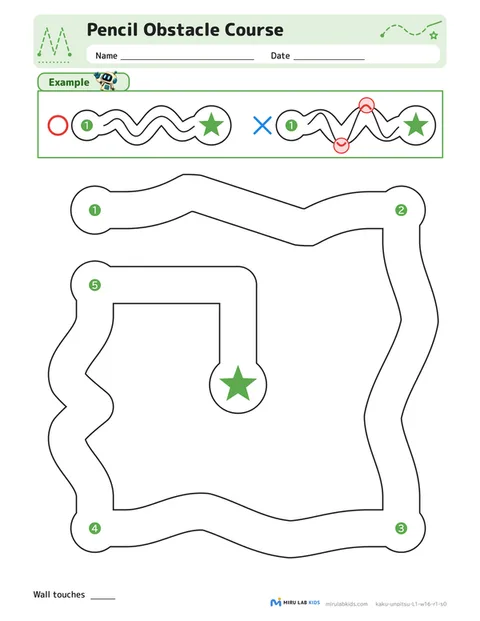
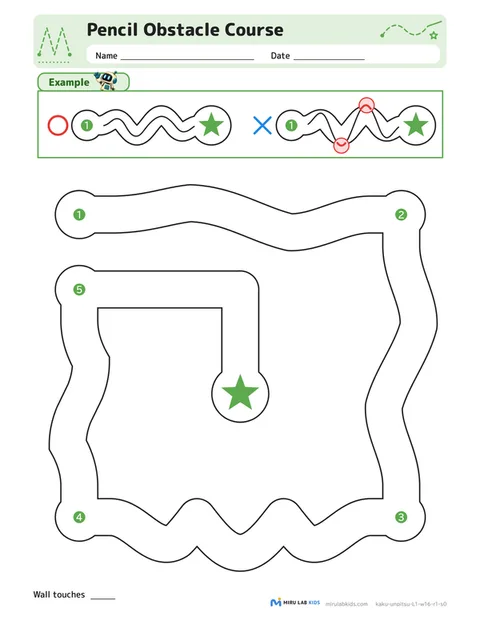
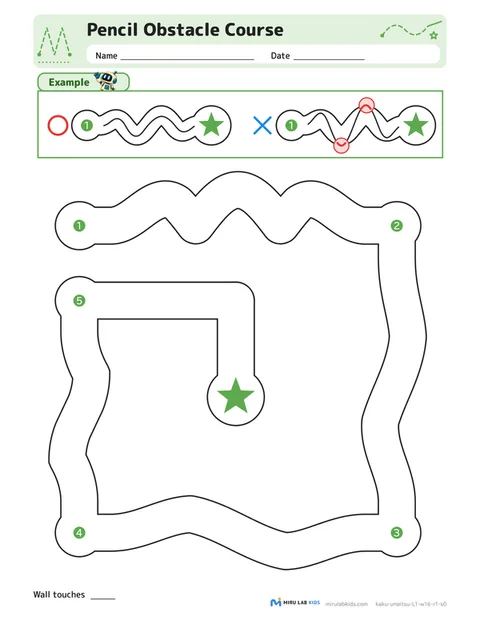
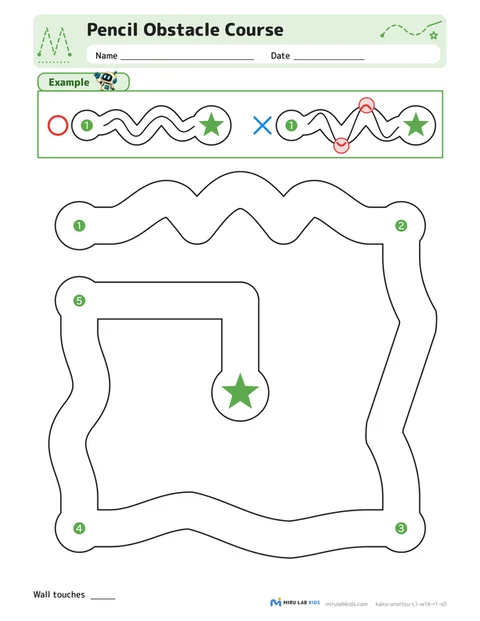
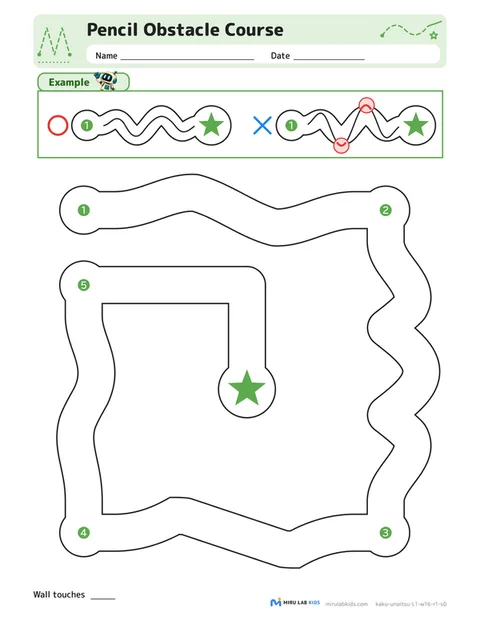
Level 2The path is 11 mm wide. 7 obstacles, including rounded squares. A short spiral in the middle (0.75 turns).
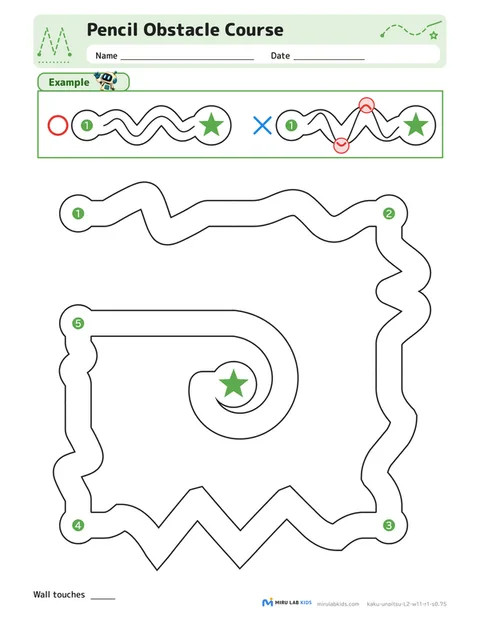
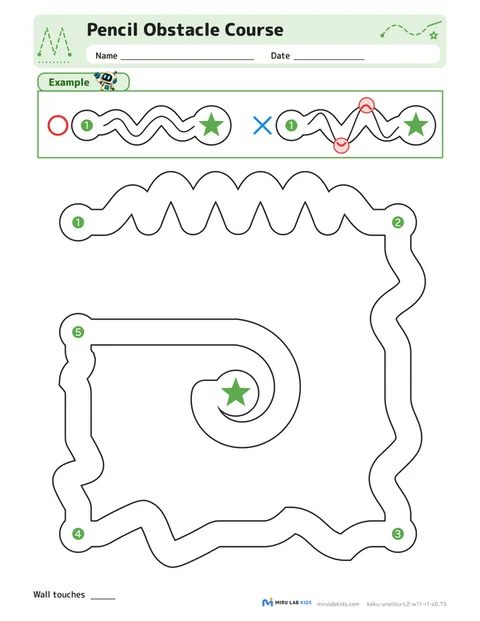
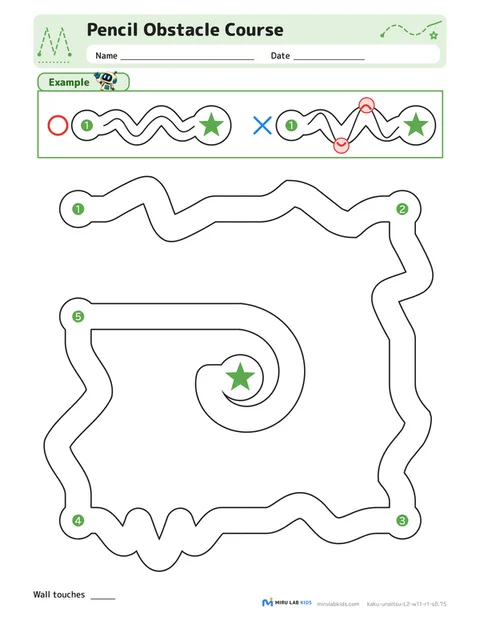
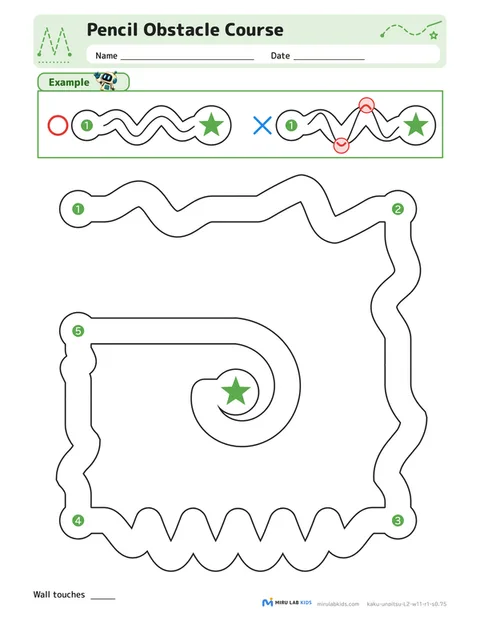
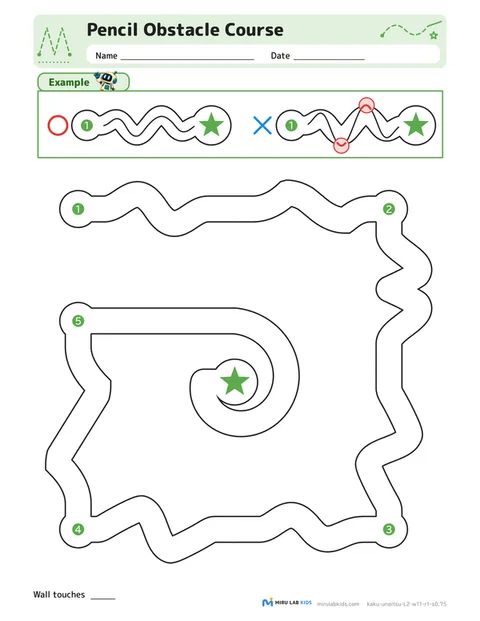
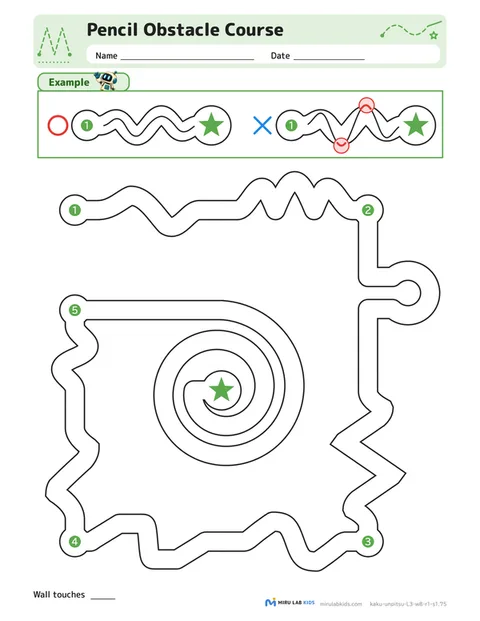
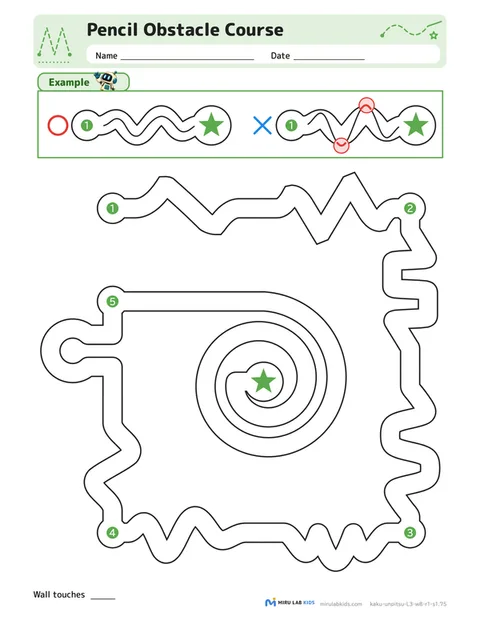
Level 3The path is 8 mm wide. Sharp zigzags, square waves, and mushrooms. The spiral makes 1.75 turns.
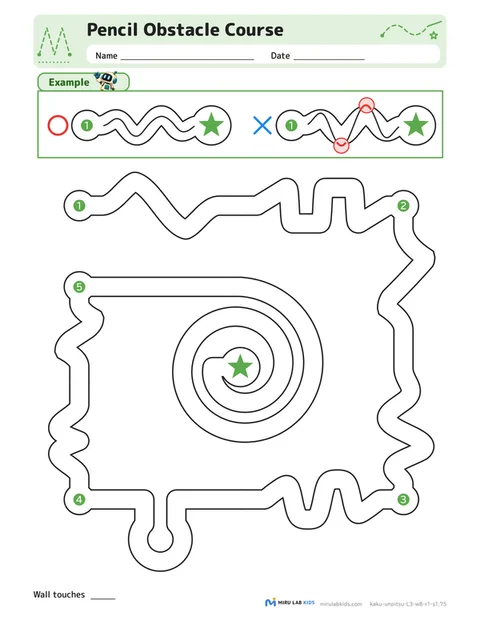
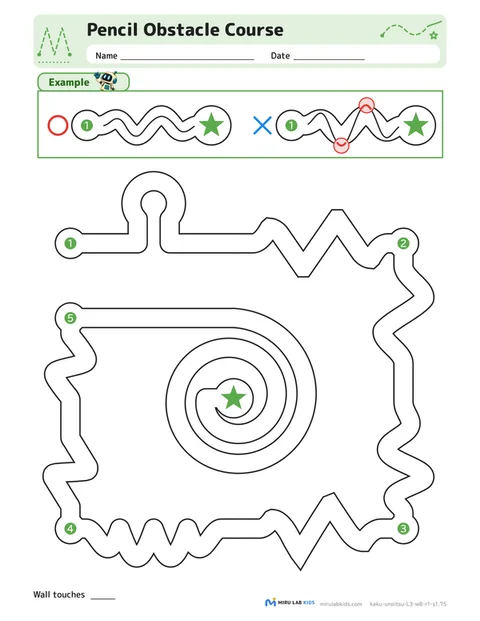
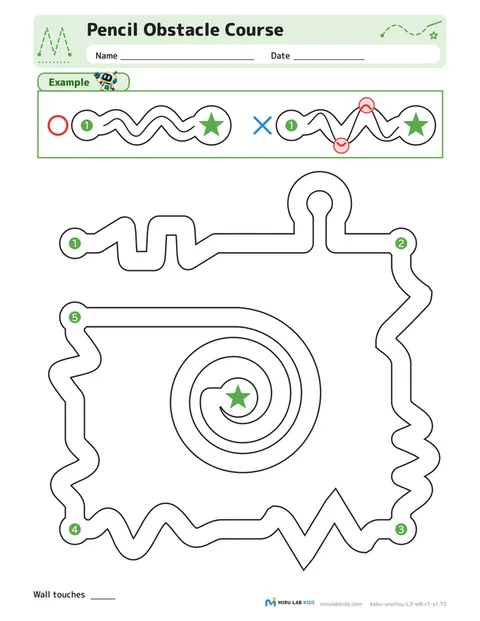
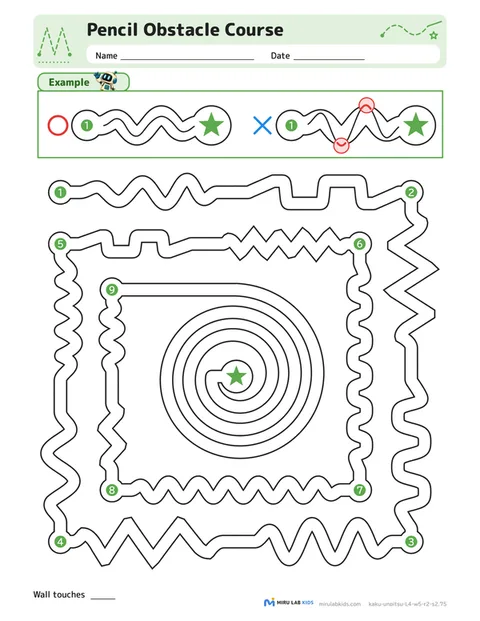
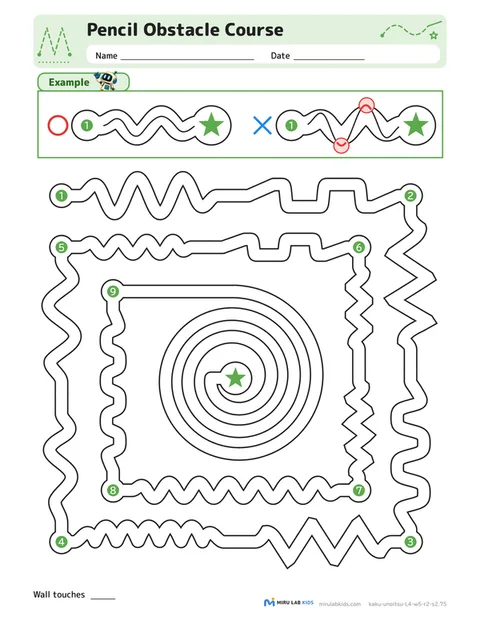
Level 4The path is 5 mm wide. The course goes around twice, and the inner lap has small, tight waves. The spiral makes 2.75 turns.
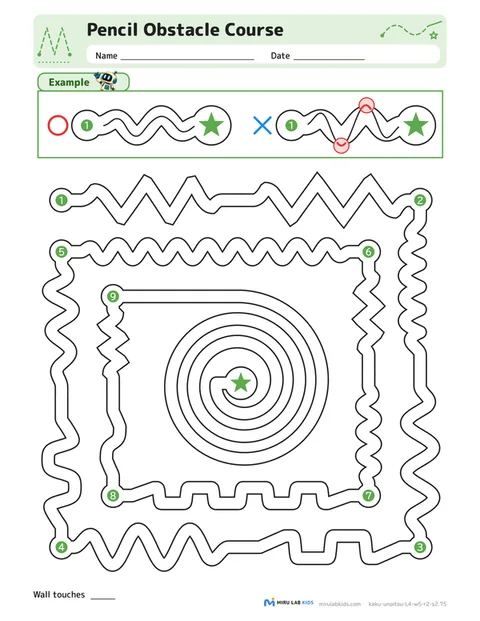
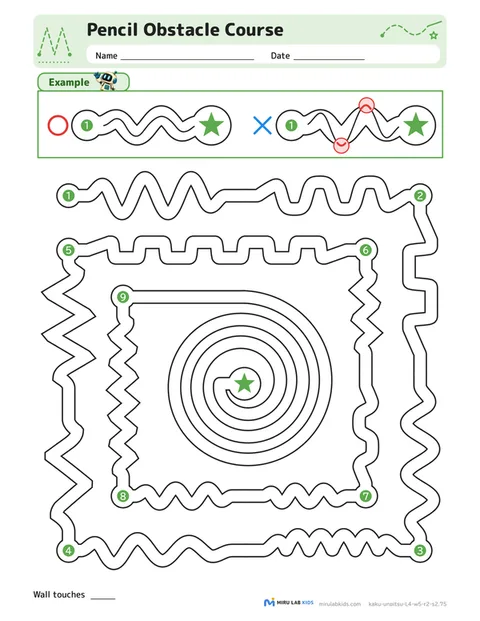
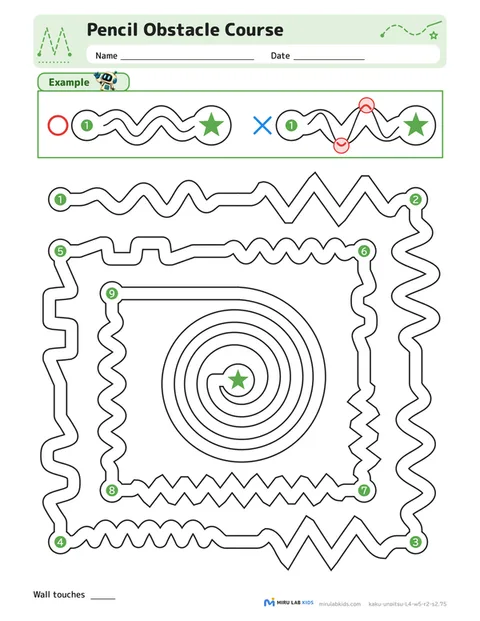
Level 5The path is 3.5 mm wide, and 2.5 mm on the inner lap. Two laps and a spiral of 3.75 turns. The narrowest and longest course.
Pencil Obstacle Course: a guide for grown-ups
Who it is for
- Just starting with a pencilLevel 1, with its wide path, is good practice for getting used to drawing lines with a pencil.
- Writing goes outside the linesPractice in controlling the pencil to stay inside boxes and lines.
- Rushes and gets messySpeed is not compared. Only care counts.
- Wants a challengeLevel 5 has a 2.5 mm path and a 3.75-turn spiral. Even adults have to concentrate.
- Has trouble staying focusedThe rest stops break the course into short parts.
- For therapy and after-school programsAll you need is one sheet and a pencil.
Choosing a level
Few wall touches, and your child enjoyed it
- Go up one level.
- Aim for zero wall touches.
- Keep going past the rest stops without lifting the pencil.
Touches the walls again and again, or gives up partway
- Go down one level.
- Trace the path with a finger first to see the shape of the course, then use the pencil.
- Split the course at the rest stops and do one or two sections a day.
What to watch for
| Pencil grip | Is your child holding the pencil with the fingertips? Are they gripping so hard that the fingertips turn white? |
|---|---|
| Holding the paper | Is the other hand holding the paper down? Is the paper sliding? |
| Posture | Is the face too close to the paper? Is the body leaning a lot? |
| Where the touches happen | Does your child touch the walls on the outside of curves, at corners, or in the spiral? If the touches happen at the same kind of place, that shape may be the hard part. |
| Pace | Is your child rushing through in one go? Are they resting the hand at the rest stops? |
| Wall touches | Writing the number at the bottom of the page each time makes changes easier to notice. Copying it onto the Pencil Obstacle Course Log lets you line up results at the same level. |
If something keeps worrying you, it can help to talk with an occupational therapist or another specialist rather than deciding on your own.
Things you can say
- Before startingLet's go slowly to the star without touching the walls.Look at the ○ and ✕ in the example together, and say it is fine to go slowly.
- While goingNice and steady.Praise the care, not the speed.
- After touching a wallThat's okay, keep going.Do not erase. Keep going from there, and count the touches together at the end.
- When finishedWhich part was tricky?Before counting, ask your child which part felt hard.
- From the second timeYou touched the walls fewer times than last time.Compare with your child's own earlier tries at the same level, not with other children.
FAQ
Is there an answer key?
No. There is no answer page. When finished, count together the places where the pencil line touched a wall.
Don't you time it?
This activity is about how carefully your child goes, not speed, so the worksheet has no space for the time. Rushing makes wall touches more likely, so going slowly is fine.
Can we do the same sheet more than once?
Yes. Repeating the same course makes it easier to compare the number of wall touches with last time. There are 5 sheets at each level, so switch to another course when your child gets bored.
Can this replace handwriting practice?
Research suggests that activities without actual handwriting practice tend not to improve handwriting much. Use this activity as practice in controlling the pencil, together with handwriting practice.
Should I correct my child's pencil grip?
One study found that differences in grip did not affect how readable or fast children's handwriting was. Rather than changing the grip itself, check whether your child is pressing too hard or getting tired. If you are worried, you can talk with an occupational therapist or another specialist.
How much should we do at a time?
There is no set amount. One sheet at a time is a good guide, and long courses can be split at the rest stops over several sessions. See "Every Day? How Much?" for more.
Articles
About the code at the bottom right
The code at the bottom right of each worksheet (for example, kaku-unpitsu-L1-w16-r1-s0) shows its difficulty settings. Worksheets with the same code have the same difficulty. If you contact us about a worksheet, including this code helps us find it right away.