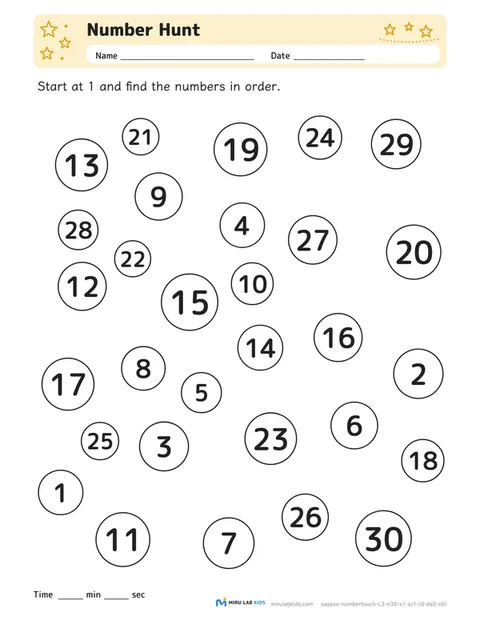
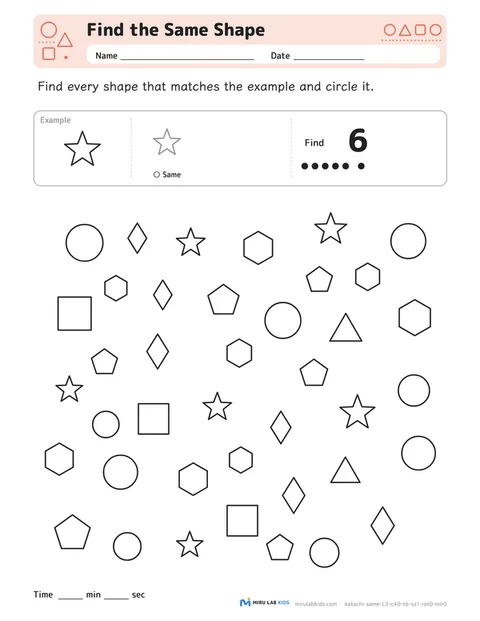
Pencil Obstacle CourseLevel 2 · Easy-Medium
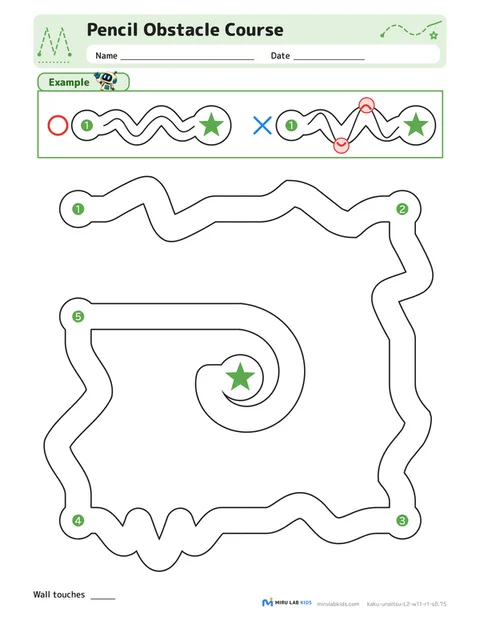
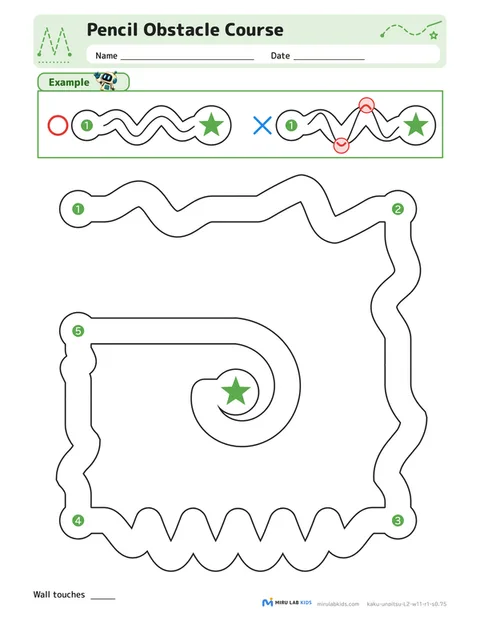
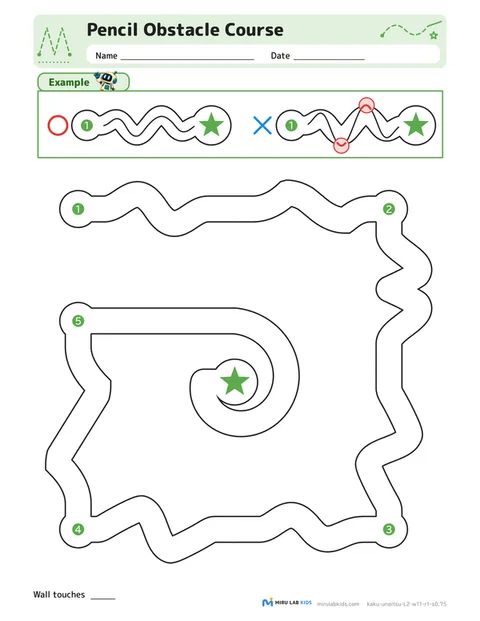
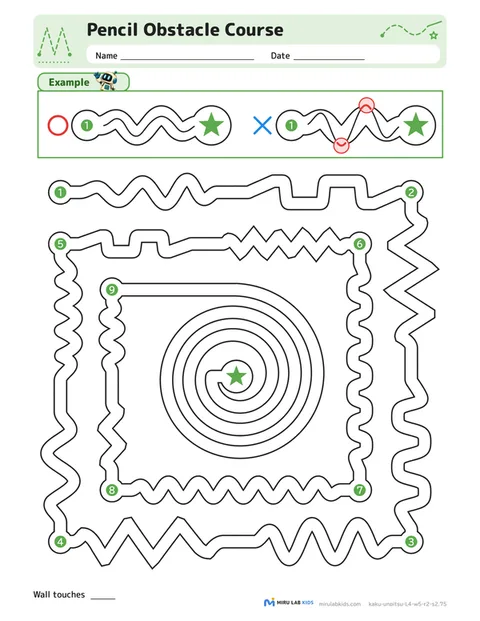
The path is 11 mm wide. 7 obstacles, including rounded squares. A short spiral in the middle (0.75 turns).
Level 2The path is 11 mm wide. 7 obstacles, including rounded squares. A short spiral in the middle (0.75 turns).
Aims of this activity
- Watching the path ahead and moving the pencil to match (eye-hand coordination)
- Adjusting pencil speed and pressure so it does not touch the walls (pencil control)
- Using the fingers and wrist to turn the pencil at curves and corners
- Staying slow and careful all the way to the end (sustained attention)
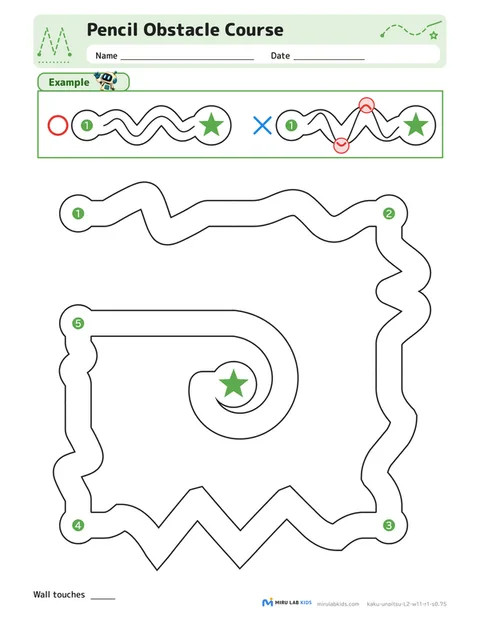
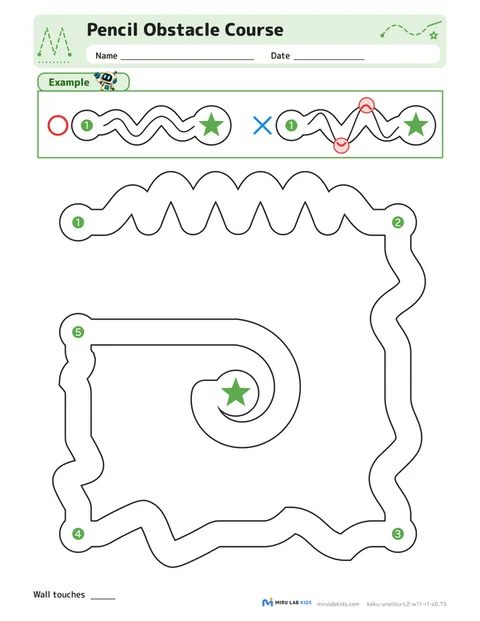
Your child moves a pencil along a path between two lines, from "1" to the star, without touching the walls (the lines of the path).The course runs clockwise from the top left toward the middle, through obstacles of different shapes: waves, zigzags, square waves, arches, mushrooms, and more.Count the places where the pencil touched a wall and write the number at the bottom of the page.Speed is not compared; what matters is how carefully your child went.It is known that the narrower and longer a path is, the longer it takes to get through without going outside it.The levels are set from the path width and length so that each level is roughly 2 to 3 times harder than the one before.Tests used in children's therapy (occupational therapy) also include drawing a line between two lines without going outside them, as one way of looking at eye-hand coordination.The activity aims to build the ability to move the hand the way the eyes see.
Tips
- Before starting, sharpen the pencil to a moderate point. A blunt pencil makes a thick line that touches the walls more easily.
- Look at the "Example" at the top together and check that the line should stay in the middle of the path without touching the walls. Going slowly and carefully matters more than speed.
- The numbered dots (2, 3, 4...) are rest stops. Your child can lift the pencil and rest the hand there.
- When finished, count together the places where the pencil line touched a wall, and write the number next to "Wall touches" at the bottom. One continuous touch counts as one.
For what to say, choosing a level and what to do if it is too hard, see Pencil Obstacle Course: a guide for grown-ups.
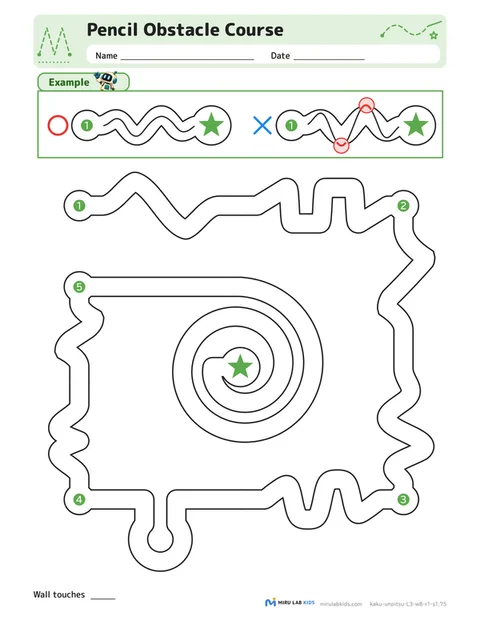
Choosing a level
Few wall touches, and your child enjoyed it
- Go up one level.
- Aim for zero wall touches.
- Keep going past the rest stops without lifting the pencil.
Touches the walls again and again, or gives up partway
- Go down one level.
- Trace the path with a finger first to see the shape of the course, then use the pencil.
- Split the course at the rest stops and do one or two sections a day.
Things you can say
- Before startingLet's go slowly to the star without touching the walls.Look at the ○ and ✕ in the example together, and say it is fine to go slowly.
- While goingNice and steady.Praise the care, not the speed.
- After touching a wallThat's okay, keep going.Do not erase. Keep going from there, and count the touches together at the end.
- When finishedWhich part was tricky?Before counting, ask your child which part felt hard.
- From the second timeYou touched the walls fewer times than last time.Compare with your child's own earlier tries at the same level, not with other children.