How Many Blocks?Level 2 · Easy-Medium
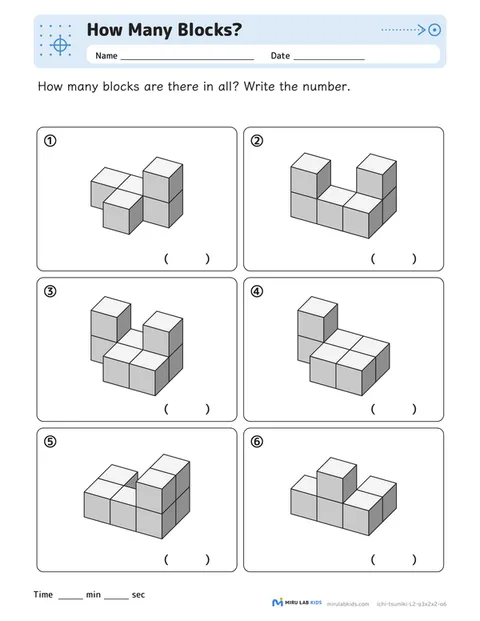
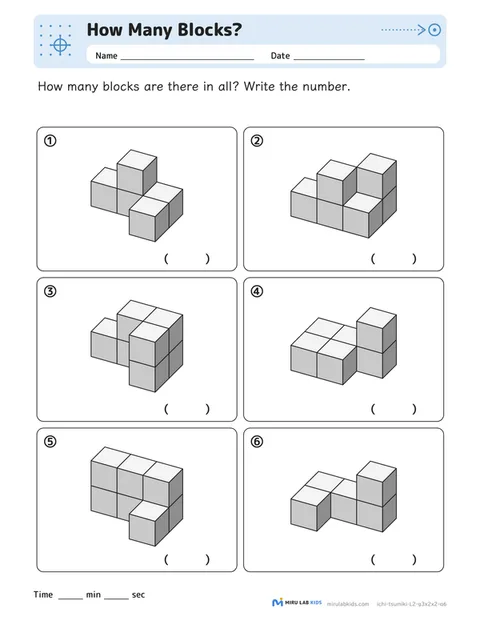
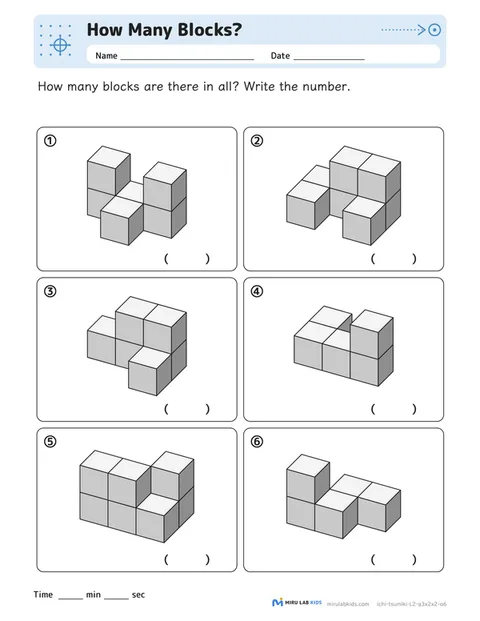
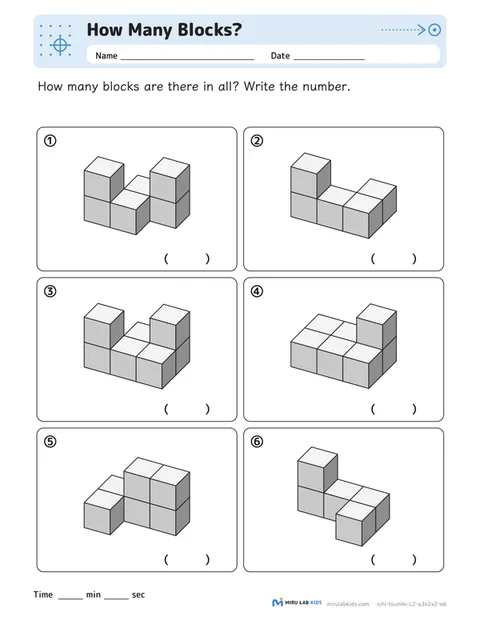
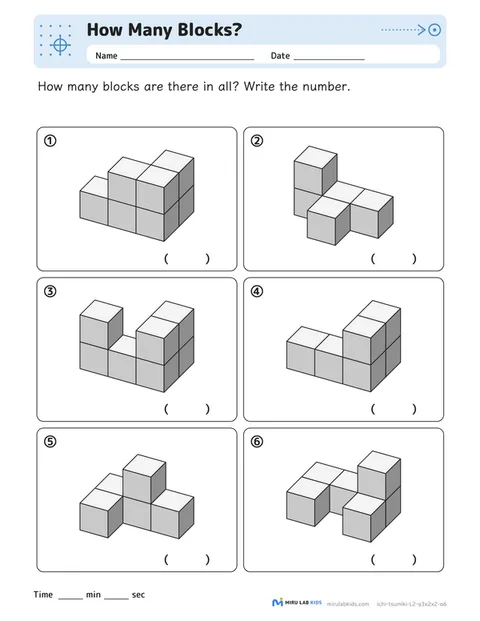
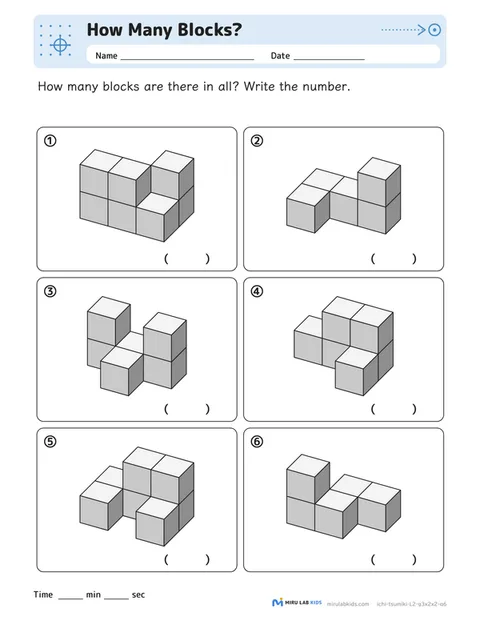
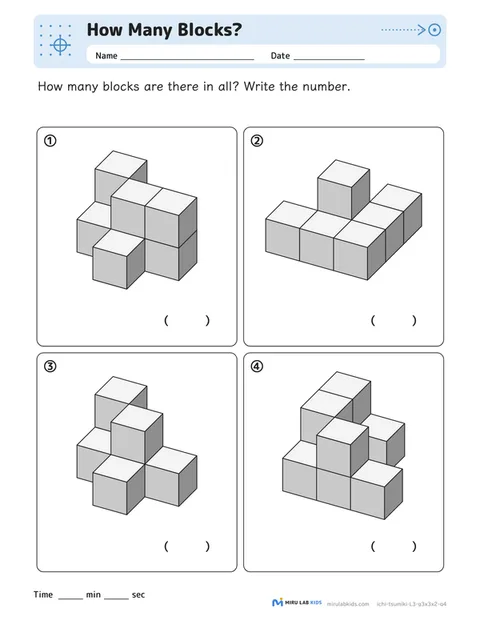
Up to 2 layers. 5 to 7 blocks, all visible. 6 questions per page.
Print in bulk
Level 2Up to 2 layers. 5 to 7 blocks, all visible. 6 questions per page.
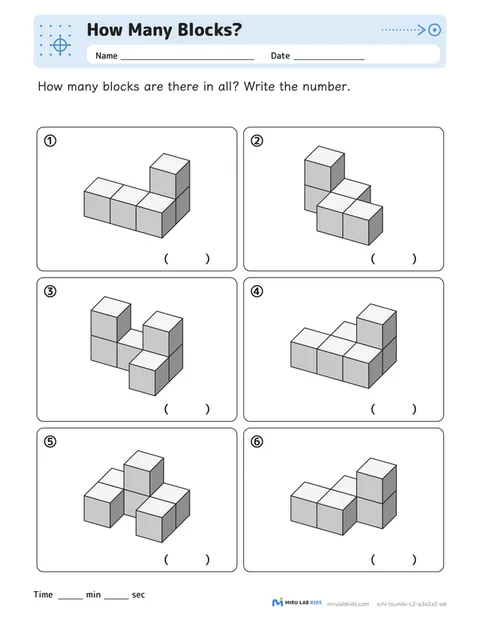
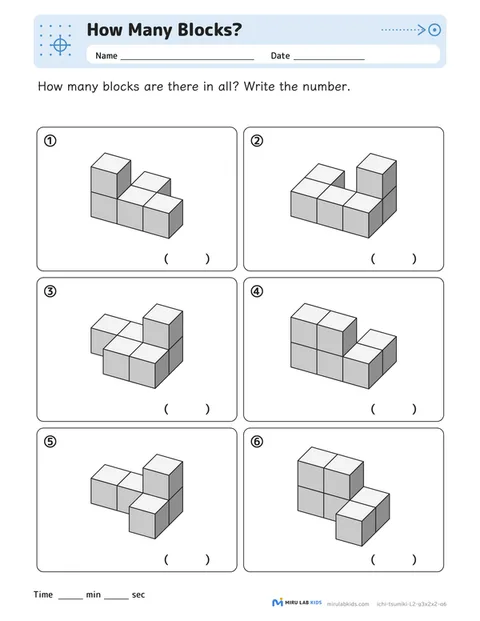
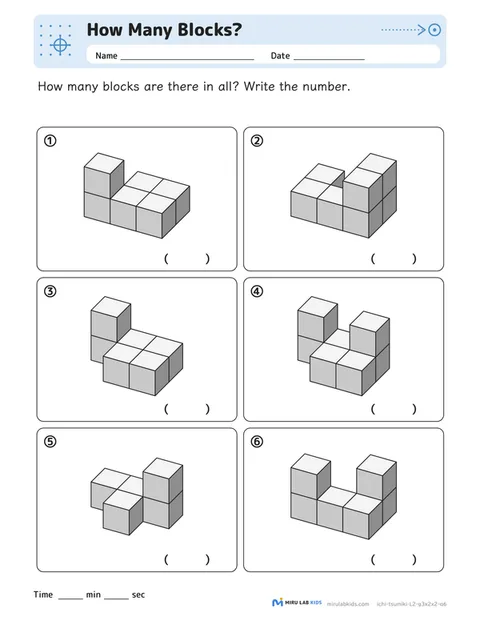
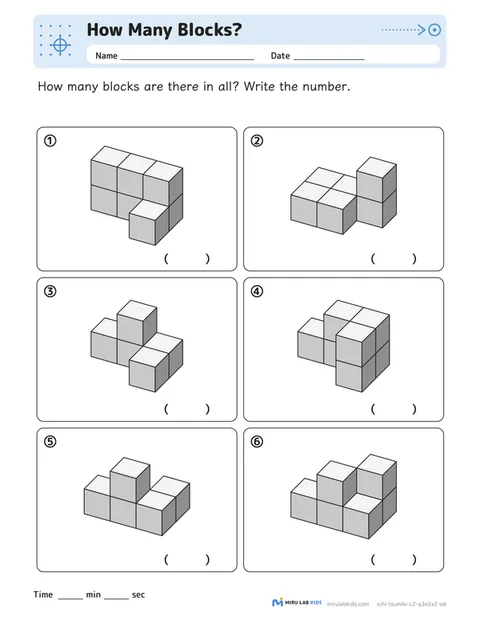
Keeping track?
Aims of this activity
- Picturing a 3D shape with depth from a flat drawing (spatial reasoning)
- Counting hidden blocks by thinking "this block must be holding up the one on top"
- Counting layer by layer or row by row to avoid missing or double-counting blocks
- Understanding front and back, top and bottom (spatial relations)
Your child looks at a drawing of stacked blocks seen from above at an angle, counts how many blocks there are in all, and writes the number in the parentheses.Blocks never float, so if a block is visible on top, there are blocks underneath it too.At higher levels the stacks get taller, and more blocks are hidden behind or under the blocks in front.Instead of counting the faces they can see, your child pictures the parts they cannot see and counts blocks.The activity aims to build the ability to understand 3D shapes.
Tips
- Look at the drawing, count, and write the number in the parentheses. If it is hard, it is fine to build the same shape with real blocks.
For what to say, choosing a level and what to do if it is too hard, see How Many Blocks?: a guide for grown-ups.
Choosing a level
Start with a level that seems a little easy. Levels 1 and 2 have no hidden blocks, so they help your child get used to the activity.
↓
Counted on their own and matched the answer
- Go up one level.
- Count with the eyes only, without pointing.
- Ask your child to point to where the hidden blocks are and explain.
Counts visible faces, or does not count the hidden blocks
- Go down one level.
- Build the same shape with real blocks, count them, then go back to the page.
- Count one layer at a time: layer 1, layer 2, and so on.
Things you can say
- Before startingBlocks don't float. If there's a block on top, there's one underneath too.Check this rule about hidden blocks together first.
- When unsureHow many are in layer 1?Counting one layer at a time makes missed blocks easier to notice.
- Checking answersLet's turn it around in 3D.On each worksheet page, tap a problem to turn its blocks around and check the hidden ones.