Why Does My Child Trip and Fall So Often? Looking Beyond the Feet, at Vision and Attention
"My child trips over nothing all the time.""When running, they pitch forward and fall."When a child falls a lot, people tend to think, "Maybe their legs are weak," or "Maybe they're just not careful."But walking and running without falling takes many skills besides leg strength.This article looks for clues in how a child falls, and shares ideas the adults around them can try, from the angles of vision, attention, and balance (including the soles of the feet and the toes).
Walking without falling takes many skills
When we walk along a path with a step in it, we do all of these things, almost without thinking:
Getting over a step
- Seelook at the ground a little ahead and spot steps and objects
- Noticepay attention: "There's a step here"
- Judgeestimate the height of the step and how far away it is
- Movelift the foot high at just the right moment
- Recoverif you wobble, steady yourself right away
If any one of these doesn't work well, falls become more likely.When "Look where you're going!" doesn't change anything, it may be because the child is struggling at a point that willpower alone can't easily fix.
Looking for clues in how a child falls
Watching closely how a child falls can give clues about where they are struggling.
| How the child falls | What may be involved |
|---|---|
| Often trips over steps or objects | Not looking at the ground ahead, difficulty judging height or distance |
| Often bumps into people or things | Difficulty noticing things coming from the side, a narrow range of attention |
| Toes catch on the ground | Strength to lift the toes, tiredness, attention to the ground |
| Pitches forward when running | Ability to sense the body tipping and recover (explained under "Balance" below) |
| Unsteady on bumpy ground or slopes | Feeling the ground through the soles, gripping with the toes |
| Falls most when absorbed in play | How attention is directed (explained under "Attention" below) |
Often, several reasons overlap in a single kind of fall.
Looking at vision
When we walk, we look not only at our feet but also at the ground a little ahead.This is so we can see in advance where our feet are going to land.A study of adults found that when people had to step on specific spots while walking, they looked about two steps ahead, not at where their foot was landing right now (Patla & Vickers, 2003).
If a child's gaze is always on their feet, they notice steps ahead too late.Their head also tends to jut forward, tipping the body forward.On the other hand, if they are always looking far away or at their friends, they miss changes in the ground under their feet.Eye movement that "looks a little ahead and checks the feet now and then" is what supports walking without falling.
Vision is also used to judge the height and distance of a step.That includes seeing depth with both eyes, and telling the edge of a step apart from the floor pattern.A child who often falls on steps that are the same color as the floor, or on busy patterned floors, may find the edges of steps hard to see.
Seeing is not the same as noticing (attention)
The important thing here is that what reaches the eyes and what we notice are two different things.Even if something reaches the eyes, if attention is not on it, that step or object is, for the child, as good as not there.
There is a well-known experiment.Many people who were counting passes in a basketball video did not notice a person in a gorilla suit walking through the scene (Simons & Chabris, 1999).The gorilla must have reached their eyes, but because their attention was on counting passes, they missed it.
The same thing happens when children fall:
- When having fun or in a hurry, the range of attention tends to narrow (absorbed in a game of tag, they don't notice the toy on the floor)
- Something interesting pulls attention away (looking at a friend while running, and falling)
- If switching attention is hard, going back and forth between "look ahead" and "look at your feet" tends to lag
Looking at balance: can the child recover when tipping over?
Balance is kept using information from three sources: the eyes, the inner ear (vestibular system), and the body's senses.
Three sources of information for balance
- Eyestell us how the body is tilting or moving from what we see around us
- Inner ear (vestibular system)senses the tilt of the head and changes in speed
- Body sensestell us the body's position and where its weight is falling, from the soles of the feet and the joints
The child who pitches forward when running
A common sight is a child whose legs can't keep up as they run, so they pitch forward and fall.
When we run, we are constantly catching a body that is falling forward by stepping a foot out in front.If speed goes up or the body leans too far forward, the foot can't get there in time.This kind of fall is common going downhill, or when the child is excited.
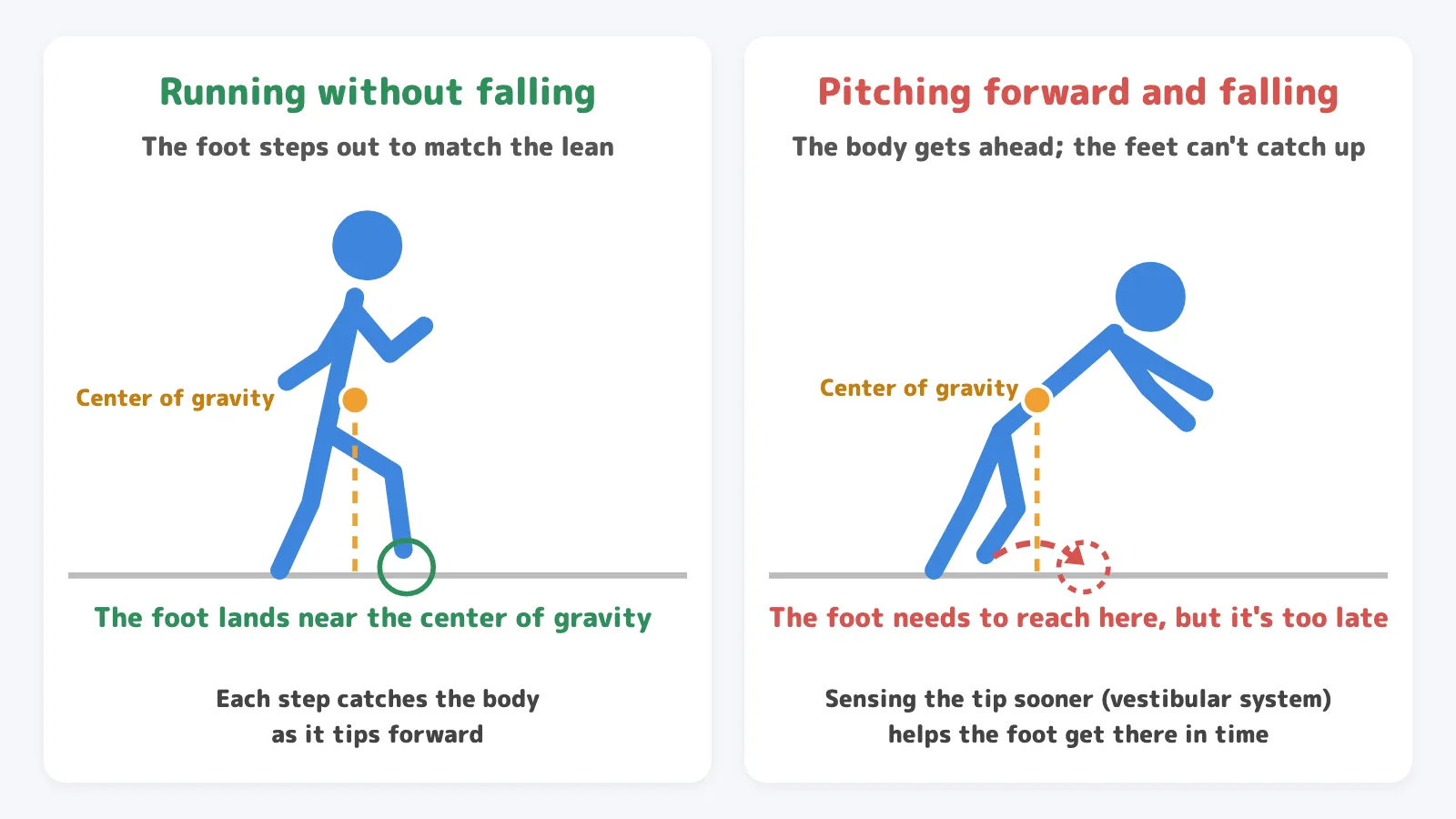
This is where the vestibular system in the inner ear comes in.It senses that the body is tilting, or that speed is increasing.Using that information, we step a foot out or straighten up before we fall (righting reactions and stepping reactions).I believe that as the vestibular system develops a little more, a child can sense "I'm tipping over" sooner, and recover more easily before falling.
The vestibular system also keeps the view steady while we run (the vestibulo-ocular reflex).For more, see "Eyes and inner ear, working as a team" in "Visual Perception Shows Up in Unexpected Places."
The child whose toes catch on the ground
Another common sight is a child whose toes catch on the ground, making them fall.
Each time we step forward when walking or running, we lift the toes a little.If the muscles that lift the toes (at the front of the shin) are on the weak side, or the feet stop lifting as the child gets tired, the toes catch more easily.A child who is fine at first but starts falling after a while may be affected by tiredness.
If the muscles that hold the body steady (around the belly and hips) are on the weak side and the body wobbles, it is also harder to step the foot straight forward.This is often seen in children with low muscle tone (hypotonia).
Looking at the soles and toes: feeling the ground and gripping it
Of the three sources of information for balance, the sense in the soles of the feet is easy to overlook.
The soles are always sensing how hard, bumpy, or sloped the ground is, and where the body's weight is falling.Using that information, we keep making tiny adjustments to our posture without thinking.If the soles don't pass on what the ground is like, a child notices the body tipping too late, and recovering becomes harder.
The toes have an important job too.When we stand or walk, the toes press into the ground and grip to keep the body steady.If the toes don't touch the ground firmly and stay lifted, it is harder to stay steady.The push that moves us forward also comes through the toes.
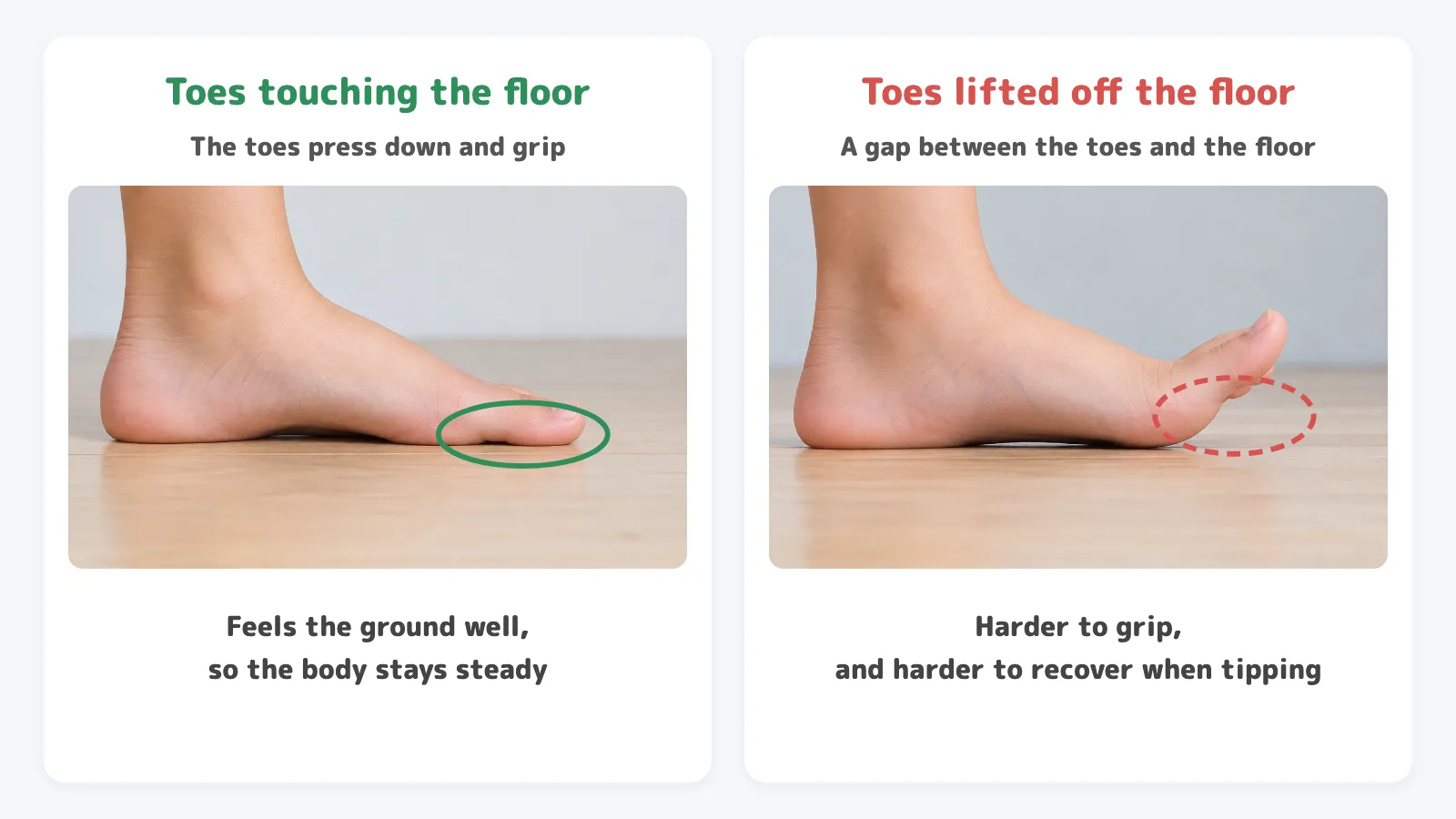
| What the soles and toes do | When it doesn't work well |
|---|---|
| Feel how hard, bumpy, or sloped the ground is | More unsteady on bumpy ground or slopes |
| Feel where the body's weight is falling | Slower to notice the body tipping |
| Press into the ground and grip with the toes | Wobbles when stopping or when bumped |
| Push off the ground with the toes | Walking and running look flat-footed |
When children always wear shoes and walk only on flat floors, they get fewer chances to use their soles and toes.I believe walking barefoot on many kinds of ground is a good way to build the ability to feel the ground through the soles and grip with the toes.
Things to keep in mind
Every child's reasons for falling are different.Besides vision, attention, and balance, things like a sudden growth spurt can also play a part.
- First, check that there are no problems with eyesight.
- If your child suddenly started falling, falls differently than usual, or gets hurt often, talk to a doctor.
- If clumsiness in how your child moves stands out in other situations too, talk to their teacher, or to a physical therapist or occupational therapist.
In pediatric rehabilitation, international recommendations have been published on clumsiness in movement (developmental coordination disorder, or DCD) (Blank et al., 2019).They emphasize looking carefully at what is actually hard for the child at home, at school, and in play, and say that practicing the very movements the child wants to be able to do is more likely to carry over into daily life in less time.The ability to walk and run without falling also grows not only through practice at a desk, but through everyday play and walks outside.
Falling is also an important experience
Children learn a lot from falling and feeling "Ouch!""This spot is slippery." "If I turn suddenly, I fall." "If I don't look down, I trip."As these experiences add up, children develop the ability to notice danger themselves and move carefully (the ability to anticipate risk).
If adults step in ahead of time to remove every hazard, or always lend a hand so the child never falls, these experiences become less frequent.Rather than creating an environment where a child never falls, I want to value experiences where they can take small falls and learn from them.Of course, in situations that could lead to serious injury, such as near traffic or at a height, adults need to keep children safe.
Reflecting together after a fall
Some children find it hard to learn from a fall.They keep falling in the same place, in the same way.
In that case, once things have calmed down, try reflecting briefly together.
Reflecting after a fall
- Where"Where did you fall?"
- Why"What were you looking at?" "Were you in a hurry?"
- Next time"What could you do next time so you don't fall?"
The key is to ask questions that help the child notice things for themselves.Ending with a forward-looking question like "What will you do next time?" makes it easier for the child to take it in a positive way.If it's hard for the child to answer, simply putting what happened into a few words, like "There was a step, wasn't there?" or "You were running," is enough.
Ideas for the adults around the child
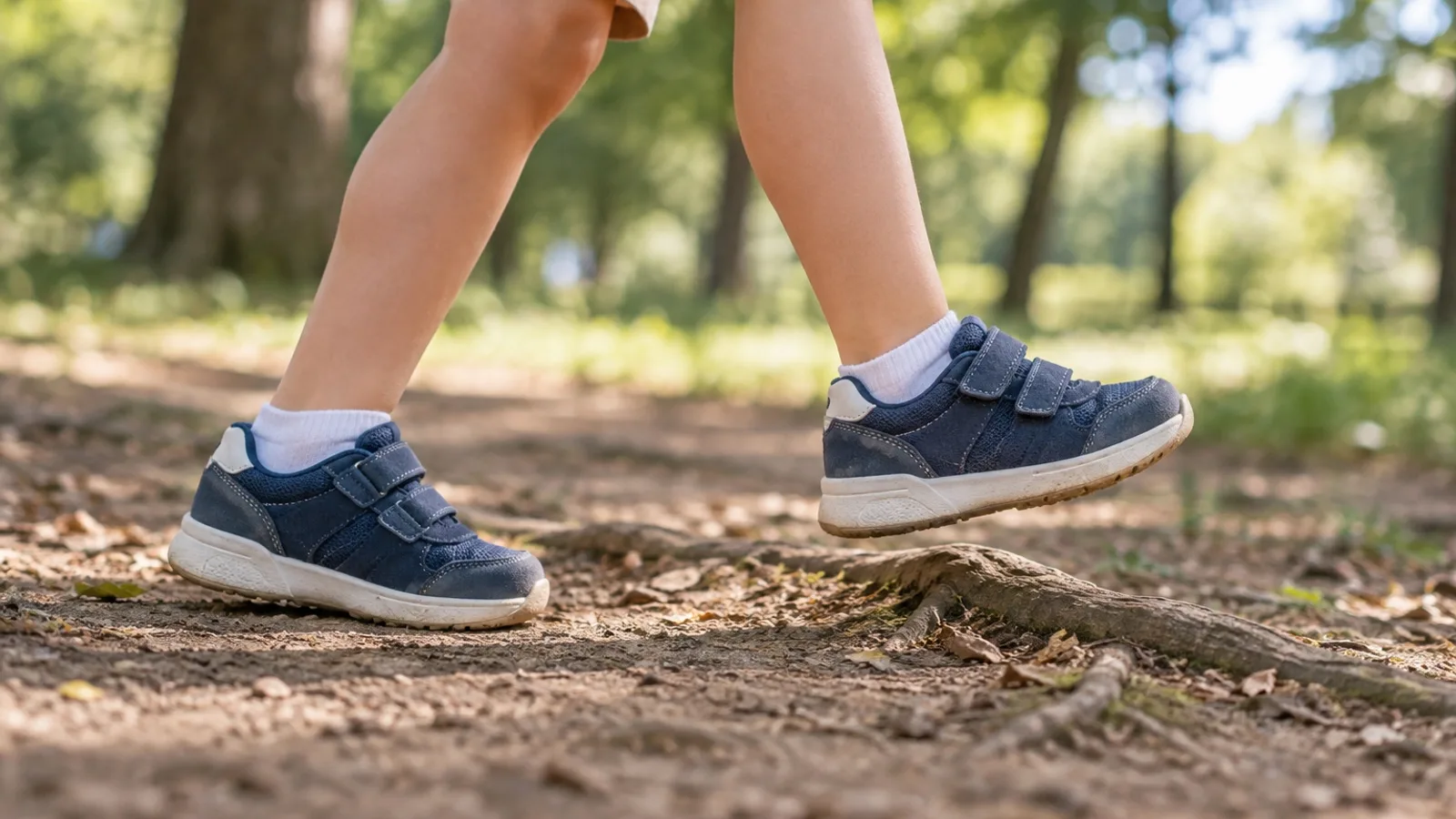
Choose shoes that fit
Children's feet grow quickly, so it is tempting to buy shoes a size big to allow for growth.But shoes that are too big can make falls more likely:
- The foot slides around inside the shoe, making it harder to feel the ground through the sole
- The child curls their toes to grip the shoe and keep it on, so the toes can't be used to grip the ground
- The extra length at the toe catches on the ground more easily
- The heel lifts out, making walking less stable
When choosing shoes, check these points:
- There is about 1/4 to 1/2 inch (5 mm to 1 cm) of room at the toes (and not much more)
- The heel of the shoe is firm, and the heel doesn't lift inside the shoe
- Hook-and-loop straps or laces hold the top of the foot securely
- Children's feet grow fast, so check the size every few months
Walk barefoot on many kinds of ground
- Walk barefoot on surfaces with different textures and firmness: grass, dirt, sand, rugs
- At home, walk on soft, slightly unstable surfaces like cushions or a mattress
- Scrunch up a towel with the toes, pick up small toys with the feet, or play rock-paper-scissors with the feet
When walking barefoot outside, an adult should first check for hazards like glass or sharp stones, and make sure the ground isn't too hot.Socks can be slippery on smooth floors, so barefoot may be the safer choice indoors.
Active play
- Play that swings, jumps, and spins, like swings, trampolines, and slides (these stimulate the vestibular system)
- Walking slowly up and down slopes
- Hopscotch, or walking along a line (practice deciding where to put the feet by looking)
- Games like Red Light, Green Light, where you have to stop on a signal (practice controlling speed)
Go at the child's own pace, a little at a time, as long as they enjoy it.For a child who is scared, start low and slow.
Related worksheets
Worksheets use vision and attention at a desk.They aren't meant to stop falls, but they let children practice "searching with the eyes" and "directing attention where it's needed" in a calm setting.
- Circle the Numbers: scan the whole page and find the target numbers (directing attention, looking without gaps)
- Number Hunt: move the eyes quickly to the next number
- Overlapping Shapes: pick out the outline of one shape among overlapping lines
- Mazes: look ahead along the path and decide which way to go
For how much to do in a day and how to keep going, see "Every Day? How Much?"
Final thoughts
Falling often isn't always just about carelessness or weak legs.Somewhere in vision, attention, balance, or the soles and toes, there may be a point where the child is trying hard but it just doesn't work well.
Once you know where the child is struggling, you can see more ideas to try besides "Look where you're going."And falling itself is an important chance for children to learn.I hope this article gives you a new clue when watching how your child falls.
Studies referred to
- Patla AE, Vickers JN. How far ahead do we look when required to step on specific locations in the travel path during locomotion? Experimental Brain Research. 2003;148(1):133-138.
- Simons DJ, Chabris CF. Gorillas in our midst: sustained inattentional blindness for dynamic events. Perception. 1999;28(9):1059-1074.
- Blank R, Barnett AL, Cairney J, et al. International clinical practice recommendations on the definition, diagnosis, assessment, intervention, and psychosocial aspects of developmental coordination disorder. Developmental Medicine & Child Neurology. 2019;61(3):242-285.
- Peterka RJ. Sensorimotor integration in human postural control. Journal of Neurophysiology. 2002;88(3):1097-1118.