Dot Grid Copying: What It Builds, and What Mistakes Can Tell You
Looking at lines drawn on a dot grid, and copying them onto the empty grid next to it: dot grid copying.It is a popular activity at the after-school day programs for children with developmental needs where I work.In pediatric therapy as well, copying shapes is used both to assess and to practice visual perception and hand movement.It is a simple activity, but if you look closely at the lines a child has copied, they leave many clues about where the child is struggling.This article covers the skills dot grid copying uses, what mistakes can tell you, why diagonal lines are hard, and how to choose a level.
The skills dot grid copying uses
Dot grid copying looks like a simple "look and copy" activity.But copying a single line uses several skills, one after another:
Copying one line
- Find the positionfind which dot the line starts from, by counting or using corners and edges as landmarks
- See the directionis it across, up and down, or diagonal, and which dot is it heading to?
- Hold it in mindremember the position and direction while moving the eyes from the example to your own grid
- Draw and stopmove the hand from the starting dot so the line stops at the ending dot
- Checkcompare the copied line with the example to see if it matches
If a child struggles at any point in this flow, it leaves a trace in the copied lines.So the way a child makes mistakes gives clues about where to help.
The dots make it easier
Copying a shape onto blank paper is harder than it might seem.The length of each line, the angle, and where it starts all have to be decided by the child.
In dot grid copying, the dots act like a ruler.Because the start and end dots are fixed, the child can check the length and direction of a line by counting dots.Another good point is that difficulty can be adjusted step by step, through the number of dots, the number of lines, and whether there are diagonal lines.Since it only involves connecting dots, children who are not writing letters yet can do it too.
Shape copying in pediatric therapy
In pediatric rehabilitation, especially occupational therapy, copying shapes is used for both assessment and practice.
For assessment, there are tests such as the Beery VMI, in which children copy shapes that gradually get harder: a vertical line, a circle, a cross, a triangle, and so on.A study of kindergarten children found that those who copied shapes well on this test tended to copy letters more legibly too (Daly et al., 2003).
Drawing lines and shapes is also used as practice.In a study where first graders who scored low on this test did a short program of drawing lines and shapes, scores went up on the parts of a visual perception test that are answered by moving the hand, and on a test of fine motor skills (Ratzon et al., 2007).
On the other hand, a review that brought together studies of interventions for handwriting found that interventions that did not include actual handwriting practice tended to show little effect (Hoy et al., 2011).
Dot grid copying is an approachable way to use some of the skills involved in handwriting.But it is not a replacement for handwriting practice.If handwriting is the goal, please make time for actual writing alongside dot grid copying.
What mistakes can tell you
When your child finishes a worksheet, don't just check "right or wrong" against the answer. Also look at how the mistakes were made.Here are six common types of mistakes.

| Type of mistake | What it may mean | What you can try |
|---|---|---|
| 1. Shifted by one dot | The child sees the shape, but counting to find the starting dot is hard | Before copying, point to the starting dot on both the example and the child's grid |
| 2. Left and right reversed | Judging left-right relationships is hard | Put it into words using landmarks around the room, like "toward the window" |
| 3. Shallow diagonal drawn too steep | Telling different diagonal angles apart is hard | Count the dots out loud: "two across, one up" |
| 4. Missing a line, or copying it twice | Keeping track of what has been copied is hard | Make a small mark on each example line after copying it |
| 5. Turning at a crossing | Seeing crossing lines as separate lines is hard | Trace each example line with a finger to see where it goes, then copy it |
| 6. Not stopping at the dot | Watching while moving the hand and stopping is hard | Draw slowly while looking at the ending dot |
With mistake 1, when the shape is right but the whole thing is shifted, the ability to see the shape is working well.In that case, helping the child check the starting position, rather than the shape, can make copying much easier.On the other hand, if mistakes 5 and 6 are frequent, going back to a level with fewer lines and crossings is one option.
Look at the body too, not just the lines
As a physical therapist, I also like to watch how the child's body is moving while they copy.
- The whole head moves each time they look at the example: moving just the eyes back and forth between the example and the grid may still be hard work. Eye movements are covered in "Smooth Pursuit and Saccades."
- The body leans, or the paper isn't held down: when the body isn't steady, lines are less steady too. Posture and holding the paper are covered in "When Handwriting Won't Stay on the Lines."
- The paper is turned for every diagonal line: turning the paper to a comfortable angle is also the child's own strategy. Noting which direction of line makes them turn it shows which directions are hard.
Why are diagonal lines hard?
Diagonal lines are where children most often get stuck in dot grid copying.
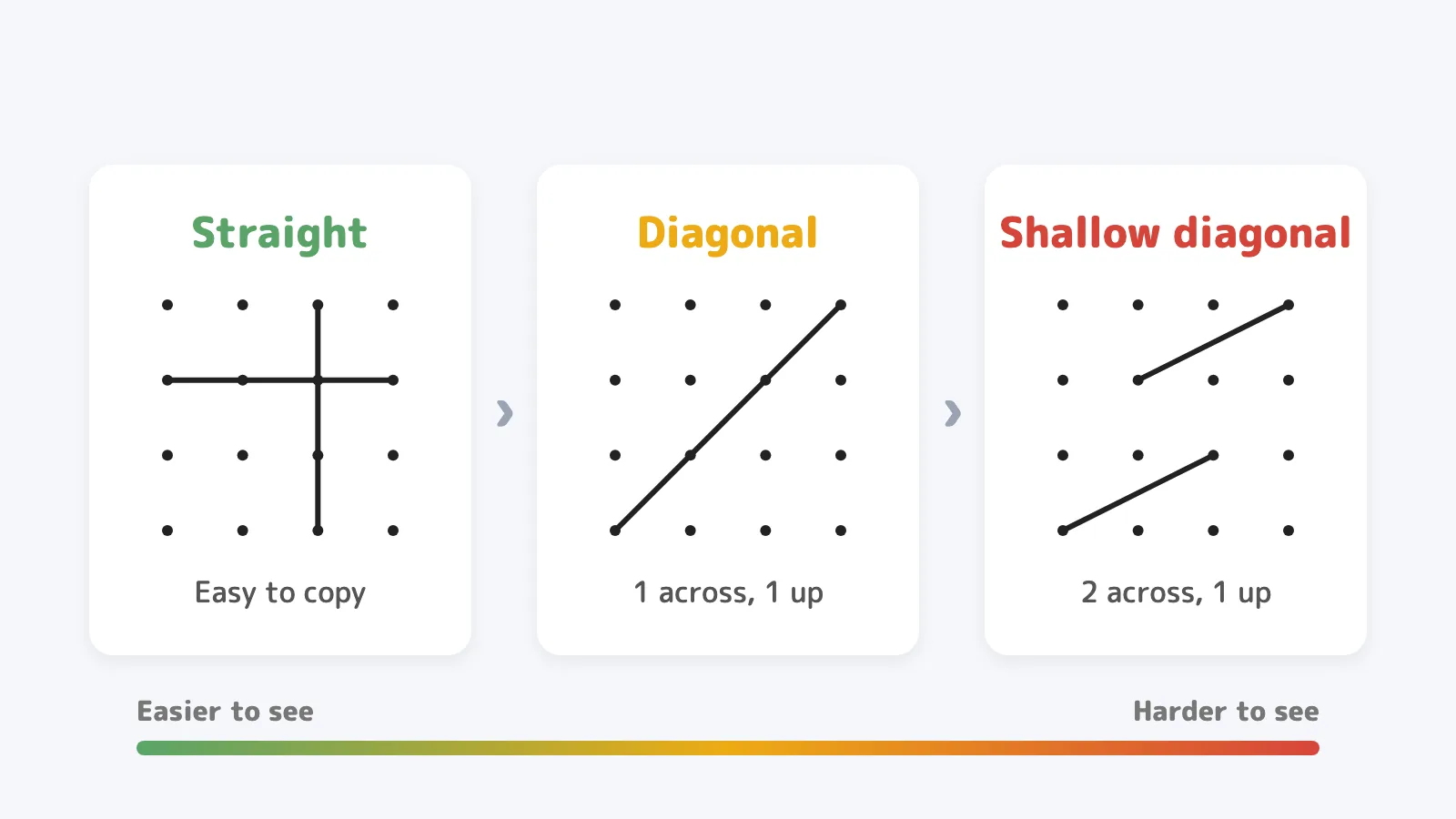
In fact, our eyes are not as good at telling the direction of diagonal lines as they are with vertical and horizontal lines.This is called the "oblique effect," and it is known to occur in adults and even in animals (Appelle, 1972).
A study of children found that they could pick out a matching diagonal pattern, yet found it hard to build the same diagonal themselves by placing pieces on a board (Olson, 1970).In other words, there is a step between "knowing it's the same" and "being able to make it yourself."
The child says "I get it" when looking at the example, but the copy comes out wrong.In that case, it may not be that they don't understand. They may be standing on that step.Counting the dots out loud, like "two across, one up," gives them a clue for turning what they see into a hand movement.
Choosing a level
Dot Grid Copying has five levels, based on the number of dots and the types of lines.Use the way your child makes mistakes to choose a level:
| What you see | Level to try |
|---|---|
| The starting dot is off even with straight lines across and up and down | Level 1 (3 × 3 dots, across and up-and-down lines only) |
| Straight lines are fine, but diagonals cause hesitation | Level 2 (4 × 4 dots, a few diagonals) |
| Diagonals are fine, but crossing lines cause confusion | Level 3 (5 × 5 dots, with crossings) |
| Crossings are fine too | Level 4 (with shallow diagonals) |
| Can keep track of what's been copied even with many lines | Level 5 (8 × 8 dots) |
Worksheets that all involve "connecting dots" still use slightly different skills.
| Worksheet | Example | Features |
|---|---|---|
| Dot Grid Copying | Example next to the grid | Many shapes don't look like anything, so the skill of copying by the dots shows clearly |
| Dot Grid Copying: Pictures | Example next to the grid | Becomes a picture when finished. The shape helps the child notice their own mistakes |
| Dot-to-Dot | No example | Connect the dots in number order. Not copying, but finding the next number and connecting |
You might use "Dot Grid Copying: Pictures" when you want it to be fun, and "Dot Grid Copying" when you want to look closely at the kinds of mistakes.
Try it at home: note down the mistakes
Patterns of mistakes can be hard to see from just one worksheet.Writing down which mistakes happened each time helps you see changes (example below).
| Date | Level | Mistakes | Notes |
|---|---|---|---|
| Oct 6 | 2 | 1, 3 | Shifted when starting from the bottom-right dot |
| Oct 13 | 2 | 3 | Copied it correctly when saying "one across, one up" |
| Oct 20 | 3 | 4, 5 | Turned at a crossing. Missed one line |
| Oct 27 | 3 | 5 | Copied it after tracing with a finger first |
Using the numbers 1 to 6 from "What mistakes can tell you" keeps the notes tidy.
In this example, mistakes 1 and 3 were common at first, and mistake 3 decreased with the strategy of saying it out loud.After moving to Level 3, mistake 5 (crossings) appeared, but tracing with a finger first is starting to help.If you write down not only whether it went well, but what strategy helped, you'll know what to help with next.
If you'd also like to record the time it took, use the "Time Log" on the tracking sheets.
Beyond worksheets
The same skills can be used away from paper too.
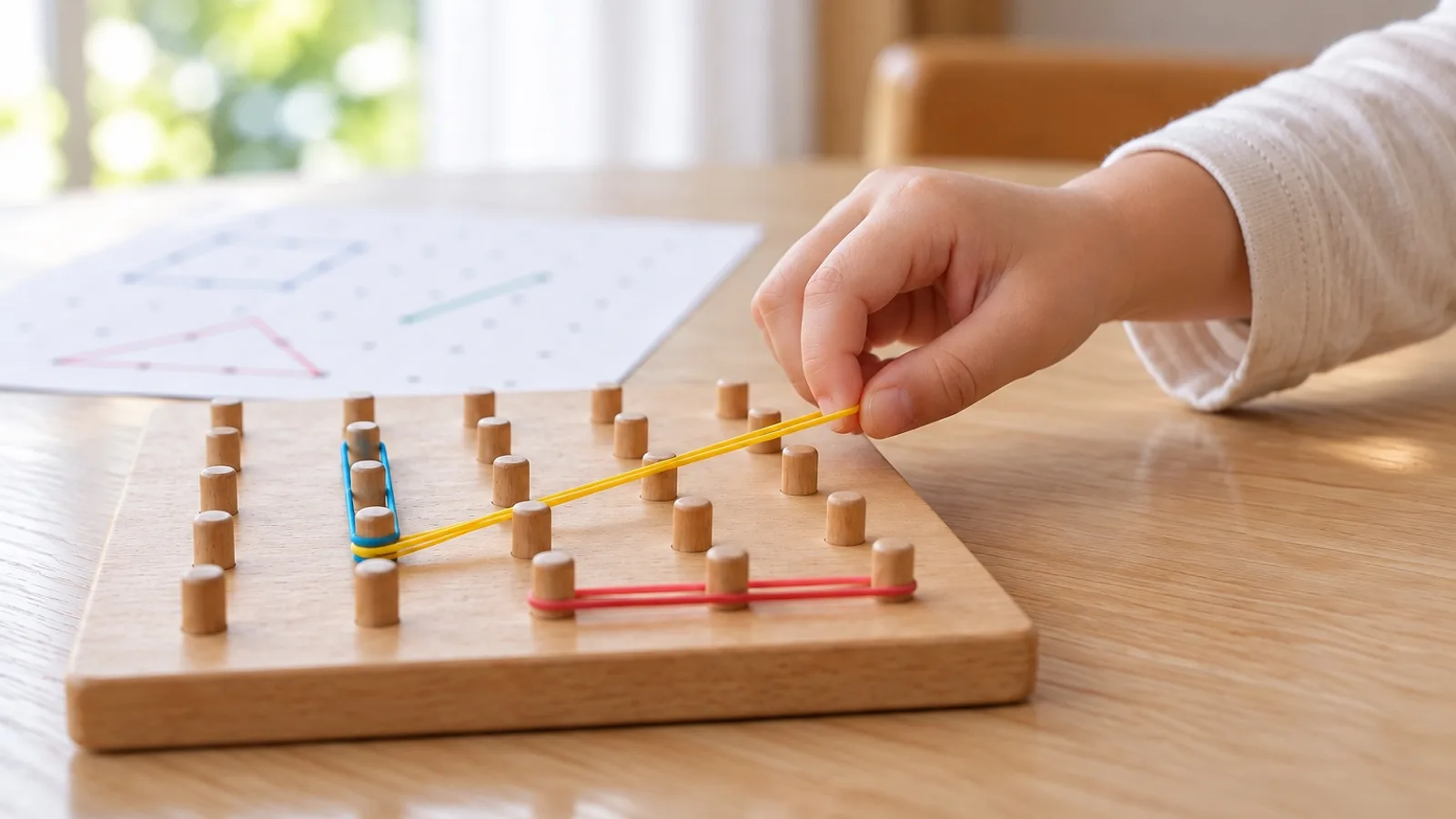
- Geoboard: stretch rubber bands over the pegs on a board to match an example. It can be redone any number of times, so the child can try without worrying about mistakes.
- Place counters or blocks in the same squares as an example: copy only the "dot positions" without drawing lines. This separates position from hand movement, so the child can focus on judging position.
- Move on a grid on the floor: make a grid on the floor with tape, and walk or jump along the lines of an example. The child can check "two to the right, one forward" with their own body.
Related worksheets
These MIRU LAB KIDS worksheets work on judging position and direction, like dot grid copying.
- Dot Grid Copying and Dot Grid Copying: Pictures: the dot grid copying covered in this article
- Symmetry Coloring: work out the mirror-image shape and color it. Close to the left-right relationships in mistake 2
- Dot-to-Dot: connect the dots in number order, using the ability to search for the next dot with the eyes
What happens in the eyes and the head when copying from an example is also covered in "Slow at Copying from the Board?"
Final thoughts
Dot grid copying is a simple activity, just dots and lines.But the copied lines show exactly how a child is seeing position and direction.
Not just right or wrong, but how the child made the mistake, and what strategy helped them copy it.Paying attention to these, you can learn much more from a single worksheet.I hope this helps you find ways to help that let your child feel "I did it!"
Studies referred to
- Appelle S. Perception and discrimination as a function of stimulus orientation: the "oblique effect" in man and animals. Psychological Bulletin. 1972;78(4):266-278.
- Olson DR. Cognitive Development: The Child's Acquisition of Diagonality. New York: Academic Press; 1970.
- Daly CJ, Kelley GT, Krauss A. Relationship between visual-motor integration and handwriting skills of children in kindergarten: a modified replication study. American Journal of Occupational Therapy. 2003;57(4):459-462.
- Ratzon NZ, Efraim D, Bart O. A short-term graphomotor program for improving writing readiness skills of first-grade students. American Journal of Occupational Therapy. 2007;61(4):399-405.
- Hoy MM, Egan MY, Feder KP. A systematic review of interventions to improve handwriting. Canadian Journal of Occupational Therapy. 2011;78(1):13-25.